Monday, July 31, 2006

In Vino Veritas?


I’ve always liked Mel Gibson and enjoyed his films, but starting back around the time of Braveheart or so, it seemed as if a dark streak evocative of personal turmoil within his own personality seemed to become more and more visible as a feature in his films.

The movie The Passion of the Christ was a film that I had awaited with great anticipation. The Stations of the Cross are my favorite Lenten Devotion. For me, one of the highlights of the liturgical year is the reading of the Passion narratives. Not only did I want to see it for my own faith and edification, but I felt that Gibson was being unfairly smeared and attacked by tin-eared critics and left-wing theologians who hadn’t even seen the film yet. I was resentful of the attacks being made on Gibson and the film by critics such as Frank Rich, Paula Fredriksen, Abe Foxman and the ADL, and Eugene Fisher.

I saw the film with one of my closest friends and his wife one night shortly after it opened. While there was much in the movie that I thought was well done and impressive, there were also some overtones in it that I found disturbing, especially in its obsessive focus on blood and on the demonic… Particularly with demonic visions with no supporting references in the scriptures. It was hard for the three of us to speak after the numbing experience of seeing the film. The silence over dinner was a bit awkward and embarrassing. I think that the film was not quite what each of us had expected. At least, speaking for myself, I’d say that his “vision” of the events of the passion story didn’t square up too well with mine.

As I wrote on the Friar’s blog, regarding my take on the film:

As for The Passion, I thought it was a fair-to-good movie that could have been a great movie, but missed the mark. I wouldn't go as far as to say that it was anti-semitic, but it went right up to the very edge. It darned near was. I thought the Jesus and Mary characters were wonderfully done, but I thought the brutality was over the top (and the Stations of the Cross happens to be my favorite devotion). Gibson seems to have a blood and brutality fetish that says more about him and his own demons than it does about Christ. It was a movie that I really wanted to like, but it left me quiet and very unsettled and troubled...

As everyone probably knows, Gibson was recently arrested for DUI in Malibu. The arresting officers reported that he had gone off on an anti-semitic rant, a rant that he has not denied and that he has apologized for profusely.

A Los Angeles Sheriff's Department report states that when Gibson was arrested early Friday morning for speeding with a .12 blood alcohol level, the 50-year-old actor lashed out at "f--ing Jews" and said that "the Jews are responsible for all the wars in the world." Gibson had asked a sheriff's deputy, "Are you a Jew?"

After the story broke on Saturday, Gibson issued a statement apologizing for his behavior and for having "said things that I do not believe to be true and which are despicable," but none of those sentiments seem all that detached from the views of the actor's father.

A couple of points… It’s a good thing that he has apologized, and those who claim to apologize in sincerity should be given the opportunity to be heard out. Experience has shown me however, that being under the influence of alcohol does not so much induce anyone to say things that they don’t believe as much as it induces them to say things that they hold, but would not come right out and say otherwise. The other point is that although it is unfair to visit the sins of the father upon the son, Gibson’s father and his views do seem to have a powerful hold over Mel, and the son does seem reluctant to judge the sins of the father…

Hutton Gibson, 87, is a leading proponent of what is called Catholic traditionalism, a canon that rejects the changes to Catholicism made during the Second Vatican Council of 1962-1965, which the elder Gibson once called ''a Masonic plot backed by the Jews.''

Hutton Gibson is also outspoken in his views that the Holocaust never happened, or at least not to the degree that historians maintain...

In one radio interview in 2004, Hutton Gibson said that "most of " what historians say about the Holocaust is "fiction." He claimed that 6 million Jews weren't killed during World War II. Rather, he said, they moved…

He said concentration camps were merely "work camps." Holocaust museums, he said, are "just a gimmick to collect money."

For Jews, he said, "it's all about control. They're after one world religion and one world government. That's why they've attacked the Catholic Church so strongly, to ultimately take control over it by their doctrine." He added that "to a Jew a Christian commits idolatry every time he looks at a crucifix and says a prayer. You know they're in control and they're going to get in control the way things are going. Because they get all of our people."

His son, he said, was happy about the controversy over "The Passion of the Christ." "Mel says he absolutely couldn't buy PR like this," Hutton Gibson said. He thanked the Anti Defamation League for ensuring that "everybody knows the line now: 'Let the blood be upon us and our children.'"

Whether Mel holds these views or not, who knows... I am no angel myself. I’m not here to attack Mel Gibson personally. See the price I paid for my own stupid and careless anti-semitic comments in the lengthy post below. What I am sick and tired of, however, is to see remarks like those of Hutton Gibson appearing with greater frequency on the web by a subset of self-described Catholic “traditionalists” who try to pass this garbage off as orthodoxy. This stuff makes me ill and it is a disgrace to our faith when someone tries to pass it off as Catholic “Truth”. I hate seeing petty bigotry masquerading as faith.

As for Gibson, I pray for him. Why he suffers so, I cannot know. It seems that he has a good wife and children, and has had nothing but success in his career. Who can say what causes us to suffer? I hope he can conquer whatever it is that torments him.

Paula Fredriksen had a long running battle going on with Mel Gibson over the Passion film. Sure to evoke strong emotions on either side, is her article on the film entitled The Pain Principle.

I think she was wounded in the fray too. The concluding paragraph, which explains much of her public silence over the last few years:

Finally, Gibson and his minions, I must note with gratitude, have certainly educated me. The hateful emails that I and my colleagues have received, the websites that this movie has spawned, and the angry displays of muscular piety prompted by this phase in the American culture wars have left me humbled and remorseful. With what conviction can I remain amazed by the literalism, the anger, and the defining power of hate in Islamic fundamentalism? With much less excuse, we have plenty of our own home-grown varieties right here.

Saturday, July 29, 2006

Born in 1959. Memories from a Catholic Childhood


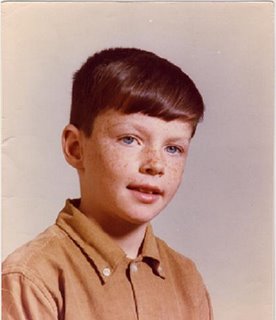
Jeff, AKA "Freckle-Faced Strawberry", circa 1967

Sorry I’ve been away so long. I’ve been pretty busy, plus I’ve been working on this rather lengthy post.

Several authors and other writers have written on this theme far better than I ever could, but I’ll take a shot at putting down some memories as well, because I was born during an interesting period of time.

I’ve noticed that some bloggers are a little older than me. The vast majority are much younger. A lot are converts. I think I might have some interesting perspective to add with my recollections, merely because of the niche that I fell into due to the year in which I was born. I've not only lived in the same community since 1962, but the same house and the same parish. My childhood coincided with the events of the Second Vatican Council. Therefore, my catechesis was a mixture of pre-conciliar and post-conciliar teaching, although I’d have to say that most of it was actually pre-conciliar. No one really knew how to implement that Council. The ship didn’t turn around overnight. There’s no way that a 2000-year-old institution can. Things just coasted along for a while as they always had. Some people wanted things to change. Some people wanted nothing to change. Some people wanted to change, but didn’t know how. Some people didn’t care or notice that anything had changed at all. Eventually things did change, but hardly in the ways that anyone had expected. My entire Catholic life has been the experience of Vatican II, in which I am still a firm believer and supporter.

The 1960s were a fascinating and exciting time to be a kid. Not only were there changes in the Church, but there were enormous changes in the culture all around. The Beatles and Rock music, the Civil Rights movement, the space program and the race to the moon, hippies, flower power, psychedelia, and of course, the shadow of Viet Nam hung over everything. The excitement of the 1960s turned into the disillusionment and vapidity of the 1970s. Viet Nam and Watergate weakened trust and respect for authority and institutions in all aspects of life. The Civil Rights movement seemed to lose its moorings after Dr. King was assassinated. Drugs seemed to have taken all of the promise out of the progressive youth movement, and progress in women’s rights had stalled and run into an enormous fissure over abortion. People seemed to stop looking outward and the 1960s optimism dried up as people became self-absorbed and turned inward. The 1970s were a tough time to be a teenager.

However, around the time of my birth and early childhood…

The Catholic Church in America is at the zenith of its golden age. In Boston, the Church is led by Richard Cardinal Cushing. The tone is militant and triumphant. The typical priest in our archdiocese is of a tough, masculine, Irish mold. They have the combativeness and the no-nonsense approach of their hero and model, Bishop Fulton Sheen. Outwardly, the Church is full of confidence. In the words of the late William Cardinal O’Connell, “The Puritan has passed. The Catholic remains.” On the other hand, it is prickly, with lingering feelings of inferiority and resentment over past prejudices and sleights. Again, in the words of O’Connell, “I’m a proud American man, and a Catholic. What about it?” The Catholic Church in America is at its height, and one of its own from Boston, John F. Kennedy, is about to be elected president. These are heady days. We have finally arrived and made it in this country.

Backing up a little bit….

My family, mostly Irish, but with some Italian thrown in on my mother’s side, was dominated in its thinking by two things. The first was its immigrant roots. Ethnicity, even among fellow American citizens, was always noticed and commented on, from childhood friends to the girls you dated later on. “Oh, Delorey… That’s that French kid you hang around with.” “What did you say her last name was? What is that? Polish?” This is not unusual at this time and place in history.

The second thing was the crucible of the great Depression of the 1930’s. The Depression had such a profound effect on my family and its attitude toward the uses of money, work, and mutual responsibility, it is hard to underestimate the impact of it. I’m still affected by inheriting some of it, much to the chagrin of my wife and kids.
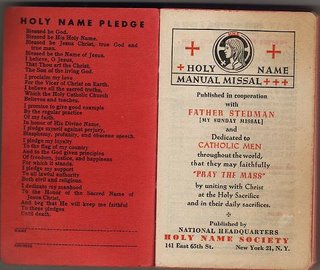

My Grandpa Doherty’s Holy Name Society Missal, 1945.
Grandpa’s advice to us – “Don’t ever vote for a Republican. They’d leave you without a pot to p*** in.”


My father was from a big Irish family in Somerville that always wanted to get out of there. My father was tough but with a sensitive side. He had a way with written and spoken words and had big dreams. In 1945 he tried to join the Marines at the age of 16. By the time the Korean War came around in 1950, he had other ideas. He was much more interested in college at Tufts University, but rather than waiting to get drafted, he enlisted in the Army and went into Officer Training School. My father never missed a Mass that I know of, but he didn’t talk about religion much. He worked as a valued copywriter and creative director for several Boston ad agencies, but the pressure and cut-throat nature of the ad business caused a lot of stress on him and took a toll.

My mother was from the urban melting pot of the West End of Boston. My mother was a devoutly Catholic woman, but on her own terms. She turned out to be a progressive later on in a lot of ways, and I suppose that came from being a nurse and seeing lots of hard cases (abused children, unwed mothers, etc..), but years later she said she always missed the "mystery" of the Tridentine Mass and always stuck to her private devotions she'd learned so long ago from the Sisters of Notre Dame who'd educated her. On the other hand, those Sisters at St. Mary’s High School in Cambridge were never able to break my mother’s defiant spirit with their corporal punishments… “I don’t care why the length of side A doesn’t equal the length of side B (thwack!) I don’t care! (thwack!) I … don’t … care….”

In the late 1950s, devotions are still very important in Catholic life. My mother and my aunt (my mother’s sister-in-law) live according to First Fridays and the Novena of Grace to St. Francis Xavier. All of the boys in my cousin’s family will be given the middle name of Francis. My brother and I will be given the middle name of Xavier, so that no one will confuse us with being named after the great man from Assisi (For my whole life, this has been a litmus test for me as to who is Catholic or at least familiar with Catholic culture. Whenever someone is completely flummoxed by my middle initial of “X”, I know there isn’t much Catholic literacy there).


Novena Of Grace of St. Francis Xavier

We have come together to worship the Lord our God and to honor the memory of His great missionary, St. Francis Xavier. Through his powerful intercession, let us pray for ourselves, for the missionary efforts of the church, and for all the People of God.

For missions and missionaries throughout the world,
that through the proclamation of the Good News of salvation, all people may come to know the one true God and Jesus Christ whom He has sent.

Let us pray to the Lord: Lord, hear our prayer.

For the Church, that renewed by the Holy Spirit, she may show forth to the world the mystery of the Lord and be an instrument of redemption for all.

Let us pray to the Lord: Lord, hear our prayer.

For Christian unity, that the Spirit of Christ, dwelling in all who believe, may bring us to that fullness of unity which Jesus desires -- one Lord, one faith, one baptism.

Let us pray to the Lord: Lord, hear our prayer.

For the unrepentant,
that moved by God's loving mercy revealed in Jesus,
they may repent their sins and open their hearts
to the divine life of grace.

Let us pray to the Lord: Lord, hear our prayer.

For ourselves, that we may be ever faithful to our baptismal commitment to Christ, and bring Christ's word and Christ's love to the world in which we live.

Let us pray to the Lord: Lord, hear our prayer.
Lord God, our Father, we honor the memory of the Apostle of the Indies and Japan, St. Francis Xavier. The remembrance of the favors with which You blessed him during life and of his glory after death fills us with joy; and we unite with him in offering to You our sincere tribute of thanksgiving and of grace.

We ask You to grant us, through his powerful intercession, the inestimable blessings of living and dying in the state of grace. We also ask You to grant us the favors we seek in this novena.

But if what we ask is not for the glory of God and the good of our souls, grant us, we pray, what is more conducive to both. We ask this through Christ our Lord.

Amen.


I remember my mother and my aunt dragging me from church to church, letting me light those candles wherever we went. "Here's a dollar to put in the box. Who would you like to pray for? Hail Mary, full of grace…" Catholic Churches seem cavernous and cool and welcoming on a hot day, filled with votive candles, marble, and fleshy paintings.

I’m getting trained for Church before I even enter one. Over and over, I am shown a triptych, and as I open the doors of it, there is a glow-in-the-dark image of Jesus inside on the central panel. I think it might even been one of those things where the face in the image opens and closes its eyes as you move it. “That’s Jesus…Shhhhhh… Shhhhhh”. The most important thing I am to take away from this is that Jesus is very holy and very sacred and that I must be quiet, very quiet in Church. At Mass, the priest has his back turned, and I can barely hear or understand what is being said. I’m on my knees with my hands resting on my arms on the lacquered pew, or I’m sprawled among everyone’s feet and legs on the kneelers. “I want to go home… When is it going to be over?”

In our town, Monsignor Louis Cunney has been the pastor at the parish since 1951. Stern, serious, cassocked, and unapproacheable. I don’t recall ever speaking to, or being spoken to by him.

The hymn, I remember being sung most often:

To Jesus Christ Our Sovereign King

To Jesus Christ, our Sovereign King,
Who is the world's salvation,
All praise and homage do we bring,
And thanks and adoration.

Refrain:
Christ Jesus Victor, Christ Jesus Ruler!
Christ Jesus, Lord and Redeemer!

Thy reign extend, O King benign,
To every land and nation,
For in Thy kingdom, Lord divine,
Alone we find salvation.
(Refrain)

To Thee and to Thy Church, great King,
We pledge our hearts' oblation,
Until before Thy throne we sing,
In endless jubilation.
(Refrain)


Our catechesis is the Baltimore Catechism. Distinctions between mortal and venial Sins are crucial. Lots of actions are mortal sins, but no sin can be mortal, unless you know it is seriously wrong and you do it anyway, on purpose.


The one that is always mentioned at the top of the list is missing Mass. Intentionally missing Mass is a mortal sin. Even worse, if you do go to Mass, and you receive communion with a mortal sin on your soul, that is a mortal sin as well. If you die with a mortal sin on your soul, just one, you will go to hell. Although it is rarely spoken about anymore, the Church has never changed its teaching on this.

In my missal it says:

The worst thing in the whole world is mortal sin. It kills the divine life in your soul and makes you deserve to suffer in hell. After mortal sin, the next worst thing is venial sin. Some young persons and even old ones care nothing about venial sin. "It is only a venial sin" they say, "and venial sins do not make you deserve to suffer in hell." How stupid ! Persons who do not try to keep out of venial sin find it hard to keep out of mortal sin. And besides, who wants to suffer in Purgatory for being careless about venial sins ? Be smart ! Try to keep out of all sins-mortal and venial.
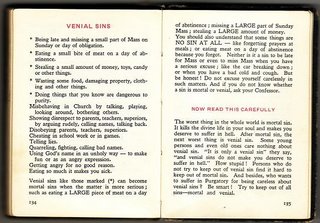


Preparation for our first Confession is lengthy and serious. I think we spent more time on prep for this than we did for our First Communion. Examination of conscience… List the sins by category and number… “Bless me Father for I have sinned. It has been two weeks since my last confession.” One Saturday afternoon I’m in a fury because my brother and sister are laughing at me and teasing me. From the pews they’d heard me saying to the priest in the confessional, “I used the Lord’s Name in vain no times at all.”

My brother is breathlessly telling a story: “Did you hear what happened at CCD today? Some kid in the communion preparation class took a practice host out of his mouth and looked at it. Cunney grabbed him and threw him right through the door out into the hall….”

My First Holy Communion. May 13, 1967
The sisters had drilled us to get ready for First Communion. This is serious business, and we are told what to wear with no exceptions. The boys are all to dress in a crisp white shirt, black pants, spotless, shined shoes, and a cloth scapular. Through long hours of drill, these women have been able to train us wild little Irishmen into disciplined ranks of well-trained soldiers for Christ.

Afterwards, there is a celebration in the Parish Hall. We receive our metal scapulars and have a great breakfast. I recall that someone from the archdiocese had brought in a relic of what was claimed to be a splinter of the True Cross. It was a great day.
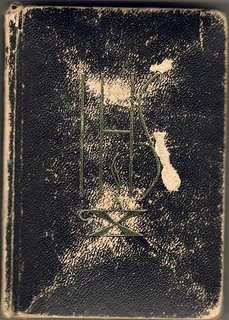


The Missal I was given on my First Communion.
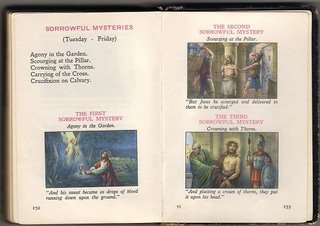


In order to take Holy Communion, you needed to fast from midnight on. For a kid, that essentially means fasting from dinnertime on Saturday night. I tell my own kids now not to complain about the current one-hour rule.

I own one blue suit, and that is what I wear to Mass every Sunday. The suit has a reversible vest. One side matches the suit, and the other side is light with a checked pattern. I alternate how I wear the vest each week. I have a few clip-on ties. Formal dress is the norm at Mass. Every guy wears a suit, or at least a tie and blazer. Women wear dresses and hats. It was a much more formal time. Casual wear or shorts never would have even been considered. I saw an episode of Classic Sports not long ago of a World Series game in the 1960’s. All of the fans were wearing white shirts and ties. In the 1970’s, everything turned around on a dime regarding this.

Holy Communion is received on the tongue over a paten, kneeling at the altar rail. You wouldn’t dream in a million years of ever touching the consecrated host with your hands. Unthinkable. The first time I saw it happen, I was stunned. Although I’m not one of those who considers communion in the hand a sacrilege (and I really appreciate being able to receive the cup), and although I receive and give out communion in the hand as an EOM, I do believe that the old way was better. I think a lot of reverence for the Eucharist has been lost, and even from a logistical point of view, this was preferable. If there is one matter in which I would long for a return to tradition, this would be it.

As much fun as Christmas is for kids, I just love the Lenten season, and I love it even as a child. One of the memories that sticks with me most vividly is how everything was covered with purple cloth during Lent. The statutes, the Stations, the big crucifix over the altar… everything had a specially-fitted purple covering that went over it. A lesson should be learned from that. Symbols are very powerful, and they stick in the minds of children forever. Important to keep in mind when considering the liturgy.
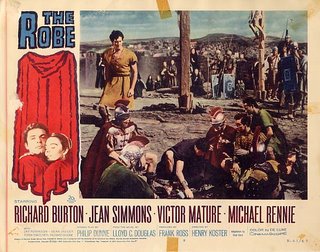


We have the day off from school on Good Friday, but it’s not your typical day off from school. There is no running around, no playing inside or outside, and no board games. It is a day to be kept solemnly, particularly around 3:00 PM, when we are reminded to be silent and prayerful. There is no TV allowed either, at least not until the late afternoon, when they start showing the Bible epics and other religious movies. I love these flicks… Richard Burton and Victor Mature in The Robe, Anthony Quinn in Barabbas, Charlton Heston in Ben Hur, Max Von Sydow in The Greatest Story Ever Told, Jeffrey Hunter in King of Kings. During the year there are a few Catholic-oriented movies that are regularly on TV – The Nun’s Story, Boy’s Town, San Francisco, Going My Way, Angels with Dirty faces, The Sound of Music, and the Miracle of Our Lady of Fatima. The last movie, and in fact, the whole Fatima story, was and still is unnerving and disturbing to me, and contrary to everything else I had ever been taught about Mary. The thing I remember the most about the movie was the provincial administrator threatening to boil the children in oil if they didn’t divulge the Fatima secrets.

On Holy Saturday we spend hours dipping hard-boiled eggs into colored dyes for our easter egg hunt. Great fun. I can still remember the white vinegar smell vividly.

When you took home some palms on Palm Sunday, that was really something…Thick, heavy, scentful palms that seemed like an entire frond for each individual. Compared to what you get now, it was like taking home half a palm tree per family.

On Easter Sunday morning, I’m always hoping against hope that I’ll get a huge solid chocolate rabbit, but it’s always a chocolate-covered coconut egg. I’m not crazy about coconut. It takes me weeks to gnaw my way through it. Sometimes we get those sugar eggs with the windows and the small chick inside.

The nuns who teach us CCD are good teachers and they are always throwing in little extras for us as far as the Mass is concerned. I follow their suggestions to this day… “When the priest lifts up the Body of Christ, pray to yourselves silently, ‘Jesus I love you’. When the priest lifts up the cup, pray to yourselves, ‘My Lord and My God’. When you pray, ‘Lord I am not worthy that you should come under my roof, speak but the word and my soul will be healed’, pray it silently to yourselves three times afterwards.”

One well-meaning but slightly cracked sister tells us that the light emanating from the Body of our Lord is so bright, that if you should look at the light from the tabernacle when the priest opens it, it could blind you. Freddy and I shield our eyes for months afterward at this point in the Mass. It is basically the same thing we’ve heard in the public school regarding a solar eclipse.

I’m not sure what year Father P. arrived, but he got everyone’s attention in a hurry. He could startle you at the beginning of Mass with a booming, nasal “In the NAME of the FATHER, and The Son….”. He was a stout, abrupt man with round glasses. In terms of style, speech, mannerisms, appearance, and probably his theology, he was remisniscent of the “Radio Priest” of the 1930’s Father Charles Coughlin (play the audio clip = You want that. You voted for that. You have that, and it’s time that you take that.”)

One Sunday, Freddy and I are clowning around and talking during CCD. The Sister hauls us out of class and takes us down to see Father P. “Give me you last names”, he barks at us. We tell him, and he rattles our home addresses back at us, rapid fire. We’re absolutely amazed and dumbfounded. He knows everything! “I know your parents. They’re good Catholics… What would your mothers and fathers say if they knew what shenanigans you were up to in CCD class?". We hardly know what to say. “Sorry Father. It won’t happen again, Father…”

One day Father P. asks the girls to leave the CCD class with the nuns for a while. He wants to have a word or two alone with just the boys… He’s going to straighten the lads out a little bit.

“What is God’s name?”

We glance at each other, a little bit confused. The sisters had taught us that you weren’t supposed to say God’s name. A few suggestions come out… “Yahweh?” “Jehovah?” “Jesus?”

Father P.’s answer is: “Hallowed.... Our Father who art in heaven, Hallowed be Thy name….”

Now we’re really confused. We know that hallowed means sacred. Is Father trying to tell us that God’s name is too sacred to say, or does he really think that “Hallowed” is a name? To this day, I’m still trying to figure this one out

“Boys, what swear is a serious, serious sin?”

We all look at each other again. Is Father really asking us to swear here in CCD class, right in front of him?? Giggling nervously, a few of us start by trying out the usual potty words.

“No, that’s not a sin… No, no, not that one either. Scatalogical reference… No, that is scatalogical as well….” He’s waiting, and we all know what he’s waiting for.

Finally, one of the oldest, biggest kids in the class has the temerity to meekly try out the bomb…

“F___?”

“THAT’S it!! THAT’S the ONE!! THAT is the ONE word you must NEVER Say!!!”

One of the nuns is young and pretty and smiles all the time. We just love her. She’s nice all the time, plays the guitar and sings, and she teaches us hymns like Michael, Row the Boat Ashore. No, I don’t think we did Kumbaya. I think we might have been a little too old for that. I think the older nuns worry about her a little bit, particularly several years later when she’s playing the Jesus Christ Superstar album over at the convent. I wonder whatever became of her. I wonder if she stayed.

It’s rare for kids to hear Mass with their parents. On most Sundays, the adults are in the upper Church, and the kids are in the lower Church in the basement. Girls are on one side, and boys are on the other. The sisters and lay volunteers walk up and down the aisles, making sure we’re not talking and that we are paying attention. Every once in a while Father P. stops himself during Mass and tells us to keep quiet.

Mike Fitzpatrick is knuckling the back of my head and shoulders from the pew behind me. “Connors, I’m going to kick you ass”, he hisses. “You’re dead tomorrow at school.”

“OK Fitz. I guess I’ll see you after school, then.”

On Monday, nothing happens, but it was not at all unusual for guys back then to settle things with their fists on the playground after school. No one is the public school administration seemed to know about it or particularly care. No suspensions, no psychologists…. There was the odd chance that a male teacher would come out and break it up and growl at everyone to “knock it off.”

One of my best friends in the neighborhood is Scott. He’s Jewish. His mother is an attractive blonde woman, a convert. His father is a big, burly man with a goatee, militant in his Jewishness, and intensely proud of Israel’s lightning victory in the Six-Day War. I think he’s really cool, because they have a leopard-skin rug in their living room made out of an animal Scott’s father had bagged on a safari in Africa. One day my brother and I came over to their house looking for Scott and his brother. I think it must have been a Jewish holiday, because we were left waiting outside for a long time on the doorstep while Scott’s mother gave them a long (and audible to us) lecture about their Jewish identity and their lack of deportment acknowledging it. Scott and I like to play for hours and hours and to talk about the various TV shows we’d seen the day before. One December day I ask him if he’d seen the new animated feature, The Little Drummer Boy. He replied “I don’t watch that Christian crap.” That stings, but I don’t hold it against him, because I think I’m hearing his father talking.

Several years later, Scott and his family have moved to a different neighborhood in town, but Scott has come by for a visit. We’re wrestling in my front yard, and I have him pinned. He can’t move, and we’re both laughing. “Say your prayers”, I say. Then, inexplicably, I add “Oh, I forgot. You don’t pray.” The laughing stops instantly, and Scott glares at me, his eyes flashing in absolute fury. He springs up to his feet as if I weigh nothing and he is on his way out. Realizing immediately what an offensive and stupid thing I’ve said, I apologize profusely and beg him to forgive me. He’s having none of it. We never saw each other again.

Summer days seem to last forever and the nights are steamy and full of mosquitos until the sprayer trucks come around, billowing huge clouds of insecticide. No one has any A/C yet on our street full of Cape houses. Some of my friends on the street have some cousins from the South up visiting for a week. One hot night we’re running around, ranging through the back yards of the neighborhood with our shirts off. The oldest brother in the Southern family asks me what I have hanging from the chain around my neck. I show him my scapular. “Ah, y’all are Cat-licks. We’re Christians.” I’m puzzled by this. “What do you mean? We’re Christians too.” He then instructs me in all sincerity, without a hint of of malice, “No, no… See, you all are Catholics. We’re Christians.”
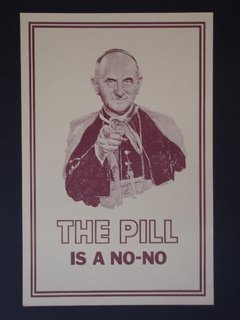


Google Image Search is an amazing thing. I doubted I was going to be able to find an image of this poster, but there it was… My mother had this poster hanging up inside the door of the closet in my parents’ bedroom. One day I asked her what it meant, and she laughed and told me in a non-explicit way. Knowing my mother’s sense of humor, this poster is the kind of thing she would have found funny, although I think she was surprised that Pope Paul came down with his decision on this the way that he did. I think she thought (along with a lot of other people) that he was going to follow the advice of his hand-picked commission and go the other way. My father had a pretty good sense of humor, but I sometimes wonder if he thought the poster was funny.

In 1971 Monsignor Cunney died suddenly. His body lay in state in the Church for a few days, the first deceased person I had ever seen.

The Age of Aquarius isn’t going down too well with Father P. at all. He seems more and more frustrated and agitated as time goes on. He just doesn’t know what the heck is wrong with young people nowadays. As we’re heading towards adolescence he blurts one afternoon, “Girls, don’t ever let the boys touch you. Boys, don’t touch the girls and don’t touch yourselves either!"

I don’t have any recollection of when the Mass started being said in English. I don’t recall any particular sense of outrage. I think most people were happy about it. If there was some resentment about it, I didn’t catch it, but that doesn’t mean there wasn’t any. I learn years later that the parish has deep divisions in it. Factions had apparently formed, and the atmosphere among some groups of adults was tense and bitter.

In 1971, a new Father P. arrives at the Parish. He remained the pastor until 1993. I only regret that it took me so long to realize what a treasure this man was. He was the finest priest I’ve ever known. He left in 1993, but returned to stay in residence from 1996 until he passed away in 2004. In addition to be a man of deep spirituality, pastoral skill, wide interests and intellect, he was a model of a priest who believed in collaborative ministry and consultation with the laity. The parish flourished under his stewardship.

By the time I finished up my CCD years, the Baltimore Catechism had started getting phased out of what was now being called Religious Education. I have to say that although there was a lot that I loved about the Catholicism of my childhood, a lot of it was fear-based rather than grace-based. In this respect, Vatican II was a great blessing, applied and understood in the proper context. The group of kids who came up directly after us, however, were the victims of a pendulum that swung too far in the opposite direction. In order to get away from this fear-based teaching, the teachers overcompensated too far the other way. As for the kids, theirs was the generation of smiley –face catechesis, are-you-running-with-me-buddy-Jesus, God is Love, God Is Love, God is Love, over and over again in word-search puzzles. Their knowledge of the faith was negligible, which is tragic. I am thankful to my parents, both incarnations of Father P., and to the sisters, that at least I had that knowledge base.

In my teens and twenties, through various struggles with the flesh and with the intellect, I think the fact that I always kept going to Mass every week throughout it all is probably the thing that is most responsible for why I kept my faith. It was like that old Dan Fogelberg song Hard To Say - “You’re faithful to her in your careless way, and so you miss her when she's far away, but every time you think you’ve got it straight, you fall.” Maybe that fear of mortal sin associated with missing Mass wasn’t such a bad thing after all. Maybe there was some deep old wisdom in that emphasis. Even when I was living in such a way that my conscience wouldn’t allow me to go up to receive communion (and that went on for years), I still kept going to Mass every week. Thank God for it. Nevertheless, I am a believer in Vatican II and what it did for the Church, reversing the grip of anti-modernist zealots over the Church who had squelched the faith in Europe and would have done the same in the USA eventually. While there was much I loved about that pre-conciliar Church, the post-conciliar Church is better. I wouldn’t want to go back. As it says in the writeup for the history of my parish:

The Second Vatican Council examined both the Church's internal life and her relationship with the world. When the Council ended, the reforms and changes went far beyond what anyone had anticipated and called all of us to a new, shared responsibility in carrying out the mission of the Church. Few aspects of Church life were unaffected. On the level of the parish, these changes were most profoundly experienced in its worship and especially the celebration of the Eucharist. What had been a very passive experience now invited the congregation to be fully involved.

Thursday, July 13, 2006

Lose your temper, risk losing your reputation

I was born with a disposition towards a quick, hot temper. I’ve had to learn to control it over the years. If I think back over my life, the moments that I most regretted and the biggest mistakes that I have made tended to be associated with events where I let my temper get away from me. I can think of several times in particular in which I thought that my display of “strength” would demonstrate to one young woman or another that I was not a pushover. Wrong move... My oldest son tends to be hot-tempered as well, and I’m working hard to help him learn to deal with that.

I enjoyed the World Cup event for the most part. I especially enjoyed living vicariously though our new fussball-mad German neighbors next door, celebrating and lamenting with them through the ups and down of the tournament. The games were a lot of fun to watch, although as an American, there are several things that felt “foreign” to me and are hard to understand. Previously, I made some references to those things that I consider as flaws of the sport here.

One of those foreign, inexplicable things, was the event that took place in the final match between France and Italy. I’ve been told that Zinedine Zidane, the brilliant French midfielder, is the greatest soccer player of his generation – probably the best player to come along in the last 20 years. He was born in Marseilles, of Algerian descent. After a long and stellar 18-year career, he recently retired from soccer, but came back out of retirement to help a floundering French team get in shape to recapture some of the glory days they enjoyed in 1998.

Well into the overtime period of last Sunday’s game, tied at 1-to-1, it looked like the teams were headed towards deciding the game by penalty-kicks (which seems to be the way that most important soccer games are decided nowadays…). This was especially worrisome for Italy, because Zidane had already scored on a penalty kick earlier in the game. He’s especially good at them. He handles the pressure with aplomb, like he has ice-water in his veins. Zidane got tangled up with the Italian defender Marco Materazzi at midfield, and the two players had words. This video shows the incident in which Materazzi (the game’s other goal scorer) was manhandling Zidane a bit. According to Zidane, he turned to Materazzi and said something like, “If you want to swap jerseys, we can wait until after the game.” As Zidane extricates himself and pulls away, Materazzi is muttering something at him. After a few more steps, Zidane turns around, walks back, and knocks Materazzi right off of his pins with a powerful head butt to the chest. Zidane was given a red card and ejected from the game, leaving the stunned French announcer to lament “Why?… Why?”. France became dispirited and discombobulated after this loss of poise from their leader, and their lack of confidence showed. They lost the World Cup to Italy minutes later on penalty-kicks. Zidane was in the locker room when the game ended, and did not come out to the stand later to collect his silver medal.

According to Zidane, Materazzi insulted his mother and sister several times. Materazzi denies insulting his mother. In this article, Britain's top forensic lip-reader, Jessica Rees, claims that Materazzi called Zidane a "son of a terrorist whore". Another lip-reader claims that Materazzi had told Zidane that his sister was a "prostitute".

Whatever the truth is, a taint is left on both players as a result of each losing his temper. Zidane was awarded the “Golden Ball” as best player in the tournament, but that might not hold up. French fans have made up songs and games about the head butt, but over time, I sense that this will be forgotten, and the conclusion will be that Zidane lost his cool and his poise when his team most needed him, and Italy won the Cup as a result. After a long and brilliant career, this will be remembered as the signature event of it, and it happened after his official retirement in a World Cup final.

In the NFL and in other American professional leagues, players try to get each other’s goat all the time, even to the point of saying nasty things about each other’s mamas, but I’ve rarely seen such a meltdown in such a clutch situation. American athletes are taught to shrug this stuff off as best as they can and to prove whatever they have to prove with their play. Then again, maybe I’ve got it all wrong in looking at it through American eyes. Will Europeans see it differently, particularly the French?
A reggae-like song about the head butt has become an instant Internet hit. Sportswriters and the French sports minister called his action odious, shameful, unsportsmanlike, and petulant. Yet rumors abounded that something unsupportable had been said. Lip-readers were employed by various news organizations and concluded that the Italian had used racial epithets or slurs against Zidane's mother and sister. The right-wing Italian Senate president fueled speculation by saying the French team "sacrificed its identity by selecting blacks, Islamists, and communists."

Finally, on Wednesday night, Zidane appeared on national television.
Yes, the soccer star said, Materazzi had used terrible language, insulting his mother and his sister. No, Zidane said, he would not repeat the exact words. All he would say was that he was profoundly, deeply hurt.

"I would rather have taken a punch in the face" than hear such insults, he said.

Zidane, dressed in a T-shirt with a khaki Army surplus coat draped over his shoulders, said repeatedly that he apologized to the children and teachers of the world who saw his head butt.

He called his act "unforgivable" but called for sanctions as well against "the true culprit" who had insulted his family.

Then, mixing his message even further, he declared that he regretted nothing. To have refrained from reacting would have implied that the Italian was right to utter the insults, he said.

"I take responsibility for the good and the bad," he said. "Now another life begins. I'll be less watched, less observed. I am going to try to devote myself to my children and my family. I intend to return to Algeria to rediscover my roots, the land of my parents."

With those words, he reminded his audience of how far he had come. For Mr. Zidane has long been the prime example of a "beur," as French people of North African descent are commonly called, who crossed over into mainstream celebrity status by way of professional sports. He was a source of pride in immigrant neighborhoods, a case in point for French politicians who insisted on the openness of French society and a bane to those on the xenophobic far-right who complained France was losing its white European identity.

In the final score, Zidane became for some the embodiment of a quality admired in more than a few French circles: the willingness to sacrifice victory for pride.

"I see, thanks to Zidane, the victory of a certain national spirit," wrote François Sureau, a French philosopher, in the newspaper Le Figaro, on Thursday. Zidane, he said, "has given us back our beautiful reputation for insolence."

Sunday, July 09, 2006

Christian Pacifism: Wimpiness, or Prophetic Witness?


One thing I’ve sometimes noticed in discussions about Christian Pacifism, is that it is often misunderstood. In the popular imagination I believe it is considered hopelessly idealistic and unrealistic, or worse, the cowardly haven of milquetoast, panty-waisted, self-hating Americans who want to bury their heads in the sand and pretend that evil forces in the world do not exist. But is this accurate?

I sense that Jesus Christ demands a lot more of us than what is covered in typical pious platitudes and pie-in-the-sky bromides we hear in a lot of Churches. There is far too much equivocation going on with the Gospel. Liberal Churches tend to stress the Peace Tradition as a form of prophetic witness. A lot of conservative Christians today are quick to look down on certain aspects of liberal Christianity, especially those who’ve traveled a hard road of alcoholism, or drug use, or promiscuity, and were pulled out of a downward spiral by the strong hand of God in a saving act of faith. For a lot of people who’ve gone back to the various churches, Christianity is a means to impart good values to their children – to keep them on the straight and narrow and to keep them from messing up their lives with indiscipline, substance abuse, and premarital sex. All of that is well and good, but that is a positive by-product of Christianity. It is not the essence of what it is.

Jesus spoke often of the Kingdom of God and our role in helping to bring it about. Jesus was speaking about a profound change to come about in the world. "The coming of the kingdom of God cannot be observed, and no one will announce, 'Look, here it is,' or, 'There it is.' For behold, the kingdom of God is among you." The Kingdom is “here, but not yet”. There is an apocalyptic aspect to it, but it is also an undercurrent that runs through history. As members of the Body of Christ, “being in Christ”, and being granted sonship, we have a cooperative role to play, but the greater role is His. A great part of holiness is to step out of the way with our own wills and to let God do his work through us. If Christians don’t work to transform the world, and if the world is never transformed, then for what was this reconciliation between God and Man? “Thy will be done on Earth as it is in Heaven…”

Stephen Hand is a traditionalist who shares with many liberal Christians a belief in Christian Pacifism. On his TCRNEWS website, he posted this article by Michael Baxter, CSC, on Just War and Pacifism: A "Pacifist" Perspective in Seven Points, in which Baxter offers his views on what Christian Pacifism is, and what it is not. Some excerpts:
Having been asked to speak from a pacifist perspective, I should state right away that I have misgivings about the word "pacifism." Not only does it have connotations of an unreasonable refusal to take up arms to defend the innocent, like your wife or daughter or grandmother who is being raped. It also implies a moral position the substance of which is intelligible without reference to Christian belief and practice. This is not the kind of "pacifism" (if one must use the word) that I espouse. Placing the qualifier "Christian" before the word "pacifism" helps to correct this problem to some extent. But the implication still remains that pacifism is a coherent position the core of which is the same in spite of its many varieties.

At the outset of Romans 5, we read, "So then, now that we have been justified by faith, we are at peace with God through our Lord Jesus Christ" (Romans 5:1). In this context, "justified by faith" means "being admitted into God's favor in which we are living" (v. 2). This favor was puzzling because we were "still helpless," "godless" (v. 6), "still sinners" (v. 8); because we were "enemies" (v. 10), as the text reads "for if, while we were enemies, we were reconciled to God through the death of his son, how much more can we be sure that, being now reconciled, we shall be saved by his life?" (v. 10). For Paul, a fundamental and far reaching reconciliation has been accomplished in and through Christ, the reconciliation of God and humanity. We, who were God's enemies, have been brought into God's peace. This is not a reconciliation of individual Christians with God, as understood in certain strands of the Lutheran and Evangelical traditions. Rather, it is a reconciliation that is inherently social. It dissolves the enmity between Jew and Gentile. In this sense, the cross of Christ forges a new people, who live in a new way, made possible by Christ. Peace is thus, first and foremost, en ecclesial reality, and inasmuch as the Church is, in traditional Catholic ecclesiology, a perfect society, it is also a social reality…

…The irreducibly social character of peace, in the Catholic theological tradition, is illustrated in the great anti-Arian treatise On the Incarnation, where Athanasius declares that the truth of the divinity of Christ has been demonstrated in Egypt inasmuch as the spread Christianity has brought that land peace, true peace, God's peace. If we were to inquire as to how this peace is established, the answer would have to be that it is through the lives of those claimed by Christ in baptism, confirmation, and Eucharist; lives that are so transformed that Christians may be described as "partakers of Christ" or, simply, as "Christs."

…Similarly, there is the witness of those in the monastic and religious life whose obligations to follow the evangelical counsels included a refusal to participate in any kind of killing. Mot notable among these, perhaps, are the follower of Francis of Assisi, who, like their founder, renounced violence as part of pursuing the imitation of Christ. There are many other elements in Catholic tradition that reflect the Church's abhorrence for bloodshed (in keeping with the longstanding principle "the Church abhors bloodshed") or, to put it in positive terms, the Church's presumption for peace.

…No one receives the gift of peace as an individual, any more than they receive the Body of Christ as an individual. Rather, we receive the gift of peace as members of a body (I Cor 12:12-30, Romans 12:4-5), as branches on a vine who remain in God's love and lay down their lives for their friends (John 15:1-17). In this sense, Francis of Assisi was not "an individual"; he was a saint, a member within a communion, who took into his body the marks of Christ, and was thus shown to be a sharer in the body of Christ.

…There is a continuity between just war and pacifism, in that when the just war tradition is faithfully theorized and practiced, it calls for a politically disruptive witness on the part of its practitioners. The fact that such faithful practice is rare and exceptional should not obscure the demands of this tradition, but should make us press it upon the church all the more urgently, precisely because, as the experience in Austria showed, it has had little impact on the moral discernment of Catholics. One would hope that there would be a long record of careful moral discernment on the part of Catholics regarding their participation in war, in particular, regarding whether or not participating in a particular war would be unjust and thus an instance of cooperating with evil; and whether or not participating in particular actions or operations within a war would be unjust, and thus an instance of cooperating with evil. But the fact of the matter is that there is very little record of this kind of discernment among Austrian Catholics or German Catholics during these years. Moreover, there is very little record of this kind of discernment among American Catholics either.

…Most critics of pacifism contend that it is either unrealistic or irresponsible or both. But if one takes this strict understanding of just war theory, then it too can be criticized on similar grounds. Take, for example, the argument advanced by Finnis, Boyle, and Grisez in Nuclear Deterrence, Morality, and Realism (which by the way has a long section in the footnotes that confirms Anscombe's view of the immoral intentions of Allied Commanders in planning how to wage war against Nazi Germany ). …They argue that deterrence strategy is immoral in that it entails a willingness to take innocent life, or if not, then it entails lying. But, the question arises, if we reject deterrence strategy, what are we supposed to do? Let the Soviet Union conquer the West? In the final chapter of the book, they provide an answer to such questions by offering some "concluding Christian thoughts" including a "profession of faith" in Jesus Christ whose life, death, and resurrection shows to humanity the path of righteousness and true freedom. This path requires Christians to pay many costs, and one of those costs in the context of the nuclear rivalry of the early 1980s is a sacrifice of the notion that the fate of Christianity depends on the future of the Christian West, which must not, they point out, be confused with the kingdom of God. Christians must, in other words, have faith in Divine Providence, which calls them to greater detachment from the Christian West. A similar emphasis on Divine Providence can be found in the encyclical Veritatis Splendor by Pope John Paul II, who argues that one should avoid evil no matter what the consequences, trusting that any and all consequences will be enveloped into God's mysterious plan. This profound belief in Divine Providence is deeply rooted in Catholic tradition which holds that God is capable of bringing forth good from any kind of horrifying evil.

…I have already alluded to the way that this legacy paved the way for a utilitarian method of doing social ethics, a method devised by professional ethicists in order to mitigate the violent dynamics of modern nation-states. But another feature in this development is that things associated with religion are relegated to, and cordoned off within, a different sphere of life. It is a sphere of ultimate ends, rather than means, a sphere of the Absolute rather than the Relative. In this thinking, the last thing we want involved in politics is someone who believes in an absolute ethics, such as set forth in the Sermon on the Mount. Also in this thinking, pacifism gets seen as an Absolute, which means it is irrelevant for politics. Thus pacifists, according to Richard John Neuhaus, in his emotional editorial in the December 2001 issue of First Things, are nothing more than a reminder of the Kingdom to come and have nothing to say about the morality of war among the kingdoms of this world. Hence my misgivings about being identified as a "pacifist." Hence too my wariness of questions such as, "Are you an absolute pacifist?"

So let me answer that question before the question period begins. I am not an "absolute pacifist." Rather, I am an absolute Nicean and Chalcedonian Christian, that is, I believe absolutely that the Son is one in being with the Father, and that the fullness of God's will and the fullness of God's life, is revealed and made possible in Jesus Christ, through the power of the Holy Spirit, which He gave to us, along with His gift of peace. And it is only by thinking more critically about, and distancing ourselves from, the waging of war by modern nation-states, that we will worthily receive that Gift of Peace.

TCR Editor Stephen Hand / On a Personal Note: I have always been a hairs breadth away from calling myself a pacifist, but it seems to me a term easily misunderstood ---and it means different things to different people. If it means opposing wars as a means to resolving international conflicts and having a radical suspicion of what hubris, greed and real motives or misguided analysis lie behind such wars, then yes, count me in from my youth. If it means considering Dorothy Day was a prophet, I have believed that since a very young man, despite a few differences. In other words I am with the radical peacemakers, and forsake all jingoistic warmongers as I would reject Hell itself.

If it means I believe War is largely "a racket" then count me in. If it means judging innocent others for defending themselves when aggressed upon (e.g., Poland after Hitler pounced), count me out. There is a higher way--- the earliest Christians, Gandhi, Tolstoy, and I praise and urge that--- but not all are capable of it when under attack. If it means watching a neighbor get jumped without trying to help, that is ridicuous and unchristian, for it is cowardice not to aid others who are victims of crimes. I can only pray that if I were (alone) personally attacked, I would have the faith and spiritual courage not to defend myself, but to call the aggressor to consider God and the eternal soul he is risking and offer my beating or life for him. But to announce in advance that I would be so heroically virtuous seems ludicrous to me (how can I know?; it would be like saying "I am a Saint" which is preposterous. I have not been so tested.) So we must, it seems to me, be radical peacemakers vis a vis nations and war in general, without announcing thoughtless pronouncements on our virtues ahead of time.

These few caveats are, again, a far cry from modern wars which kill 93% civilians to 7% soldiers. And premptive / preventive wars are out of the question. As is the extension of empire (read "vital interests") through war. And the choice of destroying nations to kill certain dictators while propping up others. We are peacemakers by grace. Not warmongers. We will not fight and kill simply because some government tells us to.

Thursday, July 06, 2006

Catching up on Old Correspondence II: Joe, on the question of Just War


I don’t have this blog set up to email me when something comes in, so every once in a while I miss a post that came in late.

Here’s one of note that came in on this thread from my friend and “right arm”, Joseph:

Crystal says it so succinctly: Christian just war = oxymoron. Thanks Crystal. If you don't mind I will use that. I've been banging the stump on this one for years. I suppose that deep down I do it with the hope that people will actually listen and be convinced (there's likely an "ego factor" at play here as well, I'll have to admit it...) But mostly it reverts back to Christ and His definition of Love. He defined it, not in terms of mushy hugs and kisses for our friends and family, but in terms of how we deal with our ENEMIES. If we asked ourselves if Christ could ever justify war, the answer is a no brainer (and no, we cannot equate Christ's "violent" temper tantrum in the temple market to war.) As a follower of Christ I would have to say that there was no greater or more noble cause to fight (and die?) for than for Christ Himself that night in the garden. Yet He was very clear in His example and in his instruction. Have Faith! Have Faith especially in those moments of greatest injustice when all seems lost! Have Faith, though logic tells you to act otherwise. Among His last battles was the urge to give in, to let the cup pass Him by when all seemed lost. What MAN would not feel it?! Yet ultimately He peacefully (not passively) opened His arms to embrace Faith in His Father in the form of death on the cross, pehaps not fully knowing what it would lead to a few days later. It was only through His hideous and unfair death (no doubt perceived as a moment of failure in the eyes of many that witnessed His life and death), that the resurrection could occur.

There's no satisfying answer for us in this life to the injustices inherent in the killing of the innocent (either through abortion or through the pornography of war), yet Christ showed us that killing is not the answer. Killing is an act completely void of Love albeit a logical human reaction in certain circumstances. Sometimes we are lured away from Faith by our emotions and our desire to SEE justice done (yes, see it with our own eyes, in this life, before death.) This is the case with the "Just War": we are hoping to see justice done, with our own eyes by own own hand. But for all its noble intention, it too is an act that lacks Faith. Having said that, turning our backs is not the peaceful alternative here. We need to pursue other active options that don't include killing, but may in the end include laying down our lives.

Clearly Love is the answer. Hope is the answer. Faith, which is illogical by definition is the answer. But Faith requires enormous patience. So much so that we might not SEE the payoff in our lifetimes. But then again, neither did Christ! (Though big dividends came in just a few days later.)

In short War has all of the logic that Faith lacks. I'm confident that I know what Christ would choose (its what He chose!). I only pray to find the strength and courage to do the same.

Our lives hang by a thread. Where do we store our treasure?


Enron CEO Ken Lay, 1942-2006

Someone in the crowd said to him, "Teacher, tell my brother to share the inheritance with me."

He replied to him, "Friend, who appointed me as your judge and arbitrator?"

Then he said to the crowd, "Take care to guard against all greed, for though one may be rich, one's life does not consist of possessions."

Then he told them a parable. "There was a rich man whose land produced a bountiful harvest.

He asked himself, 'What shall I do, for I do not have space to store my harvest?'

And he said, 'This is what I shall do: I shall tear down my barns and build larger ones. There I shall store all my grain and other goods and I shall say to myself, "Now as for you, you have so many good things stored up for many years, rest, eat, drink, be merry!"

But God said to him, 'You fool, this night your life will be demanded of you; and the things you have prepared, to whom will they belong?'

Thus will it be for the one who stores up treasure for himself but is not rich in what matters to God."

--Luke 12: 13-21

Monday, July 03, 2006

Fr. Ron Rolheiser on the Characteristics of a Healthy Spirituality


--Assisi, October of 1992

Anyone who has read this blog for a while has probably noticed that I’m a big admirer of the spiritual writer Fr. Ronald Rolheiser, OMI. It appears that he is the one who has most aptly been able to step in to fill the void after the passing of the great Henri Nouwen, and picked up his mantle. Like Nouwen, his appeal unfortunately tends to be limited largely to a female audience, which is a shame, because I think that men could benefit greatly from reading them. Trads tend to despise them as mawkish and effeminate. I’ve taken the time to read them both, but it’s hard for me to convince my guy friends to read books with titles like “The Wounded Healer”, “Bread for the Journey”, the “Shattered Lantern”, and “Forgotten Among the Lilies”.

One of Fr. Rolheiser’s best books is “The Holy Longing: Guidelines for a Christian Spirituality”. I gave my copy away, but here are some notes I jotted down from it beforehand. Any mistakes in here are mine, and not Fr. Rolheiser’s.

Kierkegaard said “A saint is someone who can will the one great thing”. The problem for the rest of us is that we will everything else as well.

Spirituality is about how we channel our eros. Disciplines and habits we choose to live by will lead to either integration or disintegration.

The soul is not something we have, it is something we are. It is a life-pulse, that which makes us alive.

Too much order leads to suffocation.
Too much chaos leads to dissipation.
Healthy spirituality has a creative tension between the two.

Societies in the past were more overtly religious…

Advantages. They had:

  • Less trouble believing in God

  • Less trouble connecting human desire to God and to obedience to God


Disadvantages. They struggled with:


  • Slavery

  • Superstition

  • Sexism

  • Fate and Predestination

  • Excessive fears of eternal punishment

  • Legalism


The present time is no Golden Age either. We suffer from:


  • Naivete about the nature of spiritual energy (no one can see God and live!)

  • Pathological busyness

  • Distraction and Restlessness

  • Problems with balance


In western cultures, the joyous shouting of children often irritates us because it interferes with our depression. That is why we invented the term “hyperactivity”, so that in good conscience, we can sedate the spontaneous joy in many of our children.

Our age constitiutes a virtual conspiracy against the interior life.

What works against interiority?


  • Narcissism (excessive preoccupation – “heartaches”)

  • Pragmatism (excessive focus on work – “headaches”)

  • Restlessness (excessive greed for experience – “insomnia”)


Balance Problem (Bad Divorces)


  • Divorce between Religion and Eros. The Secular got passion, and God got chastity.

  • Divorce between Spirituality and Ecclesiology. The number of people in churches is down. The number of “spiritual” people is up. People want faith, but not the Church. They want spiritual questions, but not answers.

  • Divorce between Private Morality and Social Justice. “The pious aren’t liberal and the liberal aren’t pious.” People seldom have the same passion for: private morality and social justice, action and contemplation, poverty and family values.

  • Divorce of the Gifted Child and the Giving Adult. Spirituality is ultimately about self-transcendance, altruism, and selflessness. True selflessness can be hard to define. Sometimes it is manipulative. Drama of the Gifted Child – The person who picks up, internalizes, and lives out the expectations of others. The pleaser who does not want to disappoint. They end up in mid-life bitter,victimized, angry that they sacrificed personal needs to another’s wishes.

  • Divorce by Contemporary Culture of its Paternalistic Christian Heritage


Catholic Tonality – Monasticism, asceticism, piety, and solitude.
Protestant Tonality – Biblical, stoic, personal experience of rebirth and justification.
Secular Tonality – God belongs in the churches and the privacy of people’s homes, but not in the public domain. In itself though, it has plenty of religious baggage and doctrinal orthodoxies.

Essentials of Christian Spirituality - Four Non-Negotiable Pillars of the Spiritual Life

A) Private Prayer and Private Morality
B) Social Justice
C) Mellowness of Heart and Spirit
D) Community as a Constitutive Element of True Worship

Stories of imbalance…

A person of Private Prayer and Private Morality, but lacking in Social Justice. Think of the traditionalist on the extreme right who only concentrates on private morality and sexual ethics.

A person of Social Justice, but lacking in Private Prayer and Private Morality. Think of the progressive liberal on the far left who only concentrates on the plight of the poor and oppressed. “Do you think God cares about all these rules on sexual morality when people are starving?” Yes, he does. Sexual purity is important.

A person of Private Prayer and Private Morality, Social Justice, but lacking in Mellowness of Heart and Spirit. Think of the angry rock star, or the elder brother of the prodigal son. Think of someone who can’t enjoy a nice hotel room, meal or a glass of wine if someone is suffering somewhere else. This person does all the right things, but with no celebration in the heart.

A person of Private Prayer and Private Morality, Social Justice, Mellowness of Heart and Spirit, but lacks involvement with a concrete community. Think of the person “who loves God, but not organized religion”.

Mellowness of Heart and Spirit: Only one kind of person transforms the world spiritually – Someone with a grateful heart. According to Fr. Gustavo Gutierrez we feed the soul in three ways:


  • Prayer (Private and Communal)

  • Justice practiced

  • Good things in life that keep the soul mellow and grateful


The wrong God of the left and right is the God who is wired, bitter, anxious, workaholic, and unhappy.

Community: Loving one’s neighbor is not an abstract thing. Anyone who claims to love God who is invisible but refuses to deal with a visible neighbor who can be seen is a liar.

Without Church, we have more private fantasy than real faith. The individual in quest for God, however sincere, lives the unconfronted life. Real conversion demands that its recipients be involved in both the muck and grace of actual church life.

Church involvement does not leave us the option to walk away when something happens that we don’t like. It is a covenant commitment, like a marriage, and binds us for better or worse.

After joining a community, others will put a belt around you and take you where you would rather not go.

Church community takes away from us our false freedom to soar unencumbered, like the birds, believing we are loving, mature, committed, and not blocking out things we should be seeing.

Real churchgoing shatters this illusion, and we find ourselves constantly humbled as our immaturities and lack of sensitivity to the pain of others are reflected off eyes that are honest and unblinking.

We cannot bypass a flawed family on earth to try to relate to a non-flawed God in Heaven.

Part of the essence of Christianity is to be together in a real community, with all the real human faults that are there and the tensions this will bring up.

Sunday, July 02, 2006

Jebbie Knights?

Actually, I think Kenrick-Glennon in St. Louis is a diocesan seminary. I first spotted this on Mark Mossa's You Duped Me Lord...

The Duel of the Seminarians. Tech-savvy seminarians with some time on their hands. Not bad. It's pretty funny, enjoy. :-)

Friday, June 30, 2006

Two Giants


Two titans in their respective fields, who were paying the cost to be the boss.

Here is a rare circumstance in which two of my abiding interests happen to intersect – The Blues and The Church. This is a photo of Blues legend B. B. King handing over his guitar “Lucille” to Pope John Paul II in 1997.

B.B. King might not be the most technically proficient blues player in the world, but as far as I’m concerned he’s earned his props just for being such an influential and seminal figure in the development of the electric guitar. Besides, he’s a beautiful player in his own right, with an unmistakeable, signature sound all of his own. He can play with great economy and taste. He can make his guitar sing and say more in a brief solo of a handful of notes than a guy like Johnny Winter can say in a blizzard of one hundred. Sadly, he has diabetes and is getting on late in years. He may not have much time left.

The Blues can’t be dismissed casually as “The Devil’s Music”. The purpose of the blues is to assuage pain. Like religious faith, it is a means to speak to the suffering inherent in the human condition and to ameriolate it. Country Music, with its tales of weal and woe and cheap trouble, has never appealed to me for some reason. I can’t relate to it at all. Maybe because it has no swing.. no lilt. I probably shouldn’t be able to relate to the blues for any logical reason either, but for some reason it grabbed me as soon as I heard it. It has always spoken to me as one of the most authentic types of music. “If you don’t like the blues, you’ve got a hole in your soul.”

Actually, the guitar that King handed over as a gift to JPII wasn’t the only, or original “Lucille”. Apparently, there have been as many guitars as women in his life. Here is B.B. telling the story of how he happened to name his guitar Lucille in the first place:
In 1949 I was playing a club just outside of Memphis. Actually, . . . it wasn't so much a club as a shack with a big room in it. For heat the manager lit a garbage can full of kerosene.

Well, don't you know these two men got to fighting over a woman and one of them knocked over that can. The whole floor instantly lit up like a river of fire and everyone, including B.B. King, went running for the door.

It was after I got outside that I realized that I left my guitar behind. I ran back in to get it, but the fire was so hot that the building started to collapse around me. I almost lost my life. I was pretty badly burned, but at least I saved my guitar.

The next morning I learned that the woman that those two men were fighting over was a waitress named Lucille. I named my guitar after her to remind me never to do something so stupid again.

And since you asked, here's a funny story. I got 16 different Lucilles. Every time I needed my guitar repaired, I'd send it to the factory. And while they were working on it, they'd loan me another one.

Only thing is, when I got my regular guitar back, I never did send back the loaner! So over the years I built up a pretty good collection. And when I travel, I only have two Lucilles on the road with me at a time.

Does this sound like a near-fatal barfight around closing time over a woman barely known to either man? Now, that is an old, familiar story. I’ve seen it happen many times myself.

As for JPII, he was an actor, poet, and singer in his youth. I guess he was known to play a bit of guitar too. When I look at photos of the young Karol in those shades with a vaguely beatnik type of look, I wonder if he ever tore off a few blues riffs on the guitar himself back in the day.

Monday, June 26, 2006

Camel's Hair, Locusts, and Wild Honey


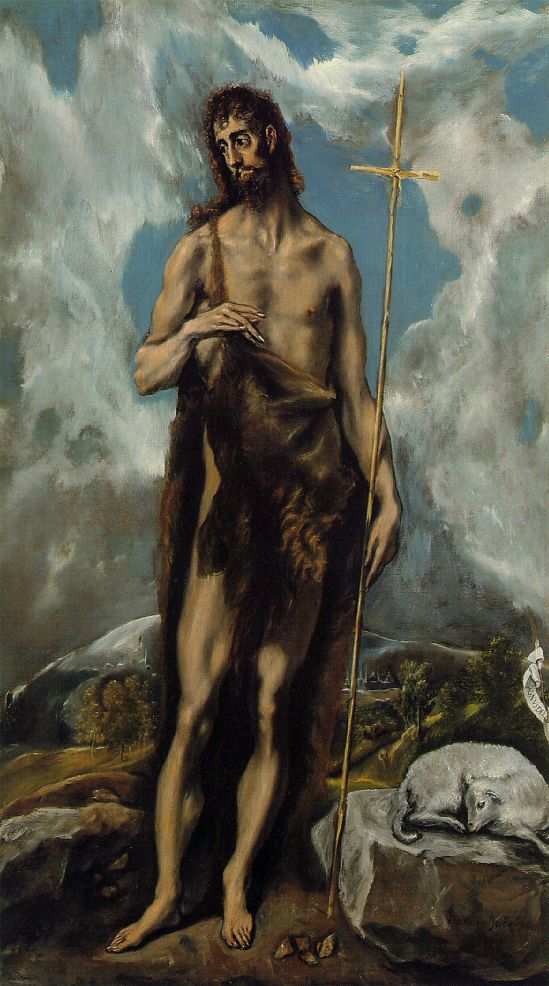
St. John the Baptist by El Greco, 1597 - 1603

Yesterday, on Crystal’s blog (along with her usual display of beautiful and inspirational artwork), there was a reminder that it was the Feast of the Solemnity of the Birth of St. John the Baptist on June 24th.

One thing that always intrigued me about John the Baptist was the strange clothing and diet. I figured it must have been rough living in the desert, but why did he wear camel-hair clothing? Why was that significant? Why did he restrict himself to eating locusts and wild honey?

Of all the current crop of historical Jesus scholars out there right now who write for the mass-market, I find Paula Fredriksen to be the most impressive (although I haven’t gotten around to reading Fr. John Meier’s tomes yet). It seems to me that she has tried the hardest to be the most honest about going where the texts lead her without letting herself be steered by presuppositions and an ideological agenda about what she wants the meaning of Jesus to have been (as opposed to say, the Jesus Seminar scholars such as John Dominic Crossan and Marcus Borg). Although I strongly disagree with her ultimate conclusions (which apparently led her to convert from Catholicism to Orthodox Judaism), I find her work to be well-researched, easy-to-read, thought-provoking, and challenging.

She had an interesting theory about John’s clothing and diet that I thought might be worth sharing. She theorizes that John the Baptist, like many of his contemporaries, had a fixation on Ritual Purity and Kashrut that was not shared by his cousin, Jesus of Nazareth. In her book ‘Jesus of Nazareth: King of the Jews’, she writes of John:
Mark's introduction of John fits with the information in Josephus:

John the baptizer appeared in the wilderness, preaching a baptism of repentance for the forgiveness of sins. And there went out to him all the country of Judea and all the people of Jerusalem; and they were baptized by him in the river Jordan, confessing their sins. Now John was clothed with camel's hair, and had a leather girdle round his waist, and ate locusts and wild honey. (Mk 1:4-6)

The italicized snippets in Mark's passage cohere well with Josephus' summary of John's preaching: John, Josephus says, "had exhorted the Jews to lead righteous lives, to practice justice towards their fellows and piety towards God, and so doing to join in baptism. In his view, this [behavior] was necessary if baptism was to be acceptable to God." This immersion, Josephus explicitly states, did not confer forgiveness of sins,but served rather "for the purification of the flesh once the soul had previously been cleansed by right conduct." Repentance and sincere contrition before God, John and his contemporaries believed, would gain forgiveness. The former sinner, having harkened to John's call to repentance, would then amplify his new moral purity by immersion for bodily purity. In short, both Mark and Josephus describe a ritual of purification so immediately associated with John's mission that the activity itself was how he was known: John the Immerser, or Baptizer. The water of the Jordan purified the bodies of the former sinners only once their prior acknowledgment of sin and consequent repentance had already "purified" their souls.

Mark's description of John's clothing and diet in this passage may further cohere with Josephus' report of John's concern with bodily purity. Cloth of camel hair, a loosely woven fabric, would easily allow water to completely penetrate the garment during immersion, thus ensuring the body's full contact with water (a desideratum of immersion for purity). Purity concerns, too, might account for the details of John's diet. True, locusts and honey fit first of all with his venue in the wilderness: Such would be readily available in the desert. But Q adds to our knowledge of John's eating habits, claiming that he "came eating no bread and drinking no wine" (Lk 7:33//Mt 11:18). In other words, the Baptizer evidently did not eat man-made or cultivated foods. This, too, may reflect his purity concerns: Such food - locusts, honey, water - runs no risk of being impure, that is, of violating in any way the laws of kashruth.

The Judaism 101 article on Kashrut says that bugs aren't generally Kosher... but apparently some kinds of locusts are:
The various winged insects that walk on all fours are loathsome for you.
But of the various winged insects that walk on all fours you may eat those that have jointed legs for leaping on the ground.
Lev. 11: 20-22

Incidentally, the author Anne Rice also admires Fredriksen’s work and used her as a consultant for her recent novel Christ the Lord : Out of Egypt, but Rice has returned to her Catholic roots. Rice says:
“In sum, the whole case for the non-divine Jesus who stumbled into Jerusalem and somehow got crucified by nobody and had nothing to do with the founding of Christianity and would be horrified by it if he knew about it – that whole picture which had floated in the liberal circles I frequented as an atheist for 30 years – that case was not made.”

Friday, June 23, 2006

"Mike McG" on Polarized Discourse

"The blind leading the blind", by Pieter Bruegel (the elder), 1568.

As stated in my profile, polarization is on of my special concerns... not that I'm not guilty of fomenting some myself now and then...

One of the occasional correspondents here, "Mike McG", has sent me an excellent essay on polarization. As someone who spent two years off-and-on in the rough and tumble combat world of Catholic apologetics, I can testify to the fact that I have seen, been guilty of, or fallen victim to every single cliche, process, syndrome, and logical fallacy that Mike lists below. Of special resonance to me is the last one he lists, on "woundedness". Thanks for the great work, Mike.

A Pox on Both Their Houses:

Why Content Matters so Little when Navigating in Polarized Waters


The Dominant Discourse in Polarized Public Debate

Polarized public conversations can be described as conforming to a ‘dominant discourse,’…the most generally available and adopted way of discussing the issue in a public context. For example, the dominant discourse about the American Revolutionary War defined the war as one of colonial liberation. It is not usually described in the United States as a conspiracy of tax dodgers led by a multi-millionaire from Virginia.

Dominant discourses strongly influence which ideas, experiences, and observations are regarded as normal or eccentric, relevant or irrelevant. On a subject that has been hotly polarized for a long time, the dominant discourse often delineates the issue in a win-lose bi-polar way; it draws a line between two simple answers to a complex dilemma and induces people to take a stand on one side of that line or the other…Most people who care deeply about the issue yield to this induction.

Being aligned with one group offers benefits. It gives one a socially validated place to stand while speaking and it offers the unswerving support of like-minded people. It also exacts costs. It portrays opponents as a single-minded and malevolent gang. In the face of such frightening and unified adversaries, one’s own group must be unified, strong, and certain. To be loyal to that group, one must suppress many uncertainties, morally complicated personal experiences, inner value conflicts, and differences between oneself and one’s allies. Complexity and authenticity are sacrificed to the demands of presenting a unified front to the opponent. A dominant discourse of antagonism is self-perpetuating. Win-lose exchanges create losers who feel they must retaliate to regain lost respect, integrity, and security, and winners who fear to lose disputed territory won at great cost. Carol Becker et al., From Stuck Debate to New Conversation on Controversial Issues: A Report from the Public Conversations Project. www.publicconversations.org/

How Polarization Sells: The Growing Disconnect between Politics & Ordinary Life

Politics is increasingly a world unto itself, inhabited by people convinced of their own moral superiority: conspicuously, the religious right among Republicans; and upscale liberal elites among Democrats. Their agendas are hard to enact because they’re minority agendas. So politicians instinctively focus on delivering psychic benefits. Each side strives to make its political ‘base’ feel good about itself. People should be confirmed in their moral superiority.

Polarization and nastiness are not side effects. They are the game. You feel good about yourself because the other side is so fanatical, misguided, corrupt and dishonest. Because real differences between party programs have narrowed, remaining differences are exaggerated. Drab policy debates become sensational showdowns – one side or the other is ‘destroying’ the schools, the environment or the economy. Every investigation aims to expose the other side’s depravity: One side’s Whitewater becomes the other’s Halliburton.

Entertainment and politics merge, because both strive to satisfy psychic needs. Rush Limbaugh and Michael Moore are more powerful political figures than most senators, because they provide more moral reinforcement. Politicians, pundits and talking heads all heed the same logic: By appealing to their supporters’ strongest passions and prejudices, they elevate their standing. Of course, much of this is essential to legitimate debate. But it’s also a marketing strategy and a formula for power. Stridency sells, because, for many, polarization feels good.

Politics should reflect and, at its best, conciliate the nation’s differences. Increasingly, it does the opposite. It distorts, amplifies and inflames conflicts. It’s a turnoff to vast numbers of centrist voters who do not see the world in such uncompromising absolutes. This may be the real polarization: between the true believers on both sides and everyone else. Robert J. Samuelson, The Washington Post, Wednesday, June 30, 2004, p. A21.

Tradition and Modernity in Tension

Before we can get a sense about the right claims being made by the traditionalist and modernist sides here, it is important to see what is wrong with both of them…To lean too much on a scriptural defense…or upon a continuous church tradition, could lead us to ignore or to downplay those situations in which we have in fact decided, not only as individuals but over time as a community, to ignore passages of scripture or areas of tradition that we do not accept the way our ancestors did.

At the same time, tradition is an important voice – or better, a harmony of voices, a consensus – that should make us critical of merely contemporary understandings. Its strength is that it is, as Chesterton said, ‘the democracy of the dead.’ To think that the common opinion of people whose perspective is blinkered by the zeitgeist of the late twentieth and early twenty-first centuries is wiser than the agreed wisdom of the previous two thousand years is, maybe, a little arrogant. Still, for many contemporary Christians, when traditional understanding meets the zeitgeist, the zeitgeist wins. It is assumed to be the correct, enlightened view. John Garvey, Commonweal, January 16, 2004.

How Can the Sometimes Vicious, Sometimes Silly Culture Wars Be Calmed?

Realize that all combatants are morally motivated. It seems to be part of the nature of moral argument that one’s opponents are seen to be motivated by evil….But such moralization and demonization obscure the true nature of the conflict and make moderation or compromise into a moral failing – one should not negotiate with the devil. It is more accurate, and certainly more conducive to cooperation, to acknowledge that both sides are driven by their moral commitments…The two sides differ in their conceptions of the good, not in the goodness of their motivations.”

Recognize that American morality is plastic and pluralistic. American morality has, from the very beginning, been woven out of two strands, which Bellah et al. (1985) call the republican and the biblical strands. It has always struggled to grant independence and autonomy to individuals within a society that believes strongly in Christianity and in some elements of Puritanism….If history is any guide, neither side can ever win the culture war and eliminate the other.”

Recognize that moral discourse is an ex post facto product. One of the most frustrating aspects of moral argument is that the other side is not swayed by one’s arguments, no matter how good they are. The failure to respond to reason makes the other side seem unreasonable, and invites charges that their ‘real’ motivations are hidden and sinister. But this inference is based on the naïve idea that moral reasoning drives moral judgment, so that one can change people’s minds by refuting their reasons. The present findings are more compatible with an intuitionist model of moral judgment in which moral judgments are based on gut feelings and emotional intuitions. People then create moral arguments by drawing on a priori moral theories, which they put forth as social products, required by the discourse of an argument (i.e., one must provide reasons for one’s judgments.) The refutation of such arguments does not cause people to change their minds; it only forces them to work harder to find replacement arguments. Jonathan Haidt and Matthew Hersh, Journal of Applied Social Psychology, 2001, 31, 1, pp. 191-221.

The Faults of Others

It’s fun to laugh at a hypocrite, and recent years have given Americans a great deal to laugh at…Scandal is great entertainment because it allows people to feel contempt, a moral emotion that gives feelings of moral superiority while asking nothing in return. With contempt you don’t need to right the wrong (as with anger) or flee the scene (as with fear or disgust). And best of all, contempt is made to share…Tell an acquaintance a cynical story that ends with both of your smirking and shaking your heads and voila, you’ve got a bond.

Well, stop smirking. One of the most universal pieces of advice from across cultures and eras is that we are all hypocrites, and in our condemnation of others’ hypocrisy we only compound our own. Social psychologists have recently isolated the mechanisms that make us blind to the logs in our own eyes. The moral implications of these findings are disturbing; indeed, they challenge our greatest moral certainties. But the implications can be liberating, too, freeing you from destructive moralism and divisive self-righteousness. Jonathan Haidt, The Happiness Hypothesis: Finding Modern Truth in Ancient Wisdom, pp. 59-60.

Do We Really Value Diversity?

Arguments (for diversity) will be so much shadow-boxing – stalking-horses for the real arguments – because diversity is not a condition anyone actually desires.

What people desire is the alteration of a situation that displeases them; they regard it as an injustice that some group or population has been excluded from a benefit. They are not for diversity with a capital D – no one is. They are for the limited expansion of the franchise in the direction of their preferences.

In short, diversity – and I would say the same for its close relatives – openness, balance and inclusiveness – is a political rather than a substantive rallying cry. You call for diversity when your enemies dominate the playing field. You preach balance when the numbers are against you; you tout openness when you and your friends have been shut out.

Once the resonant phrases have had the desired effect and remade the world so it suits you just fine, the universalist vocabulary of diversity, balance and openness is discarded, only to be picked up by those who would deploy it in the service of an agenda you would never sign on to. Live by abstraction, die by abstraction. Stanley Fish, Ph.D., New York Times, December 29, 2002.

A Collection of Clichés in Translation

Accountability: Your misdeeds are intentional and malevolent; we’ll never forget…nor let you forget…your full responsibility for them. Our mistakes are inadvertent and well intentioned, meriting full contextual understanding and a clean slate.

Dialogue: Conversations after your full renunciation of ill-considered, narrow views and acquiescence to our well-reasoned, authentic ones.

Extreme and Shrill: Your positions, as compared to our positions which are Moderate and Nuanced.

Inclusivity from the perspective of the Left: The desire to cultivate people like us plus those even more progressive.

Inclusivity from the perspective of the Right: The desire to cultivate people like us plus those even more conservative.

Inconsistency: The perfect gotcha. No need to take you seriously if we can uncover any dissonance between views espoused then with views disclosed now.

Special Interests: Intense, influential zealots who advocate for your interests. We, on the other hand, never advocate for narrow self-interest, preferring instead to devote ourselves to the interests of the entire community.

Wedge Issues: Unfair and divisive issues raised by your side to discredit us. The issues we raise, on the other hand, are fair game.

Random Thoughts on Sorting Process from Content

Ambivalence: The experience of finding compelling arguments on both sides of contentious issues, of regarding these issues as ‘close calls.’ Seems rare in public discourse, at least among participants with the greatest visibility and influence.

Binary: The tendency to categorize issues as bipolar, black and white. (Obviously their problem since we, of course, have open minds.)

Cognitive Dissonance: The discomfort felt at the discrepancy between what we already know or believe, and new information or interpretation. The repertoire for reducing dissonance is ample, but when not reduced dissonance can result in (gasp!) change.

Deconstruction: The practice of subjecting competing worldviews to debunking, harassment, sabotage, critique, contempt, caricature, and ridicule. Adroit deconstruction is often more effective…and certainly safer…than battling at the barricades!

Engagement with the Enemy: ‘Aiding and abetting’ ideological foes….especially when their arguments may be persuasive….is strictly forbidden. Never cede any ground! Any hint of conciliation only invites evisceration! Cast their positions and motives in the worst possible light. Engage the least plausible of their arguments and the least credible of their spokespersons.

Energy Management: Holding dissonant views, especially publicly, is hard work and often exhausting. Circling the wagons conserves energy for other battles. True believers are pumped; both/and thinkers become depleted and estranged.

Exile: A condition shared by those who visibly resist the comfort of parochial loyalties. Painful! Even more painful than the alternative of Silence.

Intolerance of Ambiguity: The tendency to prefer rigid boundaries of thought and experience discomfort with messier, ‘grayer’ formulations. Recognized exclusively in others; our positions are nuanced.

Myside Bias: The pervasive tendency to search for and evaluate evidence in a way that favors one’s initial beliefs.

Open-Mindedness: The willingness to search actively for evidence against one’s favored beliefs, plans, or goals, and to weigh such evidence fairly when available. A corrective virtue.

“What If:” A revealing, if exasperating, exercise in which we imagine the implications of being fundamentally mistaken in our presumptions or facts. What if they have a point? Nah!

Woundedness: The allure of ideological realignment as a method for settling personal scores. Its premise: Repudiating the views of persons and institutions that have wounded us moves us closer to the truth. But does it?

If only there were evil people somewhere insidiously committing evil deeds and it were necessary only to separate them from the rest of us and destroy them. But the line dividing good and evil cuts through the heart of every human being. …Alexander Solzhenitsyn

I have this naïve notion that despair at the spectacle of absolute ludicrous quantities of mutual contempt on all sides breeds tolerance and mutual respect – due to laughter at the absurdity of it, or wariness at the endlessness of it. …random blog comment