Wednesday, February 28, 2007

I Admit It...

I watch American Idol. Please help me… I think I may need an intervention… I could try chalking it all up to the influence of my kids, they are crazy about it, and I remember when we all used to watch the Ed Sullivan Show as a family when I was a kid, but I have to admit that I wouldn’t watch this show at all if it wasn’t for Simon Cowell. Simon is actually the real star of the show. Even though he hasn’t got a scintilla of talent of his own, even though his history of success as a producer and professional judge of talent is spotty at best, I think Simon is the real reason why most people watch the show. In fact, I think there is evidence that there is a whole college-age subculture out there that votes to elevate weak contestants like Taylor Hicks week after week just to get under Simon’s skin and provoke him.

Why am I fascinated by his put-downs? Is this bad for my kids, or is it something not worth taking seriously? What do shows like American Idol and the whole suite of Reality TV shows say about the “culture of bullying” we increasingly see around us? I’m starting to wonder if in the waning years of my career I’ll be confronted at work by a coterie of managers young enough to be my kids who will “vote me off the island” with the kind of blunt-edged “honest feedback” we are growing to become accustomed to seeing from the likes of Simon Cowell and Donald Trump.

The article Watch your back, the Bully Culture is upon us is a couple of years old, but still carries some powerful points and questions…
Remember 10 years ago, when tech stocks were booming, the Web was a new plaything and Bill Gates looked like he was one step away from Emperor of the World?

It was the Age of the Nerd, the era when the pocket-protector brigade seem to hold the future of the rest of us in their un-manicured hands. The Nerd (or Geek, Dweeb, insert your own love/hate epitaph) was ascendant, demonstrating that the Bible was off, but only by a single letter — The geek shall inherit the earth. Even the Vice President was one.

That period is over now. But the notion that life resembles high school lives on. Nowadays, there’s a new schoolyard type astride the culture. The Nerd is out; the Bully is in, setting the tone of public discourse, providing the image of what success looks like and holding the future of the rest of us in his hands. Even the Vice President is one.

There’s no other way to explain, for instance, the sudden re-emergence of Donald Trump, the buffoonish egoist who, for a while there, looked like he was going to sail into 1980s-nostalgia oblivion alongside Lee Iacocca and Ed Meese. But here we are in 2005, watching the Donald scowl and growl "You’re fired!" — when we’re not watching Simon Cowell eviscerate his many lessers on "American Idol" — in what passes for an evening’s entertainment.

The falsely labeled phenomenon known as "Reality TV" puts people in situations where bullying behavior is rewarded with boffo ratings. On the news channels, every aspirant to the pundit class is working on his/her bully skills, with the conviction that sharp elbows and bluster is the way to join the ranks of Hannity, O’Reilly and Limbaugh (Let’s give ol’ Rush credit for being an SOB back before SOBs were cool).

Yes, the left is capable of playing the bully as well. Ask anyone surrounded by "tolerant" progressives who smokes or eats red meat or drives a Hummer. Ask anyone who’s been interviewed by Michael Moore. …

As for the president, he’s always struck me as a particular sub-species of the bully you might call a "towel snapper." You know the type, the guy who puts his arms around your shoulders for a good-natured, insincere apology after pulling a nuclear wedgie on you in front of the whole school at assembly.

Business. Sports. Entertainment. Government. With Bully Culture rising in all sectors of our society, the implicit signal to those of us living normal lives is that the ends always justifies the means whether it’s in the workplace, the neighborhood or the family.

Bullying, from the schoolyard to the boardroom, is often just a case of meanness exercising its temporary power. But it’s just as often something else entirely, a kind of righteous blindness, the belief that being right gives you license to treat people like a dog treats a fire hydrant.

The Bully Culture shows no signs of abating, but comeuppance is an inevitable part of the bully’s existence. There will come that day when the antibodies in the body politic will expunge this latest threat to our cultural health, and we call all scream at the last episode of "The Apprentice": "Hey, Trump. You’re fired."

Not to be a holier-than-thou, but here is an interesting column looking askance in particular at American Idol's rehearsal round, Is American Idol Insulting to Human Dignity?

Let me ask you this: When you were in middle school, did you mock the "retards"? As an adult, do you continue this behavior by laughing at some of the emotionally and/or physically disadvantaged contestants on "Idol"? Do you have children of your own? If so, then you ridicule the "different" folks together as a "family affair" pastime? How does doing this make you feel? I'm just tryin' to understand, friends.

Friday, February 23, 2007

Icons from Sinai and Advice for the Pilgrim


The Annunciation, St. Catherine's Monastery, Sinai

"Sit down alone and in silence. Lower your head, shut your eyes, breathe out gently and imagine yourself looking into your own heart. Carry your mind, i.e., your thoughts, from your head to your heart. As you breathe out, say `Lord Jesus Christ, have mercy on me.' Say it moving your lips gently, or simply say it in your mind. Try to put all other thoughts aside. Be calm, be patient, and repeat the process very frequently."
-- St. Symeon the New Theologian, The Philokalia


It's said that St. Catherine's Monastery at the foot of Mt. Sinai in Egypt is the oldest continually working Christian monastery in the world, and the smallest diocese. It is also a repository of some of the world's finest Orthodox icons and mosaics.

Since November, and running until March 4th, forty-three icons, six manuscripts, and four liturgical objects from St. Catherine's are on display at the J. Paul Getty Museum in Los Angeles in an exhibition called Holy Image, Hallowed Ground: Icons from Sinai.

Press release describing the exhibit.

See here and here for more images of Sinai icons.

Starets, pl. startsi: A monk distinguished by his great piety, long experience of the spiritual life, and gift for guiding other souls. Lay folk frequently resort to startsi for spiritual counsel; and in a monastery a new member of the community is attached to a starets, who trains and teaches him.

Looking over some of those icons put me in mind of the great Russian Orthodox classic, The Way Of A Pilgrim, widely recognized as a masterpiece of a treatise on the Jesus Prayer.

The story is believed to have originated in Russia during the mid-Nineteenth Century, and to have been transcribed by monks at Mount Athos. It tells of a wandering pilgrim and spiritual-seeker who is taken up by the Apostle's exhortation to "pray without ceasing", but has no idea how to go about doing so. After getting unsatisfying answers from several monks and holy men, he makes acquaintance with a certain elderly starets...

At last towards evening I was overtaken by an old man who looked like a cleric of some sort. In answer to my question he told me that he was a monk belonging to a monastery some six miles off the main road. He asked me to go there with him. " We take in pilgrims," said he, " and give them rest and food with devout persons in the guest house." I did not feel like going. So in reply I said that my peace of mind in no way depended upon my finding a resting-place, but upon finding spiritual teaching. Neither was I running
after food, for I had plenty of dried bread in my knapsack.

"What sort of spiritual teaching are you wanting to get ? " he asked me. "What is it puzzling you? Come now! Do come to our house, dear brother. We have startsi of ripe experience well able to give guidance to your soul and to set it upon the true path, in the light of the word of God and the writings of the holy Fathers."

"Well, it's like this, Father"' said I. "About a year ago, while I was at the Liturgy, I heard a passage from the Epistles which bade men pray without ceasing. Failing to understand, I began to read my Bible, and there also in many places I found the divine command that we ought to pray at all times, in all places; not only while about our business, not only while awake, but even during sleep, `I sleep, but my heart waketh.' This surprised me very much, and I was at a loss to understand how it could be carried out and in what way it was to be done. A burning desire and thirst for knowledge awoke in me. Day and night the matter was never out of my mind. So I began to go to churches and to listen to sermons. But however many I heard, from not one of them did I get any teaching about how to pray without ceasing. They always talked about getting ready for prayer, or about its fruits and the like, without teaching one how to pray without ceasing, or what such prayer means. I have often read the Bible and there made sure of what I have heard. But meanwhile I have not reached the understanding that I long for, and so to this hour I am still uneasy and in doubt."

Then the old man crossed himself and spoke. "Thank God, my dear brother, for having revealed to you this unappeasable desire for unceasing interior prayer. Recognize in it the call of God, and calm yourself. Rest assured that what has hitherto been accomplished in you is the testing of the harmony of your own will with the voice of God. It has been granted to you to understand that the heavenly light of unceasing interior prayer is attained neither by the wisdom of this world, nor by the mere outward desire for knowledge, but that on the contrary it is found in poverty of spirit and in active experience in simplicity of heart. That is why it is not surprising that you have been unable to hear anything about the essential work of prayer, and to acquire the knowledge by which ceaseless activity in it is attained. Doubtless a great deal has been preached about prayer, and there is much about it in the teaching of various writers. But since for the most part all their reasonings are based upon speculation and the working of natural wisdom, and not upon active experience, they sermonize about the qualities of prayer, rather than about the nature of the thing itself. One argues beautifully about the necessity of prayer, another about its power and the blessings which attend it, a third again about the things which lead to perfection in prayer, i.e., about the absolute necessity of zeal, an attentive mind, warmth of heart, purity of thought, reconciliation with one's enemies, humility, contrition, and so on.

But what is prayer? And how does one learn to pray? Upon these questions, primary and essential as they are, one very rarely gets any precise enlightenment from present-day preachers. For these questions are more difficult to understand than all their arguments that I have just spoken of, and require mystical knowledge, not simply the learning of the schools. And the most deplorable thing of all is that the vain wisdom of the world compels them to apply the human standard to the divine. Many people reason quite the wrong way round about prayer, thinking that good actions and all sorts of preliminary measures render us capable of prayer. But quite the reverse is the case, it is prayer which bears fruit in good works and all the virtues. Those who reason so, take, incorrectly, the fruits and the results of prayer for the means of attaining it, and this is to depreciate the power of prayer. And it is quite contrary to Holy Scripture, for the Apostle Paul says, `I exhort therefore that first of all supplications be made'. The first thing laid down in the Apostle's words about prayer is that the work of prayer comes before everything else : ‘I exhort therefore that first of all . . .' The Christian is bound to perform many good works, but before all else what he ought to do is to pray, for without prayer no other good work whatever can be accomplished. Without prayer he cannot find the way to the Lord, he cannot understand the truth, he cannot crucify the flesh with its passions and lusts, his heart cannot be enlightened with the light of Christ, he cannot be savingly united to God.

None of those things can be effected unless they are preceded by constant prayer. I say `constant,' for the perfection of prayer does not lie within our power; as the Apostle Paul says, `For we know not what we should pray for as we ought'. Consequently it is just to pray often, to pray always, which falls within our power as the means of attaining purity of prayer, which is the mother of all spiritual blessings. `Capture the Mother, and she will bring you the children,' said St. Isaac the Syrian. Learn first to acquire the power of prayer and you will easily practice all the other virtues. But those who know little of this from practical experience and the profoundest teaching of the holy Fathers, have no clear knowledge of it and speak of it but little."


Here is what the Catholic Catechism says of the Jesus Prayer:

2667 This simple invocation of faith developed in the tradition of prayer under many forms in East and West. The most usual formulation, transmitted by the spiritual writers of the Sinai, Syria, and Mt. Athos, is the invocation, "Lord Jesus Christ, Son of God, have mercy on us sinners." It combines the Christological hymn of Philippians 2:6-11 with the cry of the publican [Lk 18:9-14] and the blind men begging for light.[Matt. 9:27] By it the heart is opened to human wretchedness and the Savior's mercy.

2668 The invocation of the holy name of Jesus is the simplest way of praying always. When the holy name is repeated often by a humbly attentive heart, the prayer is not lost by heaping up empty phrases, but holds fast to the word and "brings forth fruit with patience." This prayer is possible "at all times" because it is not one occupation among others but the only occupation: that of loving God, which animates and transfigures every action in Christ Jesus.

More images from Sinai...


The Ladder to Heaven


St. Theodosia


Christ Pantocrator

One eye, loving and forgiving teacher and redeemer. The other eye, stern judge.

Sunday, February 18, 2007

Manos Blancas. Can They Break The Chain of Violence?


"White Hands for Peace" Demonstration - Madrid, 2004

Sunday morning at Mass I was still ruminating over the previous post and the lively discussion it provoked, when I was hit straight in the chops with the day's Gospel reading, like manna from heaven...

Lk 6:27-38

Jesus said to his disciples:
“To you who hear I say,
love your enemies, do good to those who hate you,
bless those who curse you, pray for those who mistreat you.
To the person who strikes you on one cheek,
offer the other one as well,
and from the person who takes your cloak,
do not withhold even your tunic.
Give to everyone who asks of you,
and from the one who takes what is yours do not demand it back.
Do to others as you would have them do to you.
For if you love those who love you,
what credit is that to you?
Even sinners love those who love them.
And if you do good to those who do good to you,
what credit is that to you?
Even sinners do the same.
If you lend money to those from whom you expect repayment,
what credit is that to you?
Even sinners lend to sinners,
and get back the same amount.
But rather, love your enemies and do good to them,
and lend expecting nothing back;
then your reward will be great
and you will be children of the Most High,
for he himself is kind to the ungrateful and the wicked.
Be merciful, just as your Father is merciful.

“Stop judging and you will not be judged.
Stop condemning and you will not be condemned.
Forgive and you will be forgiven.
Give, and gifts will be given to you;
a good measure, packed together, shaken down, and overflowing,
will be poured into your lap.
For the measure with which you measure
will in return be measured out to you.”


Christ didn't expect that everyone who heard Him was going to follow Him, but that those whom He called would be recognizable in how radically different their behavior was going to be. As Christians, if we wish to be taken serious by anyone else as such, the tit-for-tat cycle of offense, recrimination, retaliation, and retribution that we find in the world all around us is not supposed to be the way for us. As supposed Leaven, Salt of the Earth, Light on a Hill, etc..., we have to be the ones that break the chains that bind together the logic of escalation and violence, or presumably no one else will.

At any rate, the previous post was really over a minor matter in the grander scheme of things. This past week I was reminded that we are coming up on the third annivesary of the Madrid Train Bombings, and that the trial of the 29 surviving co-conspirators in the plot is now underway.

The bombing occurred on March 11, 2004, and when it happened I was as shocked and horrified as anyone else, and concerned about my friends in Madrid. I was also very interested in seeing how Spain was going to react to it, knowing how fiercely the Spanish had been opposed to the sending of troops to Iraq in support of the Coalition effort in 2003. The bombings occurred just a few days before the national elections, and Aznar's Conservative government bungled badly by initially pointing the accusing finger towards the Basque separatist group ETA. Huge crowds took to the street in Spain, over 11 million people, representing more than 1 out of every 4 people in the country, expressing sorrow and solidarity with the victims, and peaceful defiance in the face of terrorism. When news came out a day or two later that a Moroccan cell suspected of Al Qaeda ties was most likely behind the attack, a popular wave of anger swept aside Aznar and brought Zapatero's Socialist Party back into power.

Needless to say, with the Socialists back in charge, the Spanish troops were soon recalled from Iraq. I remember thinking at the time that in doing so, that the Spanish government might have just signed a death warrant for residents of Rome, London, and Warsaw, as terror attacks were likely to occur in those cities in order to force America's other partners out of the coalition too. Sure enough, in July of 2005, train bombings occurred in London as well. (Note: In all fairness, as author Tom Ricks has pointed out, Spain signed onto a peacekeeping mission, not a combat mission, which it clearly had turned out to be by 2004)


What struck me in particular, however, was the unequivocal, broadly supported, and unhesitant determination of the Spanish people to respond with a sense of defiant nonviolence. Rather than seeing the necessity of binding themseves closer to Americans and our approach in exacting justice through the use of force, as one might expect, they seemed as a nation to embrace the principles of nonviolence in perfect lockstep. In their huge street demonstrations and memorial services, they took to holding up their white-painted hands ("manos blancas"), and slogans like "Basta Ya" ("Enough Already"). The Spanish of course, with their long years of having to deal with ETA, were already well-familiarized with terrorism, and the Manos Blancas movement had actually come out of that experience...


The “white hands” (“manos blancas”) symbol did in fact originate in Spain, when students in Madrid used it in 1996 as a sign of innocence and of their revulsion at the murder, by the ETA terrorist group, of Francisco Tomás y Valiente, Professor of Law at the city’s Universidad Autónoma. Since then it has been used in numerous demonstrations, mainly against ETA. It was later associated with the “Spirit of Ermua” - the resounding “Enough is enough” response by Spanish society to the cold-blooded murder of Ermua Councillor Miguel Angel Blanco in July 1997. There is now also an association, the Asociación Manos Blancas, which gives awards to those who are outstanding in their defence of the principles of freedom.

Why was their reaction so different from ours? Is it because of their history, that still holds the bitter memories of a fairly recent Civil war? Is it because they were used to terrorism? Is it the fact that we felt that the oceans and our huge defense budgets made us invulnerable? Does our superpower status make us feel like we have something more vested in protecting? Is it lazy, effete, comfortable, decadent, Western European affluence that doesn't want to be disturbed... or is it something more principled?

The Church never tires of lamenting over Europe... for it's loss of faith, it's relativism, it's consumerism, it's loss of its sense of roots, it's failure to protect the family, it's aging population, etc... What I find interesting in this case was the way that the Spanish manifested their faith, the Christianity that lay latent within them, in a way that I suspect Christ would have approved of, and should have made the Church proud of them. As far as I could tell, it was not really a Church-directed movement. It wasn't papal exhortations, bishop's statements, or Church organizations that drove it. This is something that has come into the collective continental European soul, and I'm not sure of the origin. I don't know if it is a secular post-modern thing, or if it is a vaguely Christian, eastern Buddhist influenced ethos or what, but somehow in its manifestation, it is an entirely biblical, Christian response.

I remember how my friends and I snickered and laughed at Richard Gere when he stood before the memorial service for the fallen firefighters of 9/11 and was heckled when he said:

"The horrendous energy that we’re all feeling, and the possibility of turning it into more violence, and revenge, we can stop that. We can take that energy and turn it into something else. We can turn it into compassion, and to love, and to understanding."

"That’s apparently unpopular right now, but that’s alright."

Interesting. In this nation, in which we supposedly take our faith so much more seriously, in this Godly nation, we laughed at him. Over there, they would not have.

Not that there isn't plenty of criticism leveled at the Spanish for their stance. London was bombed, and ETA has apparently called off their cease-fire, so nonviolence continues to be challenged and questioned by pragmatists and hard-headed realists. The British didn't react quite like us, but certainly not like the Spanish either.
The Brussels Journal noted the words of French writer Pascal Bruckner in comparing the reactions between Spain and Britain to being bombed:


Together with his people [Blair] continues a tradition of liberty which I sometimes think continental Europe has lost interest in.”

Bruckner thinks this loss is the result of the continental West European tendency to “interiorise” guilt. “Certain intellectuals and opinion makers seem to think that every crime committed against us results from Western ‘domination’ of the world.” Referring to the leftist paper Le Parisien, which the day after the London bombings headed “Al-Qaeda punishes London,” Bruckner comments: “They make it seem as if Osama bin Laden is a schoolmaster caning misbehaved pupils who had the bad idea of joining the Americans. […] This attitude [of ‘interiorisation’] is extremely perverse: it actually boils down to shifting the guilt from the criminals to the victims.”
Some took those upraised white hands as a sign of surrender....

The challenge of pacifism and trying to live out the beatitudes in the cold, harsh reality of the real world... Who knows the answer? Will the debate go on and on right up until we destroy ourselves?

Clip of Come Back Jesus -- Alpha Blondy

Thursday, February 15, 2007

Paid Political Bloggers

Controversial blog entry by Amanda Marcotte, blogger for John Edwards

Well, I was considering taking a serious look at Edwards as a candidate. He moved too slow for me on this. In fact, he really didn’t move on it at all.

Every once in a while Anne will remind me that she wouldn’t mind me spending so much time writing a blog if I could get paid for it like the guy at the Daily Kos.

A lot of political bloggers are getting paid by various campaigns for their efforts, and I think it’s a bad idea, both for politics and for blogging in general. See the article Barbaric Blogging for the reasons why.

Case in point… dotCommonweal has run a couple of posts on the controversy stirred up by what has been perceived as vulgar anti-Catholic remarks made by a couple of bloggers working for the John Edwards campaign. See discussions here and here and here. The bloggers, Amanda Marcotte and Melissa McEwan, have decided to resign from the campaign. Edwards did not fire them.

I don’t have a problem with people having an axe to grind with the Catholic Church. I’m used to that. There's a long line. Take a deli number and wait. I don’t expect people to love it. I take my own swipes at the hierarchy at times myself, but the Marcotte stuff is completely over the top.

Such are the pitfalls of paying people like bloggers to carry your water for you. Most people who visit blogs figure they are witnessing an individual’s exercise of the right of free speech. That’s fine, but do we realize how much the “grassroots” of the web has been co-opted by money and by political and corporate interests? Is either side being well-served by that? What have we come to anyway, when serious political candidates are willing to sign on with the crude and foul-mouthed antics of a writer like Marcotte? Have we sunk that low in our level of discourse?

And another thing… Are the Democrats going to throw another election down the drain by continuing to alienate people who are inclined to agree with them on the issues that happen to matter to most Americans? Do they like making people feel as if they have no possible place to go but the Republican Party?

There are serious, serious problems in the world right now, issues ranging from hugely dangerous challenges surrounding war and peace, the destruction of the environment, the widening gap between the rich and the poor, the collapse of the health care system, declining standards of education, ballooning government and personal debt, unchecked corporate influence and power, the dismantling of industries and the McDonaldization of work in this country. Are they going to sacrifice the swing vote once more by concentrating primarily on taking extreme stands on gender and orientation special-interest politics again and again?

Tuesday, February 13, 2007

Of Quizzes and Polls, and Such...


Not that I'm asking any of you guys to take any quizzes. I'll lay some of my cards on the table, but I'm not asking anyone else to do so if they don't feel like it.

I took a few quizzes lately, and even managed to surprise myself a little bit...

Beliefnet: What Kind of Catholic Are You?

You scored 71, (moderately traditional) on a scale of 0 to 100. Here's how to interpret your score:

0 - 25 : You are a Centering Prayer (very progressive) Catholic.
More about you.

26 - 50 : You are an Ignatian Exercises (moderately progressive) Catholic.
More about you.

51 - 75: You are a Divine Office (moderately traditional) Catholic.
More about you.

76 - 100: You are a Daily Rosary (very traditional) Catholic.
More about you.

I guess that's about right, in very general terms. I was sort of wondering if I would come down as Ignatian, as I suspect a few of my friends here are. Actually, I don't think this quiz was crafted too well. It was too simplistic. That's why I took the next one at Quiz Farm instead of Belief-O-Matic.


What's your theological worldview?
created with QuizFarm.com


You scored as Roman Catholic. You are Roman Catholic. Church tradition and ecclesial authority are hugely important, and the most important part of worship for you is mass. As the Mother of God, Mary is important in your theology, and as the communion of saints includes the living and the dead, you can also ask the saints to intercede for you.

Roman Catholic

96%

Evangelical Holiness/Wesleyan

71%

Emergent/Postmodern

61%

Neo orthodox

57%

Charismatic/Pentecostal

50%

Classical Liberal

46%

Modern Liberal

46%

Fundamentalist

14%

Reformed Evangelical

7%


What's your theological worldview?
created with QuizFarm.com


Another Quiz Farm: Which theologian are you?


You scored as Friedrich Schleiermacher. You seek to make inner feeling and awareness of God the centre of your theology, which is the foundation of liberalism. Unfortunately, atheists are quick to accuse you of simply projecting humanity onto 'God' and liberalism never really recovers.

Friedrich Schleiermacher

80%

Anselm

67%

Augustine

67%

Jürgen Moltmann

60%

Karl Barth

60%

John Calvin

47%

Paul Tillich

40%

Martin Luther

33%

Jonathan Edwards

20%

Charles Finney

20%

Which theologian are you?
created with QuizFarm.com


Friedrich Schleiermacher, eh? I never heard of the guy.

Finally, a political one, on the 2008 presidential candidates.

SelectSmart.Com: Presidential Candidate Selector -- 2008 Front Runners

(100%)1: Sen. Barack Obama (D)
(90%) 2: Rep. Dennis Kucinich (D)
(85%) 3: Sen. John Kerry (D)
(82%) 4: Retired Gen. Wesley Clark (D)
(79%) 5: Gov. Bill Richardson (D)
(79%) 6: Gov. Tom Vilsack (D)
(78%) 7: Sen. Christopher Dodd (D)
(76%) 8: Ex-Sen. John Edwards (D)
(75%) 9: Ex-VP Al Gore (D)
(69%) 10: Rep. Ron Paul (R)
(66%) 11: Sen. Hillary Clinton (D)
(64%) 12: Sen. Joseph Biden (D)
(56%) 13: Gov. Mike Huckabee (R)
(41%) 14: Ex-Rep. Newt Gingrich (R)
(41%) 15: Gov. Mitt Romney (R)
(40%) 16: Ex-Mayor Rudy Giuliani (R)
(40%) 17: Rep. Tom Tancredo (R)
(38%) 18: Gov. George Pataki (R)
(35%) 19: Rep. Duncan Hunter (R)
(35%) 20: Sec. Condoleezza Rice (R)
(34%) 21: Sen. Chuck Hagel (R)
(27%) 22: Sen. John McCain (R)
(26%) 23: Sen. Sam Brownback (R)
(21%) 24: Sen. George Allen (R)
(0%) 25: Sen. Russ Feingold (D) Withdrew from race.


100% for Barak Obama? That surprised me... especially since I specified that I was Pro-Life. Maybe SelectSmart has the fix in for Obama and puts in 100% for everybody?

Friday, February 09, 2007

Will Mitt Romney Fly With Evangelicals?

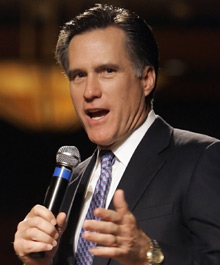
Former Massachusetts Governor Mitt Romney will be running for the Republican nomination for President in 2008. Will his Mormon faith be a problem for him, particularly among Southern evangelicals, who wield a great amount of power in the G.O.P. today? Some commentators seem to think so. Many evangelicals consider Mormonism to be a cult. Romney appears to be taking steps to try to get out in front of this as early as he can.

Maybe he’s trying to take a page out of the playbook of John F. Kennedy, who made a speech before the Greater Houston Ministerial Association during his 1960 presidential run, and endured a grilling in a lengthy Q & A session from the assembled ministers afterwards, re-assuring them that they they didn’t need to worry about him taking marching orders from the Pope. He wasn’t exactly grovelling either though...
I believe in an America that is officially neither Catholic, Protestant nor Jewish--where no public official either requests or accepts instructions on public policy from the Pope, the National Council of Churches or any other ecclesiastical source--where no religious body seeks to impose its will directly or indirectly upon the general populace or the public acts of its officials--and where religious liberty is so indivisible that an act against one church is treated as an act against all.

For while this year it may be a Catholic against whom the finger of suspicion is pointed, in other years it has been, and may someday be again, a Jew--or a Quaker--or a Unitarian--or a Baptist. It was Virginia's harassment of Baptist preachers, for example, that helped lead to Jefferson's statute of religious freedom. Today I may be the victim--but tomorrow it may be you--until the whole fabric of our harmonious society is ripped at a time of great national peril.

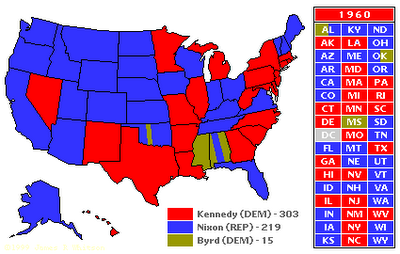
He seemed to assuage their concerns for the most part. Even so, the electoral map of the 1960 results shows that Kennedy did not do quite as well in the South as Democrats traditionally did back in those days.

Romneys’ case is going to be different from Kennedy’s case with Catholicism, because the Catholic question was loaded with all kinds of questions regarding the separation of Church and State that don’t quite apply the same way here. Still, Romney might face a bigger challenge, because Kennedy could count on strong Catholic support in the Northeast and Midwest in 1960, whereas Romney’s religious base is going to be narrower than Kennedy’s was.

I’m from Massachusetts, so I’m familiar with Romney and the Republican governors before him… 16 years of Republican governors getting bored and losing interest in the job before they were done.... I’ll tell you straight out that I don’t care for him much, and it doesn’t have anything to do with Mormonism. Like many others, I consider him a carpetbagger, an opportunist, a flip-flopper, and a corporate downsizing schill. He didn’t look at this state as much more than a stepping stone in his larger ambitions, and is now making hay out of ridiculing it.

Years ago, shortly after Romney was defeated in his senatorial bid vs. Ted Kennedy, I was in my auto mechanic’s shop when I ran into an old schoolmate of mine, Bob Marsh. At the time, Bob was a young Republican political operative who had run Romney’s election campaign against Kennedy. We talked a bit about the race, and I expressed my surprise that as a Mormon, Romney had run for the Senate with a Pro-Choice position. He was trying to unseat Ted Kennedy using the Bill Weld, libertarian, socially-liberal-fiscally-conservative type of gambit. Bob told me bluntly, “No candidate with a Pro-Life stance could ever possibly win a Senate race in Massachusetts.” I remember thinking to myself, “That’s probably true, but on the other hand, if you run a Democrat against a Democrat, the Democrat is going to win every time.”

Mitt has since shed his Pro-Choice position, flipping now to say that he is Pro-Life, and he is weighing in on the whole gay-marriage thing too, in order to prove his socially conservative bona fides to Southerners. Will it work? I don’t know. I remember when Pat Buchanan came flying out of New Hampshire with a primary win in 1996 only to land with a thud in Bob Jones’ South Carolina. Buchanan, a Catholic, was everything the Christian Coalition could ever ask for in terms of a socially conservative candidate, but it didn’t matter. They broke for Bob Dole, of all people. Hey, who knows? As far as voters are concerned in presidential runs, maybe Mormons are one thing and Catholics are still something else altogether.

Saturday, February 03, 2007

Molly Ivins 1944-2007


I honestly don't know if I ever read any of her columns, but I like this quote:

The trouble with blaming powerless people is that although it's not nearly as scary as blaming the powerful, it does miss the point.

Friday, February 02, 2007

"Will no one rid me of this meddlesome priest?"

-- King Henry II, referring to the Archbishop of Canterbury, Thomas à Becket


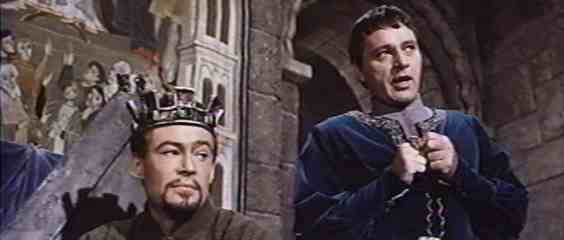
Apparently, the aging acting legend Peter O’Toole is up for an Oscar nomination for his role in the 2006 movie Venus. In what looks like an effort to boost his prospects, it has been reported that the 1964 movie Becket is being re-released in US theaters. In that film Peter O’Toole plays King Henry II and Richard Burton plays his sometimes drinking buddy, sometimes principled antagonist, the Archbishop of Canterbury, St. Thomas Becket (also known as Thomas à Becket). It’s kind of a Henry VIII / St. Thomas More kind of deal. It doesn’t end well for old Thomas in either case...

I’ve never seen this film. I’ve considered it many times at the local video store, but I’ve always put it off. Now that it’s going to be in the theaters, it might be a good time to go, because it sounds like one of those movies you really want to see on the big screen. They say this movie shows O’Toole and Burton at the top of their respective games, which makes it worth it to go and see for that reason alone. There is an audio NPR segment on the re-release here.

Speaking of Peter O’Toole and the big wide screen…. My brother still likes to needle me in front of people for getting us both thrown out of a theater for making too much noise when we went to go see Lawrence of Arabia when it first came out. Not surprising really, considering it was over 3 and ½ hours long and I was 4 flippin’ years old. Come on, Jackie, cut me some slack….

Thursday, February 01, 2007

Four Marines and a Sailor

One thing about getting to be my age – You start seeing the children of friends, family, and acquaintances reaching the age of eligibility for military service.

Listed below are the names of four young men entering the Marine Corps and one entering the Navy. All of them are fine young men of high ideals, abilities, and prospects without a hint of sadistic motive within them, who have decided for one reason or another to enter military service at this difficult time in our history. A couple of them I’ve known since they were little children; one of them before he was even born. It feels like yesterday. I have three sons of my own, the oldest being 10, and this is very sobering for me…

I can tell you that they all come from wonderful, faith-filled families. You couldn’t even say that there was anything in particular in their upbringing that would point them in this direction. In a couple of cases, I would have even guessed the opposite.

Whether a reader here is opposed to the war or supportive of it, whether one is a pacifist or a pragmatist, I hope you will join me in praying for their safe return home, their ability to stay true to their ideals and consciences, and for their loving families as they endure their absence.

Pfc. Frederick K...., Jr.- Will be deployed to Anbar Province, Iraq on February 5, 2007

Pfc. Conor S... – Awaiting deployment to Iraq

2nd Lieutentant Michael G.... - Graduate, NROTC Virginia Tech – Awaiting deployment to Iraq.

Lawrence S...., Jr – Sophomore, NROTC University of Notre Dame

Ensign Thomas H.... – Graduate, NROTC M.I.T. – Deployed to Persian Gulf on January 21, 2007

Semper Fidelis and Godspeed...

Saturday, January 27, 2007

In Praise of Simple Piety


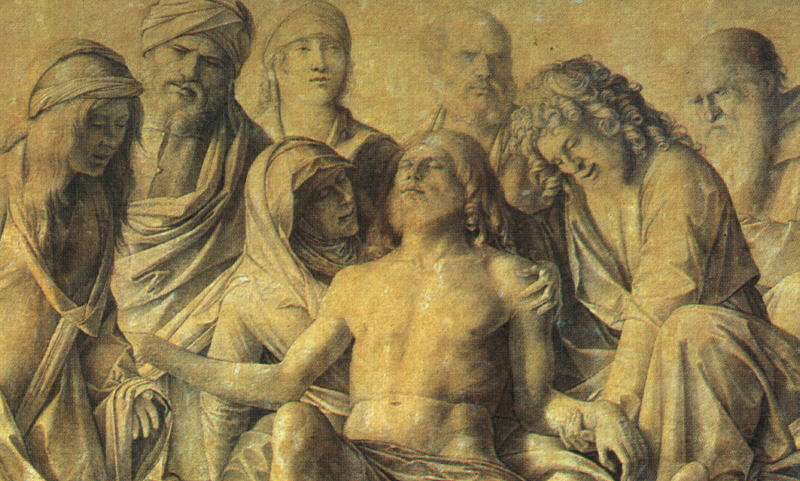
The Lamentation over the Body of Christ by Giovanni Bellini, c. 1480-1500

When the sex abuse scandal broke upon the Church in Boston five years ago, falling on us like a mighty wave, the pastor of my parish invited people to gather together and feel free to vent and to talk about it. Those sessions led to the birth of the VOTF, which was formed at that very same parish. I know a lot of the founders. I've worked in parish ministries with quite a few of them. They are very good people, and for them, the formation of a group that would really work to put survivors first was a paramount concern. They are to be lauded for working closely in the healing process with many of the survivors of clerical sexual abuse to this very day. In addition, there was a issue of credibility at stake. These are people who love the Church and want to be able to look their children and grandchildren in the eye and say that they tried to do something about this... that they just didn't roll over and say that everything is going to be fine.... That they did do everything they could to make sure that children were going to be safe. They are still demanding accountability on the part of the bishops, because as we've seen, things can all too easily fall back into the status quo if nothing is done to challenge them.

In July of 2002 the VOTF held their first annual convention at the Hynes Auditorium in Boston and were pleased and very proud to have over 4,200 people attend, especially in light of the fact that the group was only a few months old.

Something instructive, however, happened almost exactly a year later. Someone noticed what looked like an image of the Virgin Mary on a window at Milton Hospital and over 25,000 people showed up over the next few weeks to take note of it and to pray there.

Now, I have a profound love and appreciation for the BVM as many Catholics do, but like many of the the sophisticated, well-heeled suburbanites in the VOTF, I find this kind of Marian excessiveness commonly found within Catholic ranks to be embarassing and hard to defend or excuse.

On the other hand, is it really me who's missing something here, whether you can brand this as superstition or not? Milton Hospital eventually took over $14,000 in unsolicited contributions to the hospital left by the crowds and offered it as Gulf Coast hurricane relief, ironically, to the Salvation Army.

Most VOTF members tend towards the liberal and progressive side. I've been to enough of their meetings and heard enough emphasis being placed upon the necessity for women's ordination and so forth to know that is the case. That's fine, but this post really isn't about the VOTF... The point is this... The liberal critique is missing something vital. There is a need out there that is not being met. Pastoral associates, catechists, and liturgists don't always seem to have their finger on the pulse of what drives and motivates the spiritual life of a great many people.

In this column by Fr. Ron Rolheiser, he makes note of some observations made by the late Raymond Brown.
Those parishes and worshipping communities that most stress good theology and proper liturgy as a healthy corrective to privatized and devotional spirituality, often find they are losing parishioners to religious groups that stress a personal relationship to Jesus, that is, groups that come out of old-style Roman Catholic devotions or out of Protestant, "born-again" fundamentalism. Mainline pastors argue that this is not a healthy development and state, correctly, that liturgical worship should be the central piece to any ecclesiology and spirituality. But they are also learning communal worship alone, even when done with the greatest attention to proper ritual can lack something -- an accompanying personal spirituality.

Jesus needs a personal face and those conducting liturgy must help the community to know that face, otherwise liturgy alone leaves the community wanting for something. Brown goes on to suggest mainline Christians sometimes speak of "born-again Christians" pejoratively, suggesting that their stress on a privatized, salvific relationship to Jesus is not healthy. However, Brown suggests that the evangelist John might ask the mainline churches (and our liturgists and theologians) to be a little more sympathetic towards our devotionally-oriented and "born-again" siblings because, for John, Church membership alone is not a sufficient goal and liturgy is adequate only when it also helps effect a personal, affective relationship to Jesus.

Annie Dillard makes this comment: Sharing why she worshipped in a fundamentalistic, sectarian church (when her natural temperament was towards Roman Catholicism or high-church Protestantism) she replies: I go to that particular church because I like the minister. He actually believes what he preaches and when he says a prayer, he really means it."

Implied in that, sadly, is the comment that, in our high churches, that is not always so evident of those reading the word, leading the prayers, conducting the music and doing the preaching. I want to say this sympathetically, as Brown did, and yet not mute its challenge: For those of us who are "high church," either by temperament or denomination, it's too easy to look at the devotional stream within Roman Catholicism or the "low church" tradition within Protestantism and see it simply as "Jesus and I" spirituality, as excessively privatized, as seeking the wrong kind of security, as spiritually immature, as theological and liturgical backwater, and as deflecting people from the real centre, worship in liturgy.

In making such an assessment, partially, we are dangerously wrong, at least according to one New Testament writer.

In John's Gospel, ecclesiology and liturgy are subservient to the person of Jesus and a personal relationship to him. To teach this, John presents the image of "the beloved disciple," one who has a special intimacy with Jesus. For John, this intimacy outweighs everything else, including special service in the Church.

At the end of the day, Christianity must be about a real encounter with a person - the Divine Person of Jesus Christ.

Elsewhere, Rolheiser has written:
What is the Achilles heel in liberal Catholicism? One place where liberal Catholicism might want to do some self-scrutiny:

On our failure to inspire permanent, joyous religious commitment. Cardinal Francis George, speaking at a Commonweal magazine coloquium, said, "We are at a turning point in the life of the Church in this century. Liberal Catholicism is an exhausted project. Essentially a critique, even a necessary critique at one point in our history, it is now parasitical on a substance that no longer exists. It has shown itself unable to pass on the faith in its integrity and is inadequate, therefore, in fostering the joyful self-surrender called for in Christian marriage, in consecrated life, in ordained priesthood."

This is not a comment that goes down well with everyone, especially with those of us who have given the best part of our lives struggling to open our churches up to a healthier, less-fearful relationship with modernism, science, secularity, and the real moral progress these have helped to bring to the world.

But George's comment strikes at a particular painful area. For all of our work at spreading the democratic principle, highlighting the plight of the poor, working at eliminating racism, pushing for gender equality and furthering ecological sensitivity, we haven't been able to inspire our own children to follow us in the faith path. It's something we must examine ourselves on.

There may be something to that. At the turn of the Twentieth Century, Mainline Protestantism went through something similar. It put a heavy emphasis on the social gospel, probably right in doing so, but suffered from a fundamentalist backlash that has since thinned their ranks considerably.

One VOTF member remarked to my wife recently that the only people who seem to care about what they are trying to accomplish are over 60. There may be some truth in that. When I look at Catholic blogs, the traditionalist sites seem to outnumber the progressives by about 20 to 1. For Protestant sites, it looks similar to me. Young people are looking for what they regard as "authenticity". They are looking for people who appear to really mean what they say.

Columist Muriel Porter has a take on it that brings the effects of secularism into play here in her article Vulnerability of the post-Christian generation:
The mainstream churches wring their hands in despair, but some of the blame clearly belongs with them. While the lives of women in particular and families in general have changed dramatically since the 1960s, the churches by and large have failed to listen, let alone lead.

The Catholic Church's blanket ban on artificial contraception, the Anglican Church's hard-fought but only piecemeal concessions to female equality, all the churches' resistance both to more fluid family structures and to homosexual partnerships, have combined to give Christianity a gloomy, life-denying, out-of-touch image. There has been no great temptation for secular people to seek the God the Christian churches preach.

Our secular society's addiction to consumerism, gambling and large-scale debt comes at a high price. The statistics on suicide, depression, family break-up and dysfunction all indicate deep, long-term insecurity and unhappiness.
When disillusionment sets in, people often long for a spiritual dimension in their lives, and so become easy prey for fundamentalist Christian groups with their slick marketing techniques and pseudo-contemporary, music-focused programs. With no religious background to provide the tools for discernment, they are readily swayed by the clear certainties and the harsh take-it-or-leave-it morality preached by charismatic authoritarian male church leaders.

It is no coincidence that the Pentecostal churches and the fundamentalist sections of mainstream churches are drawing large numbers of converts from the very generations who missed out on even a rudimentary Christian education - people ranging from teenagers to the early middle-aged. For a sizeable proportion of these young converts, however, disillusionment will inevitably set in once more. They will eventually chafe under the uncompromising ... teaching and reject it completely. But without an earlier religious background to provide perspective and suggest alternative approaches, they will reject all of Christianity with it. A bitter cynicism and deeper malaise will result.

And there is another sad result of secularisation. A culture without a religious story is fragile and rudderless when it comes to death. People with a residual belief in God but no coherent religious framework are often left floundering when tragedy strikes. Without familiar holy places, they resort to making shrines of the actual sites of death. Homely memorials now dot our highways, or the sites of suicides. Memorial plaques speak vaguely of God, but lack the hope and peace that earlier generations - ironically much more deeply affected by sudden and tragic family deaths - drew from their faith.

As a case in point, look a the number of Latin Americans who have left the Catholic Church for Pentecostalism in recent decades. The New York Times recently ran a four-part series on it. All too often, nominal, cultural, half-catechized Latin American Catholics have been lured away, and why should it be surpising? Who can blame them? We've failed them horribly, particularly by insisting on worshipping at the altar of mandatory priestly celibacy. They have not left because the Catholic Church is too conservative or inflexible. They have left for a faith that is far, far more conservative. A faith that makes it very clear what is expected of them with simple, uncomplicated doctrines. For those who were once gangbangers, addicts or alcoholics wearing a gold crucifix for no apparent reason, their new faith has challenged them to straighten out their lives, recover their dignity and self respect, and to spread that to others. In one of the New York Times articles, we read about the family of a convert named Mr Romero:
His wife, Esperanza, took longer to let go of her Roman Catholicism, particularly the room she had filled with statues of saints — worthless idols, according to Pentecostals, who believe that people should pray directly to God. Mr. Romero persuaded his wife that the statues had to go.

“I went in that room with a hammer, and I broke every saint that was there,” he recalled. “I smashed a table, a fountain full of water, an expensive one. I broke it all. I tied it up in a bag and tossed it in the farthest dump.”

He paused at the memory. “And nothing happened to me.”

What kind of folk religion taught him that something was supposed to happen to him for smashing plaster statues?

I'm not advocating that we respond by becoming as fundamentalist as those who would prosletyse us. What I am saying is that perhaps some of us of a progressive bent have become too clever for our own good, that some of our knowledge-seeking can be for adornment, and that maybe we should do a better job of respecting the simple (healthy) piety around us - to recognize the real human need for Christ that lies in depths of the hearts of all of us, and commonly manifests itself in ways that don't require a PhD. We shouldn't write if off as "adolescent faith." Nature hates a vacuum, and so does the universe of faith. If we don't show that proper respect and appreciation, then superstition and syncretism can be one risk we run and fundamentalism the other.

Thursday, January 25, 2007

Vintage Clapton

DEREK AND THE DOMINOES ON JOHNNY CASH SHOW


Normally I’m not much of a fan of Country Music, but if you throw Eric Clapton into the mix, well, that’s a different story. I’m a huge aficionado.

Another Youtube video on a blog… I know, I know… But I thought that this particular one was a real gem. I was kicking around looking for old videos of Eric Clapton and I ran across this one of his star-crossed and ultimately tragic band Derek and the Dominos performing on the Johnny Cash Show in January of 1971.

The video runs about seven and a half minutes, covering two songs. The first song is just Clapton and his band playing It’s Too Late, followed by Johnny Cash and guitar-great Carl Perkins joining Clapton on stage for a cover of Matchbox. Great stuff. I’m thinking that Eric is looking and sounding very well here, just before the guilty and lovelorn guy (in torment over Patty Boyd, the wife of his best friend George Harrison) got completely caught up in smack and fell off of the world for a few years. I hate what the scourge of drugs did to that whole generation. How Clapton has been able to survive and keep all of his marbles with all of the things he’s abused himself with over the years is a complete mystery to me.

A couple of other old videos of Clapton worth mentioning, if you’re into this sort of thing…

This video shows the ad-hoc group ‘Dirty Mac’, comprised of Eric Clapton (Cream), John Lennon (Beatles), Keith Richards (Rolling Stones) and Mitch Mitchell (Jimi Hendrix Experience) playing Lennon’s song Yer Blues on the Rolling Stones Rock and Roll Circus, which was filmed in 1968. If you can get past the droll intro by John Lennon and Mick Jagger (a jealous Jagger is just loathing Lennon here), and the dark despairing lyrics of the song itself, the second half is just a terrific jam. There is a second part to that jam, but Yoko Ono got up on stage and started caterwauling and screaming, which just ruined it.

This video shows shows the sixties supergroup Cream (Eric Clapton, Jack Bruce, Ginger Baker) playing Crossroads in concert in 1968. Poor quality footage, but it sounds very good. That’s a lot of music coming out of three guys.

Monday, January 22, 2007

Catching Up On Old Correspondence III: 02/18/03

The current administration has gotten into the habit lately of saying that the Iraq War really wasn't about weapons of mass destruction or links to Al Qaeda, and that it never sold the war that way to the American public... I know that isn't true, because I've got some of my own correspondence from the time just before the war was launched that is reflective of how those were exactly the terms upon which the war was sold.

Cleaning up a few old files on my computer, I came across the draft of a letter I had written to my good friend Joseph in Spain right on the eve of the war, on 02/18/03. I'm going to do what a lot of people are unwilling to do, which is to show how I was wrong at the time... how I'd bitten on the administration's story hook, line, and sinker... Joseph was strongly against the notion of going to war, and I was trying to make a case, albeit a conflicted one.

Joe, I don’t know what the answer is on this Iraq thing. I’m in a real muddle about it. I can’t remember the last time I was so conflicted on an issue. One of the saddest things for me is how different our perceptions here seem to be from Europe’s, and indeed, the rest of the world. As the world’s sole remaining superpower, I’ve been wondering for some time if economic and political differences would start to manifest themselves as military differences. It is disconcerting to see us becoming so increasingly isolated, especially in the wake of September 11th. Are we the biggest threat to world peace in the eyes of other countries? That is a troubling notion. NATO seems to be falling apart. Will the new European Union Defense Force replace it? The way I see the situation is like this:

Saddam Hussein in no Islamic fundamentalist. He has modeled his whole life and modus operandi after Josef Stalin. I don’t truly believe he hates the United States. In fact, what I think he’d love to do is sell us oil after he becomes the undisputed (secular) leader of the Arab world. I’m sure he’s developing weapons of mass destruction, but is the target the US? I’m more inclined to think it is the Saudis, Kuwaitis, and ultimately the Israelis. I have a tough time imagining a control freak like him giving up some of those weapons to be used by a group like Al-Qaeda, who mean him no good will, and would likely act in unpredictable ways that he’d have no control over. The odious regime in Saudi Arabia, with its funding of Wahabi madrasas all over the Islamic world, are bigger sponsors of terrorism than he is. Is there a personal vendetta between Saddam and the Bush family? I think you’d have to say there is. I’ve no doubt that there is a real threat to stability in the region with him having these weapons. I can’t help but wonder sometimes, however, if there is some French company currently getting business that an American oil company would like to get their hands on. Are multinational corporations working across global boundaries, dismantling American industries one by one and undermining the governments of nation-states everywhere? You betcha yesiree Bob they are…. Then again, Bush, Powell, Rumsfeld and Cheney may be right about all of this(more on that later).

As for Europe, well… I have no problem with Germany’s stance. They should be pacifists – forever. God forbid they should be otherwise. No need for them to rev up their tank engines. Bad things follow when they do.

As for the French and Belgians, that is a somewhat different matter. In some strange way they may be doing America a favor by trying to force us to live up to our stated ideals. Launching a pre-emptive strike against another sovereign country would certainly be something new in our history. Crossing that Rubicon would be out of character for us, which gives me some pause. The problem with the French is that they haven’t had the sensitivity to put the question and the challenge to us in those terms. They arrogantly play a brand of realpolitik that only smacks of appeasement. They should drop the “Bush is a cowboy” rhetoric and challenge us to act like the “Beacon of Freedom” in the world that they’ve known us to be in the past. Instead the French and Belgians have people here wondering if we should dig up the war graves of our boys in Normandy and Bastogne and bring them home. They could be a tad more grateful about us bailing them out…twice.

I’m fair enough to say that most of the European reaction is principled. They know the horrors of war better than we do, although they should have learned something about the dangers of appeasement too. The only thing about it that bothers me is the undertone of anti-Semitism I see in some of it, disguised as solidarity with the plight of the Palestinians. Granted, Sharon is a war criminal. Yes, the Israelis have made a lot of trouble for themselves with their settling in the occupied territories. The fact remains, though, that they have the right to exist. In my opinion, it is also a fact that the only places in the world where Jews are truly allowed to live as Jews are the United States and Israel. Europe has forgotten too quickly their complicity in what happened to the Jews, and a generation has gone by without an appreciable number of Jews in their midst. They don’t understand them and hold antiquated ideas about who they are. Feel free to correct me if I’m wrong about this.

One thing I don’t think Europeans realize is the effect of September 11th on the American psyche. People here are unsettled and fearful over that and a number of other things. I know Europe has suffered through terrorism for decades. I don’t know how many lives the ETA campaign has taken. The conflict in Northern Ireland claimed 3,000 lives in thirty years. The September 11th attack took that many lives in a couple of hours. Someone could point out that per capita, the Northern Ireland conflict has had a much greater impact on that population. I would respond that “per capita”, September 11th had a similar impact isolated to northern New Jersey, Queens, Westchester county and Boston. In the wake of that we had a number of trusted institutions fail us – the Church, corporations. The economy has gone into the tank. This, following on the heels of the prosperous 90’s, has people pretty unsettled.

You are absolutely correct when you point out that Christianity, true Christianity, is pacifistic. There can be no other way for the real Christian. Love is the only way to conquer hate. I buy into that. I really do believe in it. We did not deserve what happened on September 11th , but between just you and me, we did contribute in bringing it upon ourselves by ignoring all the red flags. We’ve meddled in the affairs in other countries. We’ve supported autocratic regimes in the Middle East. We’ve made it clear that we couldn’t care less what happens to Arabs as long as cheap oil keeps flowing. We’ve wreaked havoc on the world by foisting this globalization of the world’s economy down everyone’s throats, whether they like it or not. We’ve launched saturation marketing campaigns pushing our crass, moronic popular culture upon traditional, conservative societies. I’d rather see us stop ALL of that rather than go to war. On the other hand – I’m a father of five little children who look to me to keep them safe. My government tells me Iraq is building weapons of mass destruction and is in league with Al-Qaeda. Al-Qaeda is committed to our destruction. They’ve proven that. Do I have to take my government and Al-Qaeda at their word, respectively? For the sake of my kids, maybe I do. A nuke can be brought all to easily in our shores in a container ship. Boston is a coastal city.

I don’t know what the answer is. As you can see, I’m torn. God help us if we attack Iraq and they don’t have these weapons. God help the Europeans if they force us to back off, and some bright, sunny September morning, several American cities vanish all at once. ..
I can tell you how I desperately want to live - with Christ at the center, and love should be my Life Principle.

Saturday, January 20, 2007

Five things you perhaps do not know about me

The memes keep coming. Liam, who announced on his list that he is getting married (congrats to him), has tagged me for the Five things you perhaps do not know about me meme. So here goes...

1. I was a wrestler in High School. Grrrr. Not as long, though, as I would have liked to have been. I was one of those "woulda been, coulda been, shoulda been" kind of stories. My coach was very high on me but my parents hated the fact that I was dieting and working out for hours in a rubber suit in order to cut my weight down to 114 lbs for every match. When I pulled a ligament in my shoulder, they put their foot down and that was pretty much it for my wrestling career. Thirty years later that shoulder still bothers me if I don't exercise it... Freestyle wrestling might look boring to some viewers, but it is intense and exhausting. It's about as demanding and complete a sport as there is. To be any good at all you need strength, speed, quickness, agility, endurance, intelligence, a high tolerance for pain, self-motivation, determination, aggressiveness, and guts. The best wrestlers have 'em all in spades.

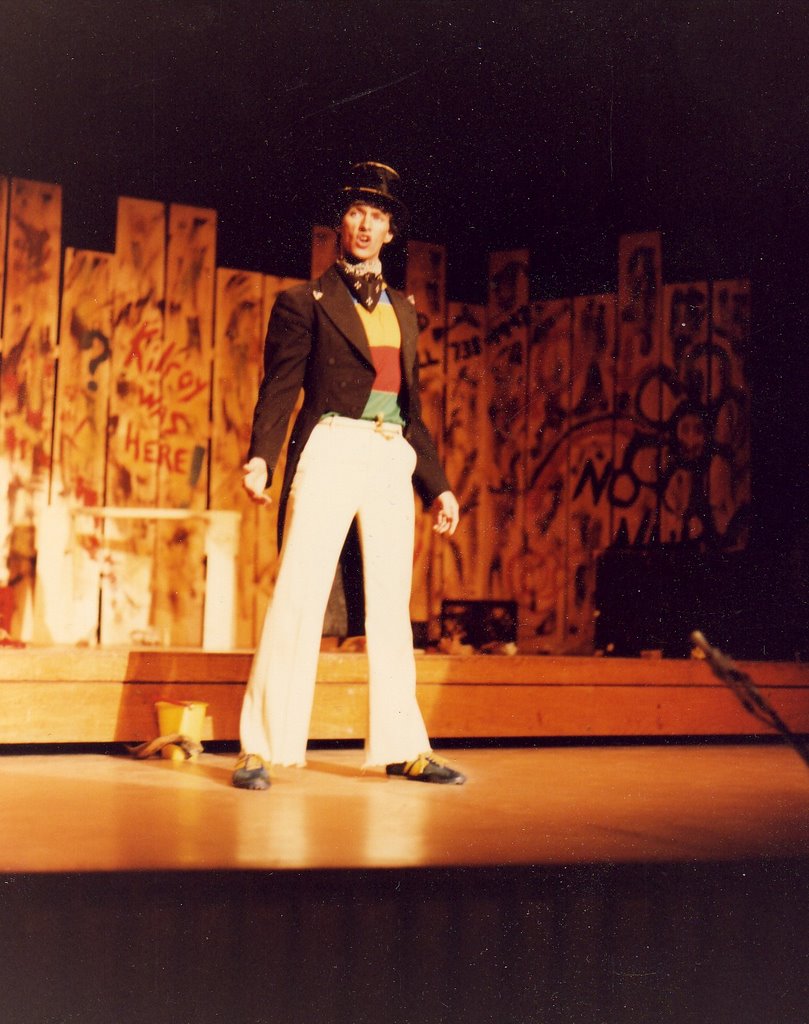
2. Like Liam, I enjoy acting too. I'm one of those shy and quiet people who tends to come alive on stage. In this photo I'm playing Nathan Detroit (center) in Guys and Dolls. I've been in somewhat avante garde plays like The Real Inspector Hound by Tom Stoppard and The Bald Soprano by Eugene Ionesco, but I've been in far more musical productions even though I can't sing for beans. I just moxied my way through them and tended to stick to character roles. Someday I'd like to get back into it... maybe when the kids are a bit older. I've always wanted to do a Shakespeare play, maybe I'll take a shot at that.

Playing the John the Baptist/Judas Iscariot role in Godspell. I've played this role in Godspell in three different productions. My friend Joe played Jesus in all three of them. What does that tell ya? I'm always the heavy.. . In this particular production I needed to open the number Prepare Ye (The Way of the Lord) with a trumpet blast on the shofar, but I could never figure out how to get a proper sound out of that thing. I sort of "tooted" through it instead. It sounded ridiculous. I'd say it was the most embarassing moment of my life, but you know, there have been so many, so many other incidents that can compete for that...

3. I despise seafood. I hate fish, of all kinds. That goes for clams, mussels, lobster, shrimp, scallops, and anything else that comes out of the ocean. If it's from the sea, it ain't for me. When Anne and I went to Nantucket together for the first time so that I could meet her family, she told me on the boat on the way over that she had reminded her mother that I didn't like fish, and that her mother was preparing a chicken plate for me while everyone else was going to be eating fish for dinner. When I got there, her mother plopped a great big scaly, silvery-grayish plate of grilled bluefish right down in front of me. Anne and her brothers grinned at me wickedly. I ate it with zest and a smile. It might have been the best acting performance of my life. Oh, the things we do for love. I even laughed at her father's Italian jokes over dinner, and I was very gracious several hours later when he belatedly decided it might be a good idea to ask me if I was part Italian (I am).


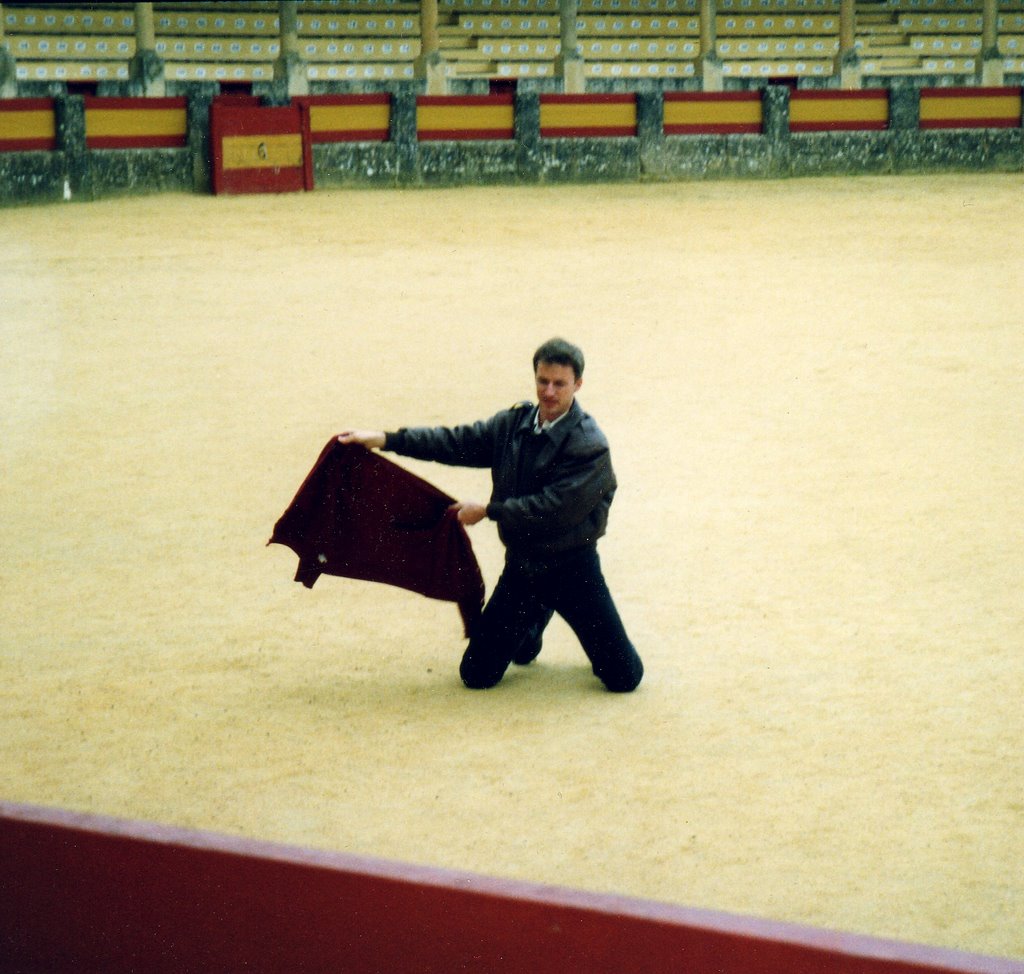
4. I am an internationally renowned Torero... shown here executing a flawless kneeling veronica at the Plaza de Toros in Ronda, Spain.
Well, no, I'm not a bullfighter, just a bullslinger. The most intimidating creature I faced in Ronda was a large beetle I unexpectedly encountered in a sandwich. I have been to Spain (twice), Ireland (twice), Portugal, Italy, and England. Within the U.S., however, I have never been south of Alexandria, Virginia. Outside of airports, I have never been west of Darlington, Wisconsin (unless you count Hawaii). On this continent, I have never been north of Parry Sound, Ontario.

I am a member of Zeta Beta Tau (Delta Omega Chapter). ZBT is a non-sectarian social fraternity. I still know my Greek alphabet forwards and backwards. ZBT's motto - "A Powerhouse of Excellence". I didn't keep up with much of this stuff after college, although my brothers and I still do use the handshake when we run into each other. Look here to see who some of my extended brothers are.

By the way... all of those pictures of me with the dark hair? I don't look like that anymore. I've gone completely gray... you might even say white. I'm just an old guy now doing the Dad thing. :-)

I'm not sure who's still reading here... I'll tag Paula (even though she's still working Crystal's tag for another meme) and the Francsican lads - Minor Friar, Don, and Rashfriar.

Saturday, January 13, 2007

Contemporary Theology Meme

Crystal has tagged me for a Best Contemporary Theology Meme. What are you trying to do Crystal, get me in trouble with the CDF or my local bishop by exposing me for having read materials that would probably be on the Index of Forbidden Books? ;-) Is there still an Index of Forbidden Books...?

As I mentioned to Crystal in one of the threads below, I haven’t been reading much current speculative theology. My reading about religion tends to center around spiritual reading, history, scripture, doctrine & apologetics, and biblical scholarship. It seems to me that in the last 25 years, with the “Third Historical Jesus Quest” well underway, that the biblical scholars have had a bigger influence on the public consciousness than theologians in any case.

If you were to ask me who my favorite Catholic Theologians of the 20th century were, I’d probably list Yves Congar, Henri de Lubac, John Courtney Murray, and Karl Rahner, all of who published the great bulk of their work more than 25 years ago, and here lies a problem... The current relationship between Catholic theologians and the Roman Curia is probably as bad and as wide apart now at this point in history as it ever has been. Ever since theologians like Kung, Schillebeeckx, Boff and Curran have been investigated, censured or silenced, there has been a sort of damper put on speculative theology. The last two popes have been decent theologians in their own right, with Joseph Ratzinger being a first-rate theologian, but in my view, the role of the pope is not to be the theologian-in-chief of the Church. That, of course, is a whole topic for discussion in and of itself. I suppose there certainly are theologians within the Catholic tradition to study, like Hans Urs Von Balthasar, John Shea and John Fisher… I’ve been reminding myself that I need to take the time to read The Analogical Imagination by David Tracy, which is highly regarded.

As far as progressive Protestant theologians are concerned, I confess I am woefully ignorant beyond Marcus Borg and John Shelby Spong, and it appears to me that “retro” reformed theology seems to be very much in vogue with evangelicals these days, with popular works for the mass market by R.C. Sproul, John MacArthur, Hank Hanegraaff, Norman Geisler, J.I. Packer, Robert Reymond, and so forth, taking precedence.

So having said all that, I’ll list a few books, which in my lowly and under-educated opinion I consider to have been very important over the last 25 years.


Paul and Palestinian Judaism by E.P. Sanders 1977

I’m going to cheat a little bit and go back almost 30 years instead of 25. I think Sanders’ book may have been one of the most important books to come out regarding Christian origins in the last quarter of the twentieth century. Sanders’ work was mirrored around the same time by Krister Stendahl, and they were the primary influences on what would become the so-called New Perspective on Paul. (According to this link about Stendahl, in his essay The Apostle Paul and the Introspective Conscience of the West, he claimed “the quest of the plagued conscience began with Augustine whose Confessions are the first great document in the history of introspective conscience… and that prior to Augustine, the church had read Paul accurately in terms of the question, what does the Messiah's arrival mean for (a) the law (not legalism) and (b) the relationship between Jews and Gentiles? Since Augustine, the church has misread Paul in terms of the question, how can I find a gracious God?”)

Sanders was important because he was able to mount a challenge to what had been the prevailing view in Pauline scholarship for centuries. The prevailing scholarship until that time had St Paul presenting Judaism as a religion of works righteousness, in which a man tries to earn God's acceptance through works of piety and good deeds, and that the Law for them was something arid, burdensome, and a curse, because it could not be kept completely. The Jew becomes a metaphor for "the religious man" who is contrasted unfavorably to the Christian who relies fully upon the grace of God. Therefore, “good” Christianity was a religion of freedom and “bad” Judaism was a religion of legalism.

Sanders knew that this was a caricature, a straw man cutout of Judaism. He knew that for a 1st century Jew, the keeping of the law was not a means to earn salvation but to maintain oneself in the Covenant. Sanders called this Covenantal Nomism. The question for St. Paul, according to the New Perspective scholars, is not the fate of the individual sinner standing alone in judgement before God, but in corporate terms of Jews and Gentiles. Who’s in and who’s out? Who participates? The Jews were waiting for a redeemer, the Messiah. The Gentiles were beyond all hope. Christ came for both. The problem facing St. Paul and the early Church was how they were going to bring all of these Gentiles into what had been an exclusively Jewish movement. If he said that righteousness was from the Law, he would be excluding Gentiles, or at the very best, forever relegating them to second-class status. He knew that trying to force the Gentiles under the Law, which was foreign to them, and never meant for them, wasn't going to work. He knew that it would be inevitable that they would slide back into their pagan ways.

The New Perspective work has been followed up on in some fashion by other scholars such as James G. Dunn, John Gager, N.T. Wright, James Carroll, and Brendon Byrne. I think that the New Perspective on Paul has great ecumenical possibilities for discussion between Catholics and Protestants, particularly around the thorny question of St. Paul’s doctrine on Justification, which has historically most divided us.

More importantly, the New Perspective had aided theologians and also the “Third Historical Quest” in underscoring the essential Jewishness of Jesus and the Apostles. The sensitive treatment of Judaism by the New Perspective scholars has also created a climate in which Jewish scholars have finally felt that they can enter into an irenic discussion with Christians about Jesus and Christianity. Jewish scholars such as Geza Vermes, Amy Jill-Levine, Daniel Boyarin, Alan Segal and others, have written fascinating books about their take on the New Testament (see more on that below).

The Non-Violent Atonement by J. Denny Weaver 2001

I confess that I have not actually read this book by this Mennonite scholar , but have only read about it. I’ve listed it because the topic is important and compelling for me, and the idea is overdue. It is an attempt, as the title aptly states, to look beyond a violent meaning of the atonement (such as in the Satisfaction and Substitutionary model), and to look to see if a modified version of Christus Victor makes more sense.

We Drink From Our Own Wells by Gustavo Gutierrez 1984

Yeah, I like Liberation Theology. Want to make something out it? I believe that someday it will be vindicated. While I’m at it, what the heck, why not…? Introducing Liberation Theology by Leonardo Boff and Clovodis Boff 1987

A Church That Can and Cannot Change by John T. Noonan 2005

John T Noonan is a Catholic layman who is a judge on the US Federal Court of Appeals 9th Circuit, and the founder of the journal Natural Law Forum. He has also extensively studied and written about the history of Catholic moral teaching. Back in the sixties he wrote the definitive landmark study on the history of Church teaching on Contraception, from the 2nd century to the 20th. In this book he grapples with the question – Does change happen in Catholic moral teaching, and if it does, how does it happen? When is it valid change and when it invalid? The three issues he focuses on in the book are Church teachings on slavery, usury, and religious freedom. He answers in the affirmative that moral teachings can in fact change. The book does have its critics. His conclusions have been challenged in a respectful manner by Cardinal Avery Dulles, no lightweight himself.

Challenging books I recommend to others to read

I’ve always liked to read material that challenges my beliefs, as long as they are presented in a respectful way.

Quite a few writers over the last few years have built some up recognition and even fame by knocking over flimsy things like The Da Vinci Code, and slightly more challenging Gnostic things like The Gospel of Thomas, The Gospel of Judas, The Gospel of Mary Magdalene, The Gospel of… whoever… In their apologetics, I have rarely seen anyone, with the possible exception of Ben Witherington, who takes on the more challenging material out there… the challenge form the quarter that always has been and always will be the most pointed and profound… As noted above, there have been several excellent Jewish scholars who have written about Jesus and the New Testament in recent years. The relationship between Jews and Christians throughout history has been long, bitter, and tragic, and I applaud that we live in an age when these scholars can feel free to present their cases in respectful dialogue with Christian scholars without opprobrium.

I hold to Nicene orthodoxy and to the Creed. Although I differ with them on the Incarnation and on the Divinity of Jesus Christ, I find that these scholars make their cases with honesty and conviction, excellent scholarship (as far as I can tell with my untrained eyes, admittedly), and in a spirit of irenicism and respect for Christian sensitivities and beliefs. We may not agree with their narrative, but is not a nonsensical or illogical narrative like the Da Vinci Code pottage. It has coherence. Even though I disagree with their ultimate conclusions, I think there is much benefit that Christians can take from reading them. To recapture the Jewishness of Jesus is accurate and essential, and I think I learned something new, and gained valuable insights about Jesus in ways that I had never thought of before from each of them.

The Authentic Gospel of Jesus and The Changing Faces of Jesus by Geza Vermes

Geza Vermes is recognized as the world’s foremost authority on the Dead Sea Scrolls. He was born to Jewish parents who perished in the Holocaust. He was raised by Catholic foster parents and entered the priesthood, joining an order whose mission was to convert Jews. After studying the Dead Sea Scrolls, the Mishnah, the Talmud, and other Rabbinic writings, he reverted back to Judaism. In the Authentic Gospel.. he offers commentary and exegesis on all of the words spoken by Jesus in the Synoptic Gospels, in the way they would have been understood in Aramaic within his own culture. In The Changing Faces of Jesus, he works backward from the Gospel of John to the other Gospels and the writings of St. Paul to examine how Jesus would have been interpreted in each book in it’s own time. To Vermes, Jesus was a Galilean Holy Man, exorcist, healer and Hasid who was crucified for causing a disturbance (cleansing) in the Temple.

From Jesus to Christ and Jesus of Nazareth, King of the Jews by Paula Fredriksen

To Paula Fredriksen, interpreting Jesus properly is a matter of What You See Is What You Get… Jesus was an apocalyptic prophet proclaiming the imminent coming of the Kingdom of God who was executed by the Romans for being what they considered he and his followers were claiming him to be – The King of The Jews. In the linked article, Fredriksen does a pretty good job of explaining and critiquing the other historical Jesus scholars as well.

The Jesus Dynasty by James Tabor

James Tabor isn’t Jewish, but in his book he makes the case that the apocalyptic writings in Isaiah and Daniel indicate that Jesus and John the Baptist saw themselves as twin messiahs described in those texts, with Jesus being the royal Davidic Messiah, and John being the priestly Aaronic Messiah. He goes into a bit of speculation on the meaning of some ossuary finds he made with his students, and on the paternal ancestry of Jesus, but to me the most valuable thing in his book is his continuation of a recent trend to start recovering the forgotten man of the early Church – James the Just. According to Tabor and some others, Jesus’ “brother” James, the Bishop of the Jerusalem Church, was the royal successor to Jesus in this messianic dynasty, and his role was diminished and underplayed when the Pauline (Gentile) wing of the Church won out over the Jamesian (Jewish) wing.

What Jesus Meant by Garry Wills

This one is a tract, really. It’s very short, you can get through it in an evening or two. Wills, the bete noir of Catholic conservatives, takes his rips at the hierarchy as usual, but there is much in this book that is interesting and valuable.

I won't tag anyone specifically. Anyone who who'd like to put up a list, please feel free...