Saturday, January 27, 2007

In Praise of Simple Piety


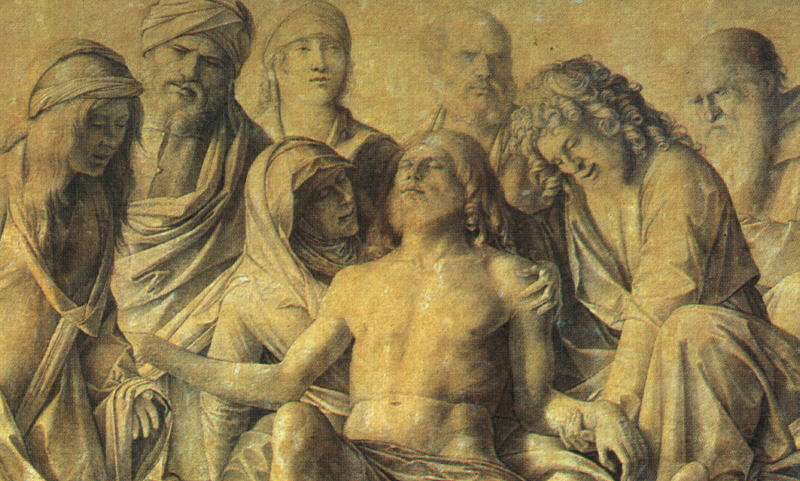
The Lamentation over the Body of Christ by Giovanni Bellini, c. 1480-1500

When the sex abuse scandal broke upon the Church in Boston five years ago, falling on us like a mighty wave, the pastor of my parish invited people to gather together and feel free to vent and to talk about it. Those sessions led to the birth of the VOTF, which was formed at that very same parish. I know a lot of the founders. I've worked in parish ministries with quite a few of them. They are very good people, and for them, the formation of a group that would really work to put survivors first was a paramount concern. They are to be lauded for working closely in the healing process with many of the survivors of clerical sexual abuse to this very day. In addition, there was a issue of credibility at stake. These are people who love the Church and want to be able to look their children and grandchildren in the eye and say that they tried to do something about this... that they just didn't roll over and say that everything is going to be fine.... That they did do everything they could to make sure that children were going to be safe. They are still demanding accountability on the part of the bishops, because as we've seen, things can all too easily fall back into the status quo if nothing is done to challenge them.

In July of 2002 the VOTF held their first annual convention at the Hynes Auditorium in Boston and were pleased and very proud to have over 4,200 people attend, especially in light of the fact that the group was only a few months old.

Something instructive, however, happened almost exactly a year later. Someone noticed what looked like an image of the Virgin Mary on a window at Milton Hospital and over 25,000 people showed up over the next few weeks to take note of it and to pray there.

Now, I have a profound love and appreciation for the BVM as many Catholics do, but like many of the the sophisticated, well-heeled suburbanites in the VOTF, I find this kind of Marian excessiveness commonly found within Catholic ranks to be embarassing and hard to defend or excuse.

On the other hand, is it really me who's missing something here, whether you can brand this as superstition or not? Milton Hospital eventually took over $14,000 in unsolicited contributions to the hospital left by the crowds and offered it as Gulf Coast hurricane relief, ironically, to the Salvation Army.

Most VOTF members tend towards the liberal and progressive side. I've been to enough of their meetings and heard enough emphasis being placed upon the necessity for women's ordination and so forth to know that is the case. That's fine, but this post really isn't about the VOTF... The point is this... The liberal critique is missing something vital. There is a need out there that is not being met. Pastoral associates, catechists, and liturgists don't always seem to have their finger on the pulse of what drives and motivates the spiritual life of a great many people.

In this column by Fr. Ron Rolheiser, he makes note of some observations made by the late Raymond Brown.
Those parishes and worshipping communities that most stress good theology and proper liturgy as a healthy corrective to privatized and devotional spirituality, often find they are losing parishioners to religious groups that stress a personal relationship to Jesus, that is, groups that come out of old-style Roman Catholic devotions or out of Protestant, "born-again" fundamentalism. Mainline pastors argue that this is not a healthy development and state, correctly, that liturgical worship should be the central piece to any ecclesiology and spirituality. But they are also learning communal worship alone, even when done with the greatest attention to proper ritual can lack something -- an accompanying personal spirituality.

Jesus needs a personal face and those conducting liturgy must help the community to know that face, otherwise liturgy alone leaves the community wanting for something. Brown goes on to suggest mainline Christians sometimes speak of "born-again Christians" pejoratively, suggesting that their stress on a privatized, salvific relationship to Jesus is not healthy. However, Brown suggests that the evangelist John might ask the mainline churches (and our liturgists and theologians) to be a little more sympathetic towards our devotionally-oriented and "born-again" siblings because, for John, Church membership alone is not a sufficient goal and liturgy is adequate only when it also helps effect a personal, affective relationship to Jesus.

Annie Dillard makes this comment: Sharing why she worshipped in a fundamentalistic, sectarian church (when her natural temperament was towards Roman Catholicism or high-church Protestantism) she replies: I go to that particular church because I like the minister. He actually believes what he preaches and when he says a prayer, he really means it."

Implied in that, sadly, is the comment that, in our high churches, that is not always so evident of those reading the word, leading the prayers, conducting the music and doing the preaching. I want to say this sympathetically, as Brown did, and yet not mute its challenge: For those of us who are "high church," either by temperament or denomination, it's too easy to look at the devotional stream within Roman Catholicism or the "low church" tradition within Protestantism and see it simply as "Jesus and I" spirituality, as excessively privatized, as seeking the wrong kind of security, as spiritually immature, as theological and liturgical backwater, and as deflecting people from the real centre, worship in liturgy.

In making such an assessment, partially, we are dangerously wrong, at least according to one New Testament writer.

In John's Gospel, ecclesiology and liturgy are subservient to the person of Jesus and a personal relationship to him. To teach this, John presents the image of "the beloved disciple," one who has a special intimacy with Jesus. For John, this intimacy outweighs everything else, including special service in the Church.

At the end of the day, Christianity must be about a real encounter with a person - the Divine Person of Jesus Christ.

Elsewhere, Rolheiser has written:
What is the Achilles heel in liberal Catholicism? One place where liberal Catholicism might want to do some self-scrutiny:

On our failure to inspire permanent, joyous religious commitment. Cardinal Francis George, speaking at a Commonweal magazine coloquium, said, "We are at a turning point in the life of the Church in this century. Liberal Catholicism is an exhausted project. Essentially a critique, even a necessary critique at one point in our history, it is now parasitical on a substance that no longer exists. It has shown itself unable to pass on the faith in its integrity and is inadequate, therefore, in fostering the joyful self-surrender called for in Christian marriage, in consecrated life, in ordained priesthood."

This is not a comment that goes down well with everyone, especially with those of us who have given the best part of our lives struggling to open our churches up to a healthier, less-fearful relationship with modernism, science, secularity, and the real moral progress these have helped to bring to the world.

But George's comment strikes at a particular painful area. For all of our work at spreading the democratic principle, highlighting the plight of the poor, working at eliminating racism, pushing for gender equality and furthering ecological sensitivity, we haven't been able to inspire our own children to follow us in the faith path. It's something we must examine ourselves on.

There may be something to that. At the turn of the Twentieth Century, Mainline Protestantism went through something similar. It put a heavy emphasis on the social gospel, probably right in doing so, but suffered from a fundamentalist backlash that has since thinned their ranks considerably.

One VOTF member remarked to my wife recently that the only people who seem to care about what they are trying to accomplish are over 60. There may be some truth in that. When I look at Catholic blogs, the traditionalist sites seem to outnumber the progressives by about 20 to 1. For Protestant sites, it looks similar to me. Young people are looking for what they regard as "authenticity". They are looking for people who appear to really mean what they say.

Columist Muriel Porter has a take on it that brings the effects of secularism into play here in her article Vulnerability of the post-Christian generation:
The mainstream churches wring their hands in despair, but some of the blame clearly belongs with them. While the lives of women in particular and families in general have changed dramatically since the 1960s, the churches by and large have failed to listen, let alone lead.

The Catholic Church's blanket ban on artificial contraception, the Anglican Church's hard-fought but only piecemeal concessions to female equality, all the churches' resistance both to more fluid family structures and to homosexual partnerships, have combined to give Christianity a gloomy, life-denying, out-of-touch image. There has been no great temptation for secular people to seek the God the Christian churches preach.

Our secular society's addiction to consumerism, gambling and large-scale debt comes at a high price. The statistics on suicide, depression, family break-up and dysfunction all indicate deep, long-term insecurity and unhappiness.
When disillusionment sets in, people often long for a spiritual dimension in their lives, and so become easy prey for fundamentalist Christian groups with their slick marketing techniques and pseudo-contemporary, music-focused programs. With no religious background to provide the tools for discernment, they are readily swayed by the clear certainties and the harsh take-it-or-leave-it morality preached by charismatic authoritarian male church leaders.

It is no coincidence that the Pentecostal churches and the fundamentalist sections of mainstream churches are drawing large numbers of converts from the very generations who missed out on even a rudimentary Christian education - people ranging from teenagers to the early middle-aged. For a sizeable proportion of these young converts, however, disillusionment will inevitably set in once more. They will eventually chafe under the uncompromising ... teaching and reject it completely. But without an earlier religious background to provide perspective and suggest alternative approaches, they will reject all of Christianity with it. A bitter cynicism and deeper malaise will result.

And there is another sad result of secularisation. A culture without a religious story is fragile and rudderless when it comes to death. People with a residual belief in God but no coherent religious framework are often left floundering when tragedy strikes. Without familiar holy places, they resort to making shrines of the actual sites of death. Homely memorials now dot our highways, or the sites of suicides. Memorial plaques speak vaguely of God, but lack the hope and peace that earlier generations - ironically much more deeply affected by sudden and tragic family deaths - drew from their faith.

As a case in point, look a the number of Latin Americans who have left the Catholic Church for Pentecostalism in recent decades. The New York Times recently ran a four-part series on it. All too often, nominal, cultural, half-catechized Latin American Catholics have been lured away, and why should it be surpising? Who can blame them? We've failed them horribly, particularly by insisting on worshipping at the altar of mandatory priestly celibacy. They have not left because the Catholic Church is too conservative or inflexible. They have left for a faith that is far, far more conservative. A faith that makes it very clear what is expected of them with simple, uncomplicated doctrines. For those who were once gangbangers, addicts or alcoholics wearing a gold crucifix for no apparent reason, their new faith has challenged them to straighten out their lives, recover their dignity and self respect, and to spread that to others. In one of the New York Times articles, we read about the family of a convert named Mr Romero:
His wife, Esperanza, took longer to let go of her Roman Catholicism, particularly the room she had filled with statues of saints — worthless idols, according to Pentecostals, who believe that people should pray directly to God. Mr. Romero persuaded his wife that the statues had to go.

“I went in that room with a hammer, and I broke every saint that was there,” he recalled. “I smashed a table, a fountain full of water, an expensive one. I broke it all. I tied it up in a bag and tossed it in the farthest dump.”

He paused at the memory. “And nothing happened to me.”

What kind of folk religion taught him that something was supposed to happen to him for smashing plaster statues?

I'm not advocating that we respond by becoming as fundamentalist as those who would prosletyse us. What I am saying is that perhaps some of us of a progressive bent have become too clever for our own good, that some of our knowledge-seeking can be for adornment, and that maybe we should do a better job of respecting the simple (healthy) piety around us - to recognize the real human need for Christ that lies in depths of the hearts of all of us, and commonly manifests itself in ways that don't require a PhD. We shouldn't write if off as "adolescent faith." Nature hates a vacuum, and so does the universe of faith. If we don't show that proper respect and appreciation, then superstition and syncretism can be one risk we run and fundamentalism the other.

Thursday, January 25, 2007

Vintage Clapton

DEREK AND THE DOMINOES ON JOHNNY CASH SHOW


Normally I’m not much of a fan of Country Music, but if you throw Eric Clapton into the mix, well, that’s a different story. I’m a huge aficionado.

Another Youtube video on a blog… I know, I know… But I thought that this particular one was a real gem. I was kicking around looking for old videos of Eric Clapton and I ran across this one of his star-crossed and ultimately tragic band Derek and the Dominos performing on the Johnny Cash Show in January of 1971.

The video runs about seven and a half minutes, covering two songs. The first song is just Clapton and his band playing It’s Too Late, followed by Johnny Cash and guitar-great Carl Perkins joining Clapton on stage for a cover of Matchbox. Great stuff. I’m thinking that Eric is looking and sounding very well here, just before the guilty and lovelorn guy (in torment over Patty Boyd, the wife of his best friend George Harrison) got completely caught up in smack and fell off of the world for a few years. I hate what the scourge of drugs did to that whole generation. How Clapton has been able to survive and keep all of his marbles with all of the things he’s abused himself with over the years is a complete mystery to me.

A couple of other old videos of Clapton worth mentioning, if you’re into this sort of thing…

This video shows the ad-hoc group ‘Dirty Mac’, comprised of Eric Clapton (Cream), John Lennon (Beatles), Keith Richards (Rolling Stones) and Mitch Mitchell (Jimi Hendrix Experience) playing Lennon’s song Yer Blues on the Rolling Stones Rock and Roll Circus, which was filmed in 1968. If you can get past the droll intro by John Lennon and Mick Jagger (a jealous Jagger is just loathing Lennon here), and the dark despairing lyrics of the song itself, the second half is just a terrific jam. There is a second part to that jam, but Yoko Ono got up on stage and started caterwauling and screaming, which just ruined it.

This video shows shows the sixties supergroup Cream (Eric Clapton, Jack Bruce, Ginger Baker) playing Crossroads in concert in 1968. Poor quality footage, but it sounds very good. That’s a lot of music coming out of three guys.

Monday, January 22, 2007

Catching Up On Old Correspondence III: 02/18/03

The current administration has gotten into the habit lately of saying that the Iraq War really wasn't about weapons of mass destruction or links to Al Qaeda, and that it never sold the war that way to the American public... I know that isn't true, because I've got some of my own correspondence from the time just before the war was launched that is reflective of how those were exactly the terms upon which the war was sold.

Cleaning up a few old files on my computer, I came across the draft of a letter I had written to my good friend Joseph in Spain right on the eve of the war, on 02/18/03. I'm going to do what a lot of people are unwilling to do, which is to show how I was wrong at the time... how I'd bitten on the administration's story hook, line, and sinker... Joseph was strongly against the notion of going to war, and I was trying to make a case, albeit a conflicted one.

Joe, I don’t know what the answer is on this Iraq thing. I’m in a real muddle about it. I can’t remember the last time I was so conflicted on an issue. One of the saddest things for me is how different our perceptions here seem to be from Europe’s, and indeed, the rest of the world. As the world’s sole remaining superpower, I’ve been wondering for some time if economic and political differences would start to manifest themselves as military differences. It is disconcerting to see us becoming so increasingly isolated, especially in the wake of September 11th. Are we the biggest threat to world peace in the eyes of other countries? That is a troubling notion. NATO seems to be falling apart. Will the new European Union Defense Force replace it? The way I see the situation is like this:

Saddam Hussein in no Islamic fundamentalist. He has modeled his whole life and modus operandi after Josef Stalin. I don’t truly believe he hates the United States. In fact, what I think he’d love to do is sell us oil after he becomes the undisputed (secular) leader of the Arab world. I’m sure he’s developing weapons of mass destruction, but is the target the US? I’m more inclined to think it is the Saudis, Kuwaitis, and ultimately the Israelis. I have a tough time imagining a control freak like him giving up some of those weapons to be used by a group like Al-Qaeda, who mean him no good will, and would likely act in unpredictable ways that he’d have no control over. The odious regime in Saudi Arabia, with its funding of Wahabi madrasas all over the Islamic world, are bigger sponsors of terrorism than he is. Is there a personal vendetta between Saddam and the Bush family? I think you’d have to say there is. I’ve no doubt that there is a real threat to stability in the region with him having these weapons. I can’t help but wonder sometimes, however, if there is some French company currently getting business that an American oil company would like to get their hands on. Are multinational corporations working across global boundaries, dismantling American industries one by one and undermining the governments of nation-states everywhere? You betcha yesiree Bob they are…. Then again, Bush, Powell, Rumsfeld and Cheney may be right about all of this(more on that later).

As for Europe, well… I have no problem with Germany’s stance. They should be pacifists – forever. God forbid they should be otherwise. No need for them to rev up their tank engines. Bad things follow when they do.

As for the French and Belgians, that is a somewhat different matter. In some strange way they may be doing America a favor by trying to force us to live up to our stated ideals. Launching a pre-emptive strike against another sovereign country would certainly be something new in our history. Crossing that Rubicon would be out of character for us, which gives me some pause. The problem with the French is that they haven’t had the sensitivity to put the question and the challenge to us in those terms. They arrogantly play a brand of realpolitik that only smacks of appeasement. They should drop the “Bush is a cowboy” rhetoric and challenge us to act like the “Beacon of Freedom” in the world that they’ve known us to be in the past. Instead the French and Belgians have people here wondering if we should dig up the war graves of our boys in Normandy and Bastogne and bring them home. They could be a tad more grateful about us bailing them out…twice.

I’m fair enough to say that most of the European reaction is principled. They know the horrors of war better than we do, although they should have learned something about the dangers of appeasement too. The only thing about it that bothers me is the undertone of anti-Semitism I see in some of it, disguised as solidarity with the plight of the Palestinians. Granted, Sharon is a war criminal. Yes, the Israelis have made a lot of trouble for themselves with their settling in the occupied territories. The fact remains, though, that they have the right to exist. In my opinion, it is also a fact that the only places in the world where Jews are truly allowed to live as Jews are the United States and Israel. Europe has forgotten too quickly their complicity in what happened to the Jews, and a generation has gone by without an appreciable number of Jews in their midst. They don’t understand them and hold antiquated ideas about who they are. Feel free to correct me if I’m wrong about this.

One thing I don’t think Europeans realize is the effect of September 11th on the American psyche. People here are unsettled and fearful over that and a number of other things. I know Europe has suffered through terrorism for decades. I don’t know how many lives the ETA campaign has taken. The conflict in Northern Ireland claimed 3,000 lives in thirty years. The September 11th attack took that many lives in a couple of hours. Someone could point out that per capita, the Northern Ireland conflict has had a much greater impact on that population. I would respond that “per capita”, September 11th had a similar impact isolated to northern New Jersey, Queens, Westchester county and Boston. In the wake of that we had a number of trusted institutions fail us – the Church, corporations. The economy has gone into the tank. This, following on the heels of the prosperous 90’s, has people pretty unsettled.

You are absolutely correct when you point out that Christianity, true Christianity, is pacifistic. There can be no other way for the real Christian. Love is the only way to conquer hate. I buy into that. I really do believe in it. We did not deserve what happened on September 11th , but between just you and me, we did contribute in bringing it upon ourselves by ignoring all the red flags. We’ve meddled in the affairs in other countries. We’ve supported autocratic regimes in the Middle East. We’ve made it clear that we couldn’t care less what happens to Arabs as long as cheap oil keeps flowing. We’ve wreaked havoc on the world by foisting this globalization of the world’s economy down everyone’s throats, whether they like it or not. We’ve launched saturation marketing campaigns pushing our crass, moronic popular culture upon traditional, conservative societies. I’d rather see us stop ALL of that rather than go to war. On the other hand – I’m a father of five little children who look to me to keep them safe. My government tells me Iraq is building weapons of mass destruction and is in league with Al-Qaeda. Al-Qaeda is committed to our destruction. They’ve proven that. Do I have to take my government and Al-Qaeda at their word, respectively? For the sake of my kids, maybe I do. A nuke can be brought all to easily in our shores in a container ship. Boston is a coastal city.

I don’t know what the answer is. As you can see, I’m torn. God help us if we attack Iraq and they don’t have these weapons. God help the Europeans if they force us to back off, and some bright, sunny September morning, several American cities vanish all at once. ..
I can tell you how I desperately want to live - with Christ at the center, and love should be my Life Principle.

Saturday, January 20, 2007

Five things you perhaps do not know about me

The memes keep coming. Liam, who announced on his list that he is getting married (congrats to him), has tagged me for the Five things you perhaps do not know about me meme. So here goes...

1. I was a wrestler in High School. Grrrr. Not as long, though, as I would have liked to have been. I was one of those "woulda been, coulda been, shoulda been" kind of stories. My coach was very high on me but my parents hated the fact that I was dieting and working out for hours in a rubber suit in order to cut my weight down to 114 lbs for every match. When I pulled a ligament in my shoulder, they put their foot down and that was pretty much it for my wrestling career. Thirty years later that shoulder still bothers me if I don't exercise it... Freestyle wrestling might look boring to some viewers, but it is intense and exhausting. It's about as demanding and complete a sport as there is. To be any good at all you need strength, speed, quickness, agility, endurance, intelligence, a high tolerance for pain, self-motivation, determination, aggressiveness, and guts. The best wrestlers have 'em all in spades.

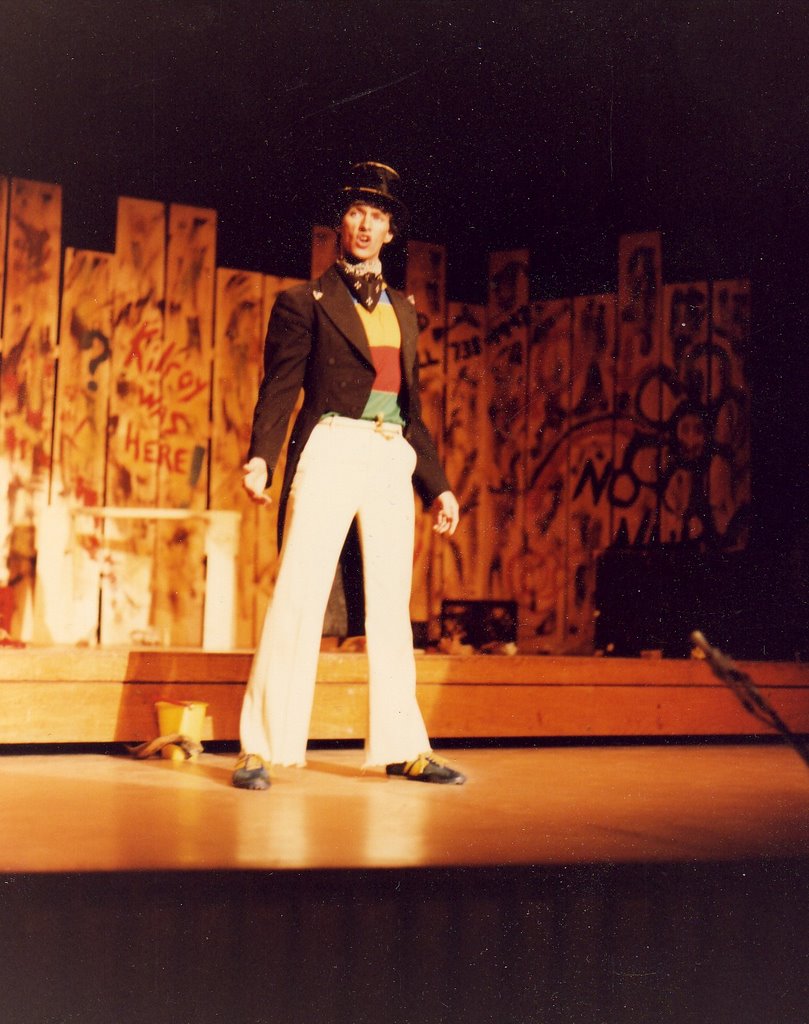
2. Like Liam, I enjoy acting too. I'm one of those shy and quiet people who tends to come alive on stage. In this photo I'm playing Nathan Detroit (center) in Guys and Dolls. I've been in somewhat avante garde plays like The Real Inspector Hound by Tom Stoppard and The Bald Soprano by Eugene Ionesco, but I've been in far more musical productions even though I can't sing for beans. I just moxied my way through them and tended to stick to character roles. Someday I'd like to get back into it... maybe when the kids are a bit older. I've always wanted to do a Shakespeare play, maybe I'll take a shot at that.

Playing the John the Baptist/Judas Iscariot role in Godspell. I've played this role in Godspell in three different productions. My friend Joe played Jesus in all three of them. What does that tell ya? I'm always the heavy.. . In this particular production I needed to open the number Prepare Ye (The Way of the Lord) with a trumpet blast on the shofar, but I could never figure out how to get a proper sound out of that thing. I sort of "tooted" through it instead. It sounded ridiculous. I'd say it was the most embarassing moment of my life, but you know, there have been so many, so many other incidents that can compete for that...

3. I despise seafood. I hate fish, of all kinds. That goes for clams, mussels, lobster, shrimp, scallops, and anything else that comes out of the ocean. If it's from the sea, it ain't for me. When Anne and I went to Nantucket together for the first time so that I could meet her family, she told me on the boat on the way over that she had reminded her mother that I didn't like fish, and that her mother was preparing a chicken plate for me while everyone else was going to be eating fish for dinner. When I got there, her mother plopped a great big scaly, silvery-grayish plate of grilled bluefish right down in front of me. Anne and her brothers grinned at me wickedly. I ate it with zest and a smile. It might have been the best acting performance of my life. Oh, the things we do for love. I even laughed at her father's Italian jokes over dinner, and I was very gracious several hours later when he belatedly decided it might be a good idea to ask me if I was part Italian (I am).


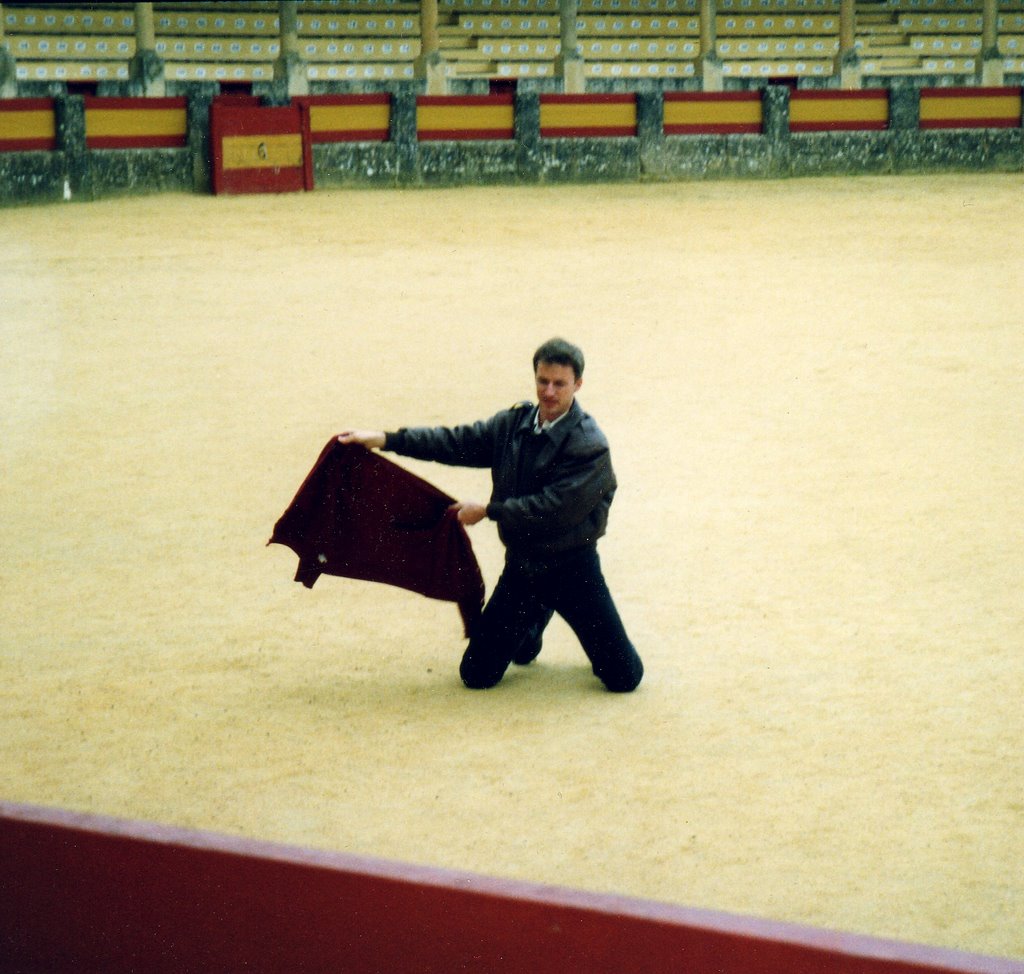
4. I am an internationally renowned Torero... shown here executing a flawless kneeling veronica at the Plaza de Toros in Ronda, Spain.
Well, no, I'm not a bullfighter, just a bullslinger. The most intimidating creature I faced in Ronda was a large beetle I unexpectedly encountered in a sandwich. I have been to Spain (twice), Ireland (twice), Portugal, Italy, and England. Within the U.S., however, I have never been south of Alexandria, Virginia. Outside of airports, I have never been west of Darlington, Wisconsin (unless you count Hawaii). On this continent, I have never been north of Parry Sound, Ontario.

I am a member of Zeta Beta Tau (Delta Omega Chapter). ZBT is a non-sectarian social fraternity. I still know my Greek alphabet forwards and backwards. ZBT's motto - "A Powerhouse of Excellence". I didn't keep up with much of this stuff after college, although my brothers and I still do use the handshake when we run into each other. Look here to see who some of my extended brothers are.

By the way... all of those pictures of me with the dark hair? I don't look like that anymore. I've gone completely gray... you might even say white. I'm just an old guy now doing the Dad thing. :-)

I'm not sure who's still reading here... I'll tag Paula (even though she's still working Crystal's tag for another meme) and the Francsican lads - Minor Friar, Don, and Rashfriar.

Saturday, January 13, 2007

Contemporary Theology Meme

Crystal has tagged me for a Best Contemporary Theology Meme. What are you trying to do Crystal, get me in trouble with the CDF or my local bishop by exposing me for having read materials that would probably be on the Index of Forbidden Books? ;-) Is there still an Index of Forbidden Books...?

As I mentioned to Crystal in one of the threads below, I haven’t been reading much current speculative theology. My reading about religion tends to center around spiritual reading, history, scripture, doctrine & apologetics, and biblical scholarship. It seems to me that in the last 25 years, with the “Third Historical Jesus Quest” well underway, that the biblical scholars have had a bigger influence on the public consciousness than theologians in any case.

If you were to ask me who my favorite Catholic Theologians of the 20th century were, I’d probably list Yves Congar, Henri de Lubac, John Courtney Murray, and Karl Rahner, all of who published the great bulk of their work more than 25 years ago, and here lies a problem... The current relationship between Catholic theologians and the Roman Curia is probably as bad and as wide apart now at this point in history as it ever has been. Ever since theologians like Kung, Schillebeeckx, Boff and Curran have been investigated, censured or silenced, there has been a sort of damper put on speculative theology. The last two popes have been decent theologians in their own right, with Joseph Ratzinger being a first-rate theologian, but in my view, the role of the pope is not to be the theologian-in-chief of the Church. That, of course, is a whole topic for discussion in and of itself. I suppose there certainly are theologians within the Catholic tradition to study, like Hans Urs Von Balthasar, John Shea and John Fisher… I’ve been reminding myself that I need to take the time to read The Analogical Imagination by David Tracy, which is highly regarded.

As far as progressive Protestant theologians are concerned, I confess I am woefully ignorant beyond Marcus Borg and John Shelby Spong, and it appears to me that “retro” reformed theology seems to be very much in vogue with evangelicals these days, with popular works for the mass market by R.C. Sproul, John MacArthur, Hank Hanegraaff, Norman Geisler, J.I. Packer, Robert Reymond, and so forth, taking precedence.

So having said all that, I’ll list a few books, which in my lowly and under-educated opinion I consider to have been very important over the last 25 years.


Paul and Palestinian Judaism by E.P. Sanders 1977

I’m going to cheat a little bit and go back almost 30 years instead of 25. I think Sanders’ book may have been one of the most important books to come out regarding Christian origins in the last quarter of the twentieth century. Sanders’ work was mirrored around the same time by Krister Stendahl, and they were the primary influences on what would become the so-called New Perspective on Paul. (According to this link about Stendahl, in his essay The Apostle Paul and the Introspective Conscience of the West, he claimed “the quest of the plagued conscience began with Augustine whose Confessions are the first great document in the history of introspective conscience… and that prior to Augustine, the church had read Paul accurately in terms of the question, what does the Messiah's arrival mean for (a) the law (not legalism) and (b) the relationship between Jews and Gentiles? Since Augustine, the church has misread Paul in terms of the question, how can I find a gracious God?”)

Sanders was important because he was able to mount a challenge to what had been the prevailing view in Pauline scholarship for centuries. The prevailing scholarship until that time had St Paul presenting Judaism as a religion of works righteousness, in which a man tries to earn God's acceptance through works of piety and good deeds, and that the Law for them was something arid, burdensome, and a curse, because it could not be kept completely. The Jew becomes a metaphor for "the religious man" who is contrasted unfavorably to the Christian who relies fully upon the grace of God. Therefore, “good” Christianity was a religion of freedom and “bad” Judaism was a religion of legalism.

Sanders knew that this was a caricature, a straw man cutout of Judaism. He knew that for a 1st century Jew, the keeping of the law was not a means to earn salvation but to maintain oneself in the Covenant. Sanders called this Covenantal Nomism. The question for St. Paul, according to the New Perspective scholars, is not the fate of the individual sinner standing alone in judgement before God, but in corporate terms of Jews and Gentiles. Who’s in and who’s out? Who participates? The Jews were waiting for a redeemer, the Messiah. The Gentiles were beyond all hope. Christ came for both. The problem facing St. Paul and the early Church was how they were going to bring all of these Gentiles into what had been an exclusively Jewish movement. If he said that righteousness was from the Law, he would be excluding Gentiles, or at the very best, forever relegating them to second-class status. He knew that trying to force the Gentiles under the Law, which was foreign to them, and never meant for them, wasn't going to work. He knew that it would be inevitable that they would slide back into their pagan ways.

The New Perspective work has been followed up on in some fashion by other scholars such as James G. Dunn, John Gager, N.T. Wright, James Carroll, and Brendon Byrne. I think that the New Perspective on Paul has great ecumenical possibilities for discussion between Catholics and Protestants, particularly around the thorny question of St. Paul’s doctrine on Justification, which has historically most divided us.

More importantly, the New Perspective had aided theologians and also the “Third Historical Quest” in underscoring the essential Jewishness of Jesus and the Apostles. The sensitive treatment of Judaism by the New Perspective scholars has also created a climate in which Jewish scholars have finally felt that they can enter into an irenic discussion with Christians about Jesus and Christianity. Jewish scholars such as Geza Vermes, Amy Jill-Levine, Daniel Boyarin, Alan Segal and others, have written fascinating books about their take on the New Testament (see more on that below).

The Non-Violent Atonement by J. Denny Weaver 2001

I confess that I have not actually read this book by this Mennonite scholar , but have only read about it. I’ve listed it because the topic is important and compelling for me, and the idea is overdue. It is an attempt, as the title aptly states, to look beyond a violent meaning of the atonement (such as in the Satisfaction and Substitutionary model), and to look to see if a modified version of Christus Victor makes more sense.

We Drink From Our Own Wells by Gustavo Gutierrez 1984

Yeah, I like Liberation Theology. Want to make something out it? I believe that someday it will be vindicated. While I’m at it, what the heck, why not…? Introducing Liberation Theology by Leonardo Boff and Clovodis Boff 1987

A Church That Can and Cannot Change by John T. Noonan 2005

John T Noonan is a Catholic layman who is a judge on the US Federal Court of Appeals 9th Circuit, and the founder of the journal Natural Law Forum. He has also extensively studied and written about the history of Catholic moral teaching. Back in the sixties he wrote the definitive landmark study on the history of Church teaching on Contraception, from the 2nd century to the 20th. In this book he grapples with the question – Does change happen in Catholic moral teaching, and if it does, how does it happen? When is it valid change and when it invalid? The three issues he focuses on in the book are Church teachings on slavery, usury, and religious freedom. He answers in the affirmative that moral teachings can in fact change. The book does have its critics. His conclusions have been challenged in a respectful manner by Cardinal Avery Dulles, no lightweight himself.

Challenging books I recommend to others to read

I’ve always liked to read material that challenges my beliefs, as long as they are presented in a respectful way.

Quite a few writers over the last few years have built some up recognition and even fame by knocking over flimsy things like The Da Vinci Code, and slightly more challenging Gnostic things like The Gospel of Thomas, The Gospel of Judas, The Gospel of Mary Magdalene, The Gospel of… whoever… In their apologetics, I have rarely seen anyone, with the possible exception of Ben Witherington, who takes on the more challenging material out there… the challenge form the quarter that always has been and always will be the most pointed and profound… As noted above, there have been several excellent Jewish scholars who have written about Jesus and the New Testament in recent years. The relationship between Jews and Christians throughout history has been long, bitter, and tragic, and I applaud that we live in an age when these scholars can feel free to present their cases in respectful dialogue with Christian scholars without opprobrium.

I hold to Nicene orthodoxy and to the Creed. Although I differ with them on the Incarnation and on the Divinity of Jesus Christ, I find that these scholars make their cases with honesty and conviction, excellent scholarship (as far as I can tell with my untrained eyes, admittedly), and in a spirit of irenicism and respect for Christian sensitivities and beliefs. We may not agree with their narrative, but is not a nonsensical or illogical narrative like the Da Vinci Code pottage. It has coherence. Even though I disagree with their ultimate conclusions, I think there is much benefit that Christians can take from reading them. To recapture the Jewishness of Jesus is accurate and essential, and I think I learned something new, and gained valuable insights about Jesus in ways that I had never thought of before from each of them.

The Authentic Gospel of Jesus and The Changing Faces of Jesus by Geza Vermes

Geza Vermes is recognized as the world’s foremost authority on the Dead Sea Scrolls. He was born to Jewish parents who perished in the Holocaust. He was raised by Catholic foster parents and entered the priesthood, joining an order whose mission was to convert Jews. After studying the Dead Sea Scrolls, the Mishnah, the Talmud, and other Rabbinic writings, he reverted back to Judaism. In the Authentic Gospel.. he offers commentary and exegesis on all of the words spoken by Jesus in the Synoptic Gospels, in the way they would have been understood in Aramaic within his own culture. In The Changing Faces of Jesus, he works backward from the Gospel of John to the other Gospels and the writings of St. Paul to examine how Jesus would have been interpreted in each book in it’s own time. To Vermes, Jesus was a Galilean Holy Man, exorcist, healer and Hasid who was crucified for causing a disturbance (cleansing) in the Temple.

From Jesus to Christ and Jesus of Nazareth, King of the Jews by Paula Fredriksen

To Paula Fredriksen, interpreting Jesus properly is a matter of What You See Is What You Get… Jesus was an apocalyptic prophet proclaiming the imminent coming of the Kingdom of God who was executed by the Romans for being what they considered he and his followers were claiming him to be – The King of The Jews. In the linked article, Fredriksen does a pretty good job of explaining and critiquing the other historical Jesus scholars as well.

The Jesus Dynasty by James Tabor

James Tabor isn’t Jewish, but in his book he makes the case that the apocalyptic writings in Isaiah and Daniel indicate that Jesus and John the Baptist saw themselves as twin messiahs described in those texts, with Jesus being the royal Davidic Messiah, and John being the priestly Aaronic Messiah. He goes into a bit of speculation on the meaning of some ossuary finds he made with his students, and on the paternal ancestry of Jesus, but to me the most valuable thing in his book is his continuation of a recent trend to start recovering the forgotten man of the early Church – James the Just. According to Tabor and some others, Jesus’ “brother” James, the Bishop of the Jerusalem Church, was the royal successor to Jesus in this messianic dynasty, and his role was diminished and underplayed when the Pauline (Gentile) wing of the Church won out over the Jamesian (Jewish) wing.

What Jesus Meant by Garry Wills

This one is a tract, really. It’s very short, you can get through it in an evening or two. Wills, the bete noir of Catholic conservatives, takes his rips at the hierarchy as usual, but there is much in this book that is interesting and valuable.

I won't tag anyone specifically. Anyone who who'd like to put up a list, please feel free...

Friday, January 12, 2007

Cataclysms and Religious and Cultural Upheaval: I


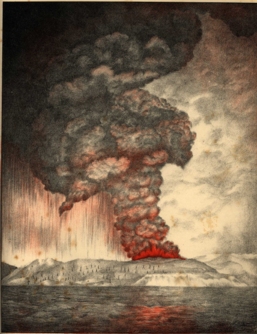
The Eruption of Krakatoa, 1883

While we were down on Nantucket Island the week following Christmas, I was sitting in the living room of my father-in-law’s cottage and pulled out a book from the shelf that Anne and I had given to him as a gift a few years ago, but hadn’t yet read ourselves, Krakatoa: The Day the World Exploded: August 27, 1883. I was quickly hooked. It was a riveting and fascinating read about the volcanic island in the Sunda Strait between Sumatra and Java that blew itself apart in a massive phreatic eruption, taking 36,000 souls with it.

I first remember hearing about Krakatoa when I was a kid. I recall seeing ads on TV for a corny and badly produced B-movie called Krakatoa, East of Java! Actually, Krakatoa was west of the island of Java, which is part of Indonesia today, but was a Dutch colony at the time of the eruption. The author, Simon Winchester, has a background in geology and provides a thorough and highly readable description of the time and place and events surrounding the eruption, including explanations in layman’s terms of continental drift, plate tectonics, subduction zones, and vulcanology. As it turned out, the deadly tsunami of Christmas Day, 2004, which occurred after this book was written, was a manifestation of the same intense friction between the tectonic plates in the area that created the volcano at Krakatoa, and was in fact much more deadly. As we look at some of these natural disasters like earthquakes and volcanoes, and wonder why God would allow such things to occur, it is interesting to note in the scientific explanations that the world is built to do these things, that it must do these things, that they were essential for life itself to flourish to begin with, and that shifting continental plates and volcanoes actually provide a means for the world to recycle and renew itself.


Anak Krakatoa (Son of Krakatoa)

Some interesting facts about the eruption at Krakatoa…

- It was not the first eruption in this general location. Winchester suspects that there was a massive eruption of Krakatoa around the year 535 AD, and at other points in history. This also happens to be the thesis of author David Keys, who wrote in his book Catastrophe: An Investigation into the Origins of Modern Civilization, that a huge explosive eruption in 535 AD actually caused Sumatra and Java to split up into separate islands. According to Keys, the eruption occurred with the force of "two thousand million Hiroshima size bombs”, and that the “Dark Ages” that we speak of really were in fact literally dark, due to the massive clouds of volcanic ash and dust that rose up into the atmosphere. His thesis is that in the face of the ensuing fear, famine, disease, and apocalyptic uncertainty that followed, the Roman Empire collapsed and Islam arose out of Arabia…

- It will not be the last eruption at that location. In 1927, Anak Krakatoa (Son of Krakatoa) first breached the surface of the ocean near the spot of the original volcano and became a permanent island by 1930. It has been growing since at a rate of 5 inches per day. This smoking, volcanic island is now 1500 feet high…

- The concluding eruption of Krakatoa in 1883 was probably the loudest sound ever heard by modern human beings. The shock wave caused by the final, obliterating explosion circled the world an amazing seven times over a period of fifteen days. It was clearly heard on the Island of Rodriguez, near Mauritius, nearly 3,000 miles away.

- The temperature of the earth was cooled by a degree, and for years afterwards, the dust clouds thrown into the air by the volcano caused lurid and colorful sunsets around the world.

- Most of the casualties were not caused by the explosion or by volcanic ash, but by the huge tsunamis created by the eruption.

- Due to the invention of the electronic telegraph several decades earlier, and its widespread usage throughout the world via rubberized undersea cables, the eruption at Krakatoa was reported quickly around the globe and can be considered to be the first worldwide media event, ushering the “global village” long before Marshall McCluhan coined the term.


One of the things that I found most interesting, however, was the cultural after-affects that in some ways mirrored the previous eruptions of Krakatoa. Shortly after these events occurred in 1883, the Dutch colonists started running into real problems with the Javanese islanders. Islam had been predominant among the native population for several centuries beforehand, but it had been tolerant, rather syncretistic, and a less observant form than what was found in the Middle East. After the eruption there was a rise in Islamic fundamentalism throughout the entire region, which planted the seeds for the eventual withdrawal of the Dutch from the area and the independence of Indonesia.

Several authors have written about how apocalyptic events have caused religious and cultural shifts that have wound up altering the course of history in significant ways. Many of the historical Jesus scholars emphasize the trauma of the Jewish-Roman Wars and the destruction of the Temple in Jerusalem when looking at the rise of Christianity and the parting of the ways between Pharisaical Judaism and the nascent Christian movement. In Plagues and Peoples, William McNeill pointed out the impact of disease on world history. In Guns, Germs, and Steel, Jared Diamond goes a bit further with that thesis and introduces the impact of flora, fauna, geography, and climate. In Winchester’s Krakatoa and Keys’ Catastrophe, we read about the impact of catalcysms caused by nature. In this interview and in this interview, Winchester says some interesting things about Krakatoa, the San Francisco Earthquake in 1906, and religious revivals of apocalyptic mood…
Well, the extraordinary thing that happened, specifically in Java and Sumatra, is that this event was immediately picked up by the religious leaders, who in those days were Muslims. The area was rapidly being converted from Hinduism to Islam. There were a lot of Arabs there who were priests or mullahs, and they said within a matter of days of the devastation, that this was clearly a sign from Allah-- Allah, who was annoyed, specifically angered by the fact that the Javanese and the Sumatrans were allowing themselves to be ruled by white, western, infidel Dutch imperialists.

"Rise up and kill them: is essentially what the mullahs said, and sure enough, within a matter of days, there was a degree of killing of Dutch soldiers and bureaucrats. Then the mullahs said, "No, no, no, don't do this in a piecemeal fashion, do it in an organized fashion." And sure enough over the next few years, careful planning went underway, triggered by Krakatoa, and five years later there was a massive rebellion, which was the beginning, one might say, of the end of Dutch rule in Java and Sumatra and the beginning of the creation of what is now the most populous Islamic state on Earth, Indonesia…

…A similar thing happened in California not, however, with the Muslims but with fundamentalist Christians. There was a church down in Los Angeles in a place called Azusa Street, which was a fledgling church of people who called themselves Pentecostalists. They spoke in tongues, they waved their arms around and did all sorts of crazy things. All things that would appear to others as crazy. And all that sort of direction came about because of manifestations as they saw it from God. He would send signs down. Miracles would be called. People would, as I mentioned, talk in tongues. On the week before the San Francisco earthquake, this little church had a modest-size meeting, and a couple of people spoke in tongues, and it was all going along quite nicely, but the Pastor stood up and said we are expecting a sign from the Lord.

Three days later San Francisco, arguably the most sinful of all American cities given over to drinking and whoring and gambling and all those fun things that happened in the aftermath of the gold rush days. But a city that lived for fun, for sin was destroyed by an earthquake. And so the Pastor, not unreasonably, said, well there's no doubt about it, this is the sign from God that we've been waiting for. And suddenly this little church was overrun with people, I mean tens of thousands of people came, they had overspill locations. It became like the Crystal Cathedral that you see in Los Angeles today and the link is not actually an unreasonable one to make because out of the Pentecostalist church that began in essentially 1906 came all the great evangelical movements from Aimee Semple McPherson right through to Pat Robertson and Tammy Fay and Jim Bakker. One might argue--and I don't want to make too much of this--that the power of the Christian right and particularly the Pentecostal brand of Evangelicals has had a crucially important effect on contemporary American politics. That movement was triggered in large part by what was perceived as a sign from God on April 18, 1906. So, the downstream effects of the San Francisco earthquake, if you do say, it caused Pentecostalism, it gave us conservative Christianity, and it gave us certain political effects that are being felt around the world.

Friday, January 05, 2007

Theatre of the Absurd

Insurgency TV, available 24 x 7 via satellite… Four years into this… You couldn’t make this stuff up.


Listen to the reports about it on NPR:

12/22/06 Sunni Insurgents Launch TV Channel

01/05/07 Insurgent TV Channel Nettles U.S., Iraqi Authorities

The term “Al Zawraa” refers to a popular soccer team in Iraq. Last year it was also the name of a Sunni-oriented television station run by a Sunni member of the Iraqi Parliament, a former Baathist named Mishaan Jaburi. On November 5th, Saddam Hussein was sentenced to death, and Al Zawraa sharply criticized the verdict. The Shia-dominated government of Prime Minister Nouri al-Maliki promptly had the station shut down, and Al Zawraa went undergound.

Today Mr. Jaburi is no longer in Iraq, and Al Zawraa has gone on to become the propaganda voice of the Sunni insurgency, running commentary and jeremiads in between hours and hours of snuff videos of attacks being launched by jihadists against American troops and Shias in Iraq. He is running Al Zawraa from a studio in Damascus, and is beaming the programming to the entire Middle East and North Africa through Nilesat, a satellite company owned primarily by the Egyptian government (the US subsidizes the Egyptian government to the tune of about $2 billion a year). Apparently, all it takes to broadcast these videos is a cellphone that can capture the footage, an internet uplink, and a dish to point at the satellite. Cellphones are also used as a common means to send the signals that detonate IEDs…

The only flack that Jaburi is catching from his Syrian hosts is for his constant drumbeat of verbal attacks on Iran, their ally. Jaburi was even seen recently as a guest on Al Jazeera, launching into one of his sectarian diatribes against a Shia guest.

American security forces closely guarded Saddam Hussein all the way through his captivity and essentially walked him all the way to the gallows, thinking they were handing him over in custody to the “Iraqi Government.” Thanks to one guy who happened to be there with a cellphone, we’ve seen the Maliki government representatives for who they really are, essentially a Shia sectarian death squad loyal only to Moqtada al Sadr.

What madness. Putting aside the legality, morality, and motives for the war for a moment... Who are we supposed to be working with and handing this place over to anyhow? Why should anyone risk his neck riding and up and down the same old streets over and over again for this anti-modern nonsense from all sides? Actually, what we are seeing is the modern being cleverly put into use for the benefit of the anti-modern. Technology is a wonderful thing, isn’t it? Satellites, cellphones…. Last week Steve put up a great post about the amount of money that each individual citizen in the US is ponying up on military spending per year. For all that’s been poured into military spending and SDI (“Star Wars”) research over the last couple of decades, am I alone is considering it absolutely mind-boggling that for all that money, we are being confounded by satellites, cellphones, and the web? Aren’t we supposed to know this stuff better than anyone else? Vladimir Lenin used to say, “The capitalists will sell us the rope we’ll use to hang them with.” He and his successors failed in that, but did he stumble into a sort of truism?

    Tuesday, January 02, 2007

    The Playoffs!


    It's NFL Playoff time, baby. The New England Patriots vs. the New York Jets at 1:00 on Sunday... Where's that Cowboyangel at?

    William, did you see Vinny Testaverde throw a TD strike to Troy Brown in what will probably be his last set of downs in the NFL? A touchdown throw in each one of his 20 seasons. Quite an accomplishment...

    Monday, January 01, 2007

    Resolutions


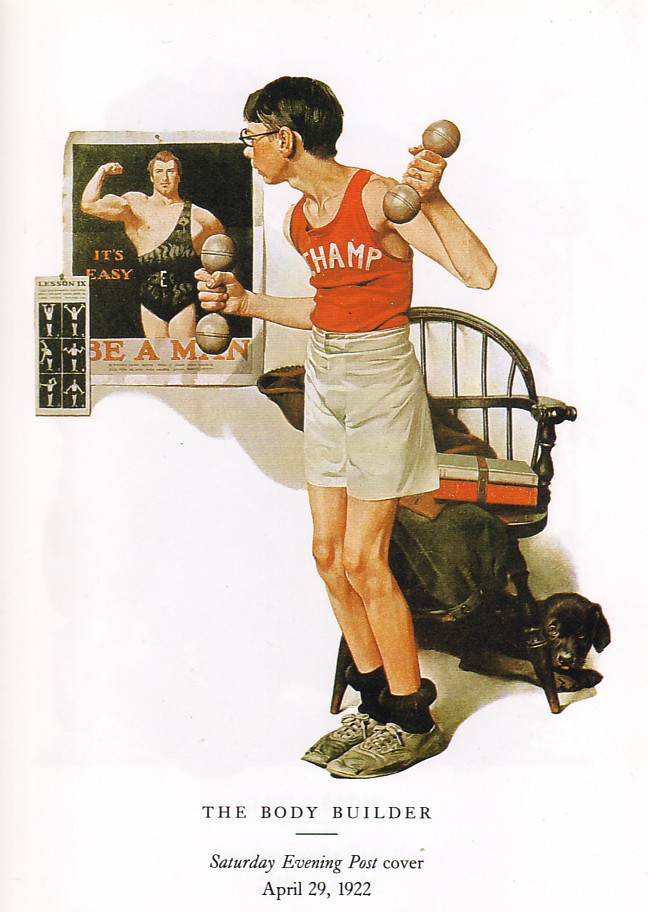
    It's Easy, Be A Man by Norman Rockwell 1922

    Do our New Year's resolutions usually get kept?

    I need to get back in shape. Not like the kid in Rockwell's illustration, although it is a familiar theme that resonates with me. A couple of decades ago I gave up my intense but ultimately futile effort to change my somatotype from that of an ectomorph to that of an mesomorph... Now that I'm older and married and full of responsibilities I'm a lot more concerned about my cardiovascular condition instead. Weight training should be part of it, though. I need to stengthen my lower back, firm up the abdominals, and lose about 15-20 pounds. It's tough, getting into your forties...

    Other thoughts for 2007?

    I want to make sure I remember to do something especially kind for Anne every single day.

    I'd like to get more actively back into Parish life, getting involved in a specific ministry that benefits the poor, elderly, or shut-ins directly.

    I need to be more patient and attentive in dealing with my children. To curb the harshness that comes with being tired and irritable.

    This is probably the year that I should knuckle down and start getting serious about getting that PMI Certification. Zzzzzzzzzzz.

    Speaking of Norman Rockwell... Crystal and I have been discussing lately some of the nicer holiday spots in New England, so here is where this two-SUV-owning economic populist goes further in revealing his true epicurian proclivities. :-)

    Years ago, Anne reserved a weekend for her parents at the Inn On Covered Bridge Green in Arlington Vermont as an anniversary gift for them. Unfortunately her mother grew ill, and her parents were never able to make the trip (her mother passed away a few years later).

    We discussed it one Spring a while back, and we decided it would be nice if we all went up there as a family, and took my father-in-law along with us. Anne called the folks at the Inn, and they agreed that the reservation and pre-payment were still valid, so up we went.

    The building we stayed in at the Inn was actually Norman Rockwell's art studio from the years 1942 to 1954. In addition to being fascinating for its history, it's one of the most beautiful and peaceful places I've ever been. Tres expensive, but well worth it as an unforgettable family trip. Even though I love the ocean, and could never live far from it, Vermont is my favorite New England state to visit.

    Saturday, December 30, 2006

    The Godfather

    JAMES BROWN

    While I was away I was saddened to hear about the passing away of the “Godfather of Soul”, James Brown, on Christmas Day. I don’t know why, but it seems appropriate to me that “The Godfatha” would pass on Christmas.

    Brown liked to cultivate a bit of a macho, revenge-obsessed image regarding payback, and had a bit of a checkered history with the law, but there is at least one thing he should always be remembered for... He was performing in concert at the Boston Garden the night that Martin Luther King was assassinated, and in his appeal to the crowd that night, he pled with them not to do injustice to Dr. King’s memory by responding violently, and his appeal had a lot to do with why Boston did not erupt with the same level of destruction and violence that was seen in other American cities that week. By the way, Cowboyangel has an excellent post on a sermon on non-violence delivered by Martin Luther King, during the Christmas of 1967.

    Here is a fuller version of Please Please Please, complete with the cape being placed upon his shoulders by his acolytes every time he collapses to his knees on stage.

    Could James Brown get down? You bet. What ever happened to Soul Music anyway? Who took the Soul out of it? I suppose one could argue that Brown was a seminal figure in the formation of Hip-Hop, but he was so much better than these current pretenders. I loathe Rap and Hip-Hop. It’s a shame that the whole Hip-Hop genre of music didn’t pass away on Christmas instead of James Brown.

    Other Milestones of 2006

    Saddam Hussein Another act of brutality in a land already saturated with brutality. Hussein had stopped being a relevant factor in Iraq since his overthrow nearly four years ago. I’m not sure what his execution will accomplish at this point but the begetting of more violence.

    Gerald Ford I had always like Gerald Ford and considered him a decent man. I was a little bit disappointed when the media posthumously released some information from some interview tapes he’d made a while back with some bitter and bitchy comments about his feelings towards other members of the Republican Party. They didn’t reflect well upon him in my opinion. It turns out that personal friendship had a lot more to do with his pardon of Richard Nixon than we’d previously been led to believe, and apparently his definition of what constituted a “hard right” Republican was based solely upon one holding to an anti-abortion position.

    This is just the kind of comfortable, self-satisfied, morally obtuse libertarian thinking in the Republican Party that I can’t stand…. But I don’t wish to speak badly of the dead. The Fords have done some good things for charity. Besides, I actually agree with the late Jerry Ford that the Pro-Life plank doesn’t have a natural home in the Republican Party. Folks like James Dobson in the Bible Belt may think the G.O.P. belongs to them, but I’m not fooled for a minute. it still belongs to country-club golfers. It always has and it always will.

    Ed Bradley This was a huge loss. Ed Bradley was a man of grace, wit, and charm, and he was a superb investigative reporter. He will be missed.

    John Kenneth Galbraith A brilliant economist and humanitarian.

    Milton Friedman I can’t say he wasn’t brilliant, but he was a far too influential economist, and the effects have been pernicious.

    Louis Rukeyser I was surprised to hear about this one. I remember having to sit through Wall Street Week on PBS many a Friday evening. I liked Rukeyser, but the topic is one I just can’t build a passion for, although perhaps I should. I have a lot of children to educate.

    His passing reminds me of the passing of a beloved uncle of mine a few years ago. He was a brilliant investor, who watched his stocks and portfolio carefully on a daily basis, and he’d done very well. It was like a game with him. One night, he died of an embolism in an instant. What becomes of all that financial brilliance? To what end? What do we ultimately take with us when we go? We leave with our hands empty.

    Monday, December 25, 2006

    Off to Nantucket


    Photo by Bill Kantor

    I hope that everyone had a wonderful Christmas. Ours was great.

    I see some very, very fine posts to catch up with and comment on, but we'll be gone for the next few days. We are not going to spend the rest of the week cooped up in the house getting cranky over the over-use of new video games and trying to find places for all the new toys to fit while we wait for a stomach flu to hit... We'll be heading to Nantucket for a few days before the end of the year. Until then, God Bless...

    Friday, December 22, 2006

    The Boy Jesus


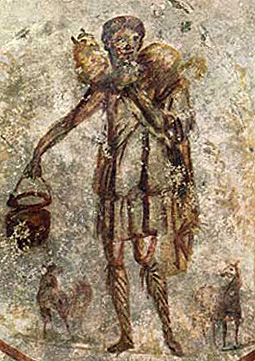
    Jesus portrayed as the Good Shepherd, c. 250

    Back in 1999, Boston University Professor Paula Fredriksen wrote an outstanding, provocative, and fascinating book called Jesus of Nazareth, King of the Jews. In that book she used a superb literary device in order to describe Second Temple Judaism. She opened a chapter on the Temple itself with several pages of a fictional account of Jesus (Yeshua) and his family heading down from Galilee to the Temple in Jerusalem for the Passover Feast. Yeshua is described as a young boy who will be advancing past the Temple's Court of the Women for the first time, proceeding into the inner Temple precincts with Joseph (Yosef) and James (Ya'akov) to actually watch the family's corban sacrifice for the Passover being made.

    Although her trajectory and ultimate conclusion about Jesus is quite different from Fredriksen's, the popular author Anne Rice rice has picked up on this same theme and literary device and has presented it in a full book form in her novel Christ the Lord out of Egypt. I'm about halfway through it, and I recommend it highly.

    Anne Rice of course, has been well known for her popular novels on vampire themes, and to a lesser degree, for her erotica. In a faith journey that has resulted in her coming back to the Catholic faith of her youth, she has decided to leave those topics behind her. She threw herself into the latest that was available in historical Jesus research in preparation for the book, yet stuck in her faith and intellect to the main elements of The Creed. Rice says:

    "In 2002 I made up my mind that I would not write anything that wasn't for Christ"

    In the end, Rice seems to consider her new book a gift, both to Christians and to non-Christian fans of her previous work. "This is a book I offer to all Christians," she writes, "to the fundamentalists, to the Roman Catholics, to the most liberal Christians in the hope that my embrace of more conservative doctrines will have some coherence for them in the here and now of the book...


    In the book, the young boy Jesus, starting to come of age, struggles with his own sense of power, what he seems to know intuitively, and especially with what his own family members say about him in hushed tones. How you would accept this book of course, comes down to a large degree on whether you hold to a 'High Christology" (Jesus was always self aware, in control, and knew everything he ever needed to know), or whether you hold to a "Low Christology" (which emphasizes the humanity of Jesus, and suggests that he learned, grew, and struggled with certain matters, and had to accept certain things on faith).

    Shown below are a couple of excerpts (I hope this isn't illegal or a violation of blog netiquette... If it is, can someone let me know?). In the first, the extended Holy Family has arrived in Jerusalem from Alexandria, and Jesus' uncle Cleopas is giving him some insight into who Mary is, and who Jesus is...

    Afterwards, Cleopas wanted to talk to me and made everyone leave us alone. Aunt Mary just made a quitting gesture again and moved away to rest for a moment, and then went to other chores with the clearing away, and Aunt Salome was tending to Little James and the other children. Little Salome was helping with Baby Esther and Little Zoker whom she loved so much.

    My mother came near to Cleopas. "Why, what are you going to say?" my mother asked him. She sat down on his left, not very close but close enough. "Why should we go away?" She said this in a kind way but she had something on her mind.

    "You go away," he told her. He sounded like he had drunk himself drunk but he hadn't. He had drunk less wine than anybody else. "Jesus, come in so you can hear me if I whisper in your ear."
    My mother refused to leave. "Don't you tempt him," my mother said.

    "And what do you mean by that?" Cleopas asked. "You think I've come to the Holy City of Jerusalem to tempt him?"

    Then he clutched at my arm. His fingers were burning.


    "I'm going to tell you something," he said to me. "You remember it. This goes in your heart with the Law, you hear me? When she told me the angel had come, I believed her. The angel had come to her! I believed."

    The angel-the angel who'd come in Nazareth. He'd come to her. That was what he'd said on the boat, wasn't it? But what did this mean?

    My mother stared at him. His face was wet and his eyes very big. I could feel the fever in him. I could see it. He went on.

    "I believed her," he said. "I am her brother, am I not? She was thirteen, betrothed to Joseph, and I tell you, she was never out of the sight of us outside of our house, never could there have been any chance of anyone being with her, you know what I'm saying to you, I mean a man. There was no chance, and I am her brother. Remember, I told you. I believed her." He lay back a little on the clothes bundled behind him. "A virgin child, a child in the service of the Temple of Jerusalem, to weave the great veil, with the other chosen ones, and then home under our eyes."

    He shivered. He looked at her. His eyes stayed on her. She turned away, and then moved away. But not very far. She stayed there with her back to us, close to our cousin Elizabeth. Eizabeth was watching Cleopas, and watching me. I didn't know whether she heard him or not.

    I didn't move. I looked down at Cleopas. His chest rose and fell with each rattling breath and again he shivered.

    My mind was working, collecting every bit of knowledge I had ever learned that could help me make sense of what he had said. It was the mind of a child who had grown up sleeping in a room with men and women in that same room and in other rooms open to it, and sleeping in the open courtyard with the men and women in the heat of summer, and living always close with them, and hearing and seeing many things. My mind was working and working. But I couldn't make sense of all he'd said.

    "You remember, what I said to you, that I believed!" he said.

    "But you're not really sure, are you?" I whispered. His eyes opened wide and a new expression came over him, as if he was waking from his fever.

    "And Joseph isn't either, is he?" I asked in the same whisper. "And that is why he never lies beside her." My words had come ahead of my thoughts. I was as surprised as he was by what I'd said. I felt chilled all over. Prickly all over. But I didn't try to change what I'd said.

    He rose up on his elbow, and his face was close to mine.

    "Turn it around," he said. He struggled for breath. "He never touches her because he does believe. Don't you see? How could he touch her after such a thing?" He smiled, and then he laughed in that low laugh of his, but no one else heard it. "And you?" he went on. "Must you grow up before you fulfill the prophecies? Yes, you must. And must you be a child first before you are a man? Yes. How else?" His eyes changed as if he stopped seeing things in front of him. Again he struggled for breath. "So it was with King David. Anointed, and then sent back to the flocks, a shepherd boy, wasn't it? Until such time as Saul sent for him. Until such time as the Lord God sent for him! Don't you see, that's what confounds them all! That you must grow up like any other child! And half the time they don't know what to do with you! And yes, I am sure! And have always been sure!"

    He fell back again, tired, unable to go on, but his eyes never left me. He smiled and I heard his laughter. "Why do you laugh?" I asked.

    He shrugged. "I am still amused," he answered. "Yes, amused. Did I see an angel? No, I did not. Maybe if I had, I wouldn't laugh, but then maybe again I would laugh all the more. My laughter is the way I speak, don't you think? Remember that. Ah, listen to them down in the streets. Over there, over here. They want justice. Vengeance. Did you hear all that? Herod did this. Herod did that. They've stoned Archelaus's soldiers! What does it matter to me now? I would like to breathe without it hurting me for one quarter of an hour!"

    His hand came up, groping for me. He touched the back of my head, and I bent down and kissed his wet cheek.

    Make this pain go away.


    He drew in his breath, and then he appeared to drift and to sleep, and his chest began to rise and fall slowly and easily. I placed my hand on his chest and felt his heart. Strength for this little while. What harm is there in it?

    When I moved away, I wanted to go to the edge of the roof. I wanted to cry. What had I done? Maybe nothing. But I didn't think it was nothing. And the things he'd said to me-what did they mean? How was I to understand these things?

    I wanted the answers to questions, yes, but these words only made more questions, and my head hurt. I was afraid.

    Later on that evening, Mary feels compelled to follow up on what Cleopas said to Jesus...

    I couldn't see the stars for the mist. But the sight of all the torches of the city, tumbling uphill and downhill, and above all, the Temple rising like a mountain with its great fluttering torches drove every other thought from ' my mind.

    A good feeling came over me, that in the Temple I would pray to understand all these words-not only what my uncle had said to me, but all the other things I had heard.

    My mother came back. There was just room near the wall by me for my mother to kneel down and then to sink back on her heels:

    The torchlight hit her face as she looked towards the Temple.

    "Listen to me," she said.

    "I am," I answered. I answered in Greek without thinking.

    "What I have to say to you should have waited," she said. She spoke Greek as well.

    With the noise in the streets, with the low nighttime talk on the roof, I could still hear her.


    "But it can't wait now," she said. "My brother has seen to that. Would that he could suffer in silence. But it's never been his way to do anything in silence. So I say it. And you listen. Don't ask questions of me: Do as Joseph told you in that regard. But listen to what I say." "I am," I said again.

    "You're not the child of an angel," she said. I nodded.

    She turned towards me. The torchlight was in her eyes.

    I said nothing.


    "The angel said to me-that the power of the Lord would come over me," she said. "And so the shadow of the Lord came over me-I felt it-and then in time came the stirring of life inside me, and it was you."

    I said nothing. She looked down.The noise of the city was gone. The torchlight made her look beautiful to me. Beautiful perhaps as Sarah looked to Pharaoh, beautiful as Rachel to Jacob. My mother was beautiful. Modest, but beautiful, no matter how many veils she wore to hide it, no matter how she bowed her head or blushed.

    I wanted to be in her lap, in her arms, but I didn't move. It wasn't right to move or say a word.

    "And so it happened," she said, looking up again. "I have never been with a man, not then, not now, nor will I ever. I am consecrated to the Lord."

    I nodded.


    "You can't understand this ... can you?" she asked. "You can't follow what I'm trying to tell you."

    "I do follow," I said. "I do see." Joseph wasn't my father, yes, I knew. I had never called Joseph Father. Yes, he was my father according to the Law, and married to my mother, but he wasn't my father. And she was so like a girl always, and the other women like her older sisters, I knew, yes, I knew. "Anything is possible with the Lord," I said. "The Lord made Adam from the dust. Adam didn't even have a mother. The Lord can make a child with no father." I shrugged.

    She shook her head. She wasn't like a girl now, but not like a woman either. She was soft and almost sad. When she spoke again, she didn't sound like herself.

    "No matter what anyone ever says to you in Nazareth," she said, "remember what's been said tonight."


    "People will say things ...?"

    She closed her eyes.

    "This is why you didn't want to go back there ... to Nazareth?" I asked.

    She gave a deep breath. She put her hand over her mouth. She was amazed. She took a deep breath, and she was gentle:

    "You haven't understood what I've said to you!" she whispered. She was hurt. I thought she might cry. "No, Mamma, I do see, I understand," I said at once. I didn't want her to be hurt. "The Lord can do anything."

    She was disappointed, but then she looked at me and for my sake, she smiled.

    "Mamma," I said. I reached out for her.

    My head was pounding with thoughts. The sparrows, Eleazer dead in the street and rising living from the mat, too many other things, things slipping away in my mind, and my mind too full. And all Cleopas's words and what were they? You must grow up like any other child or was it Little David back to the flock until they called him? Don't let her be sad.

    "I see. I know," I said to her. I smiled a little smile I never gave to anyone but to her if it was giving. More a little sign than a giving. She had her smile for me. A little thing.

    And now, she shook off everything that had gone before, and she reached out for me.

    I went up on my knees, and she did too, and she held me tight to her.

    Thursday, December 21, 2006

    Tuesday, December 19, 2006

    Fr. Raymond E. Brown on The Genealogy


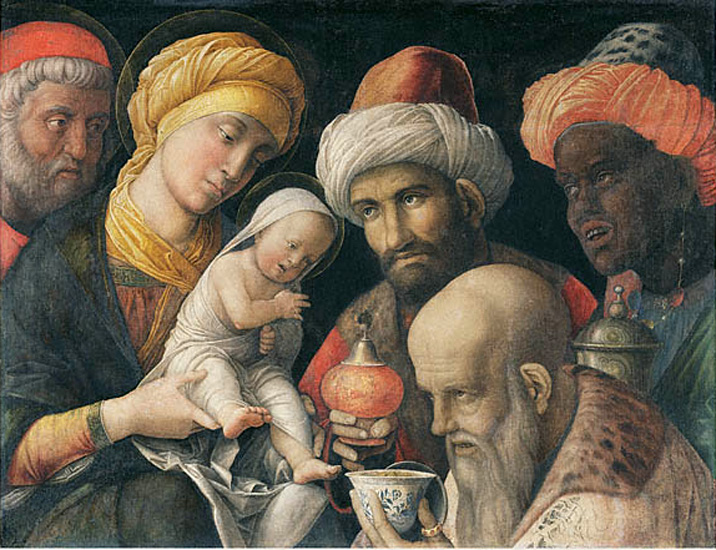
    The Adoration of the Magi by Andrea Mantegna c. 1495-1505

    I hope to get a chance to post one more time again before Christmas, but if I don’t…

    Blessings to all of you this Christmas, and may you have peace in your hearts and in your homes.


    The book of the genealogy of Jesus Christ, the son of David, the son of Abraham.

    Abraham became the father of Isaac, Isaac the father of Jacob, Jacob the father of Judah and his brothers.

    Judah became the father of Perez and Zerah, whose mother was Tamar. Perez became the father of Hezron, Hezron the father of Ram,

    Ram the father of Amminadab. Amminadab became the father of Nahshon, Nahshon the father of Salmon,

    Salmon the father of Boaz, whose mother was Rahab. Boaz became the father of Obed, whose mother was Ruth. Obed became the father of Jesse,

    Jesse the father of David the king. David became the father of Solomon, whose mother had been the wife of Uriah.

    Solomon became the father of Rehoboam, Rehoboam the father of Abijah, Abijah the father of Asaph.

    Asaph became the father of Jehoshaphat, Jehoshaphat the father of Joram, Joram the father of Uzziah.

    Uzziah became the father of Jotham, Jotham the father of Ahaz, Ahaz the father of Hezekiah.

    Hezekiah became the father of Manasseh, Manasseh the father of Amos, Amos the father of Josiah.

    Josiah became the father of Jechoniah and his brothers at the time of the Babylonian exile.

    After the Babylonian exile, Jechoniah became the father of Shealtiel, Shealtiel the father of Zerubbabel,

    Zerubbabel the father of Abiud. Abiud became the father of Eliakim, Eliakim the father of Azor,

    Azor the father of Zadok. Zadok became the father of Achim, Achim the father of Eliud,

    Eliud the father of Eleazar. Eleazar became the father of Matthan, Matthan the father of Jacob,

    Jacob the father of Joseph, the husband of Mary. Of her was born Jesus who is called the Messiah.

    Thus the total number of generations from Abraham to David is fourteen generations; from David to the Babylonian exile, fourteen generations; from the Babylonian exile to the Messiah, fourteen generations…
    -- Matthew 1: 1-17


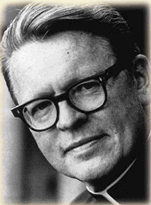
    Recently I've been looking over a small book by the late, great scripture scholar Fr. Raymond E. Brown, S.S. (what a great loss was dealt to the Church by his untimely death in 1998) called A Coming Christ in Advent: Essays on the Gospel Narratives Preparing for the Birth of Jesus : Matthew 1 and Luke 1.

    I just thought I'd post a few excerpts of his thoughts about The Genealogy of Jesus, where again we see how God works though the human in ways unexpected, and in His ways through people unexpected.

    This genealogy that opens Matthew's Gospel has one prin­cipal occurrence in liturgy, namely, on the Advent weekday December 17 which begins the pre-Christmas octave of in­fancy gospel readings. It was read more frequently in the pre-Vatican II liturgy, but often with disastrous results as the priest-celebrant stumbled over names and sometimes skipped large sections, under the pretense that the reading was a bor­ing and meaningless exercise. To the contrary I have been conducting a somewhat solitary campaign to make this Mat­thean genealogy a major Advent topic, even to the extent that, if I am invited to give a special pre-Christmas sermon, especially on an Advent Sunday, I go out of my way to make Matthew 1:1-17 the subject of the homily. The stunned look on the faces of the parish audience when I launch into the solemn list of begettings is proof that one of the prereq­uisites for effective preaching has been accomplished­…

    If a Christian today were asked to tell someone who knows noth­ing about Christianity the basic story of Jesus Christ, where would he or she be likely to begin? I am willing to wager that not one in ten thousand would begin where the author of the Gospel that the church puts first begins - where the first line of the first page of the New Testament begins-with the majestic assurance: This is "the story of the begin­ning/the origin/the genesis of Jesus Christ."

    For Matthew the origin of Jesus Christ starts with Abraham begetting Isaac! In other words the story of the He­brew patriarchs, of the kings of Judah, and of other Israelites is the opening stage of the story of Jesus Christ. That such an Old Testament component to the Jesus story would not occur to most Christians today is a sad commentary on how far we have moved from our ancestors' understanding of the good news. Matthew's list of people who are an integral part of the origin of Jesus Christ contains some of the most sig­nificant names in the biblical account of God's dealing with His people Israel, and I for one wish strongly that at least once a year their names were allowed to resound in the Christian church on a Sunday when all the worshiping New Testament people of God were there to hear…if one understood it correctly, this genealogy contains the essential theology of the Old and the New Testaments that the whole Church, Orthodox, Roman Catho­lic, and Protestant, should proclaim. Let me illustrate this by comments on the three sections of the genealogy.

    THE PATRIARCHS

    "The story of the origin of Jesus Christ" begins with the pa­triarchal period when Abraham begets Isaac. With even a catechism knowledge of Bible stories the hearer might remember with a little puzzlement that Abraham had two sons of whom Ishmael was the older and wonder why the story of the origin of Jesus Christ does not involve the beget­ting of Ishmael who with his mother Hagar was the more abused figure…

    The puzzling "story of the origin of Jesus Christ" goes on with Jacob begetting Judah and his brothers. Why is Judah singled out, and why ultimately is the Messiah from his tribe? Was not Joseph clearly the best of the brothers? Fa­vored by God with visionary dreams that aroused the hatred of the others, Joseph forgave their selling him into captivity in Egypt and saved them when they would have perished from starvation in the famine. Surely he is the embodiment of Jesus' story, not Judah who sold his brother and sought out prostitutes.
    Matthew's choice of Isaac over Ishmael, of Jacob over Esau, of Judah over Joseph is faithful to the Old Testament insight that God frequently does not choose the best or the noble or the saintly. In other words, Matthew is faithful to an insight about a God who is not controlled by human merit but manifests His own unpredictable graciousness.

    THE KINGS

    Does not the first section of Matthew's genealogy build up from Abraham to the high point of "David the king"? And does not the second section of the genealogy consist of the gloriously reigning Judean kings of the house of David? The answer to both those ques­tions invokes the basic biblical issue of God's values versus human appearances-"My thoughts are not your thoughts," says the Lord (Is 55:8).
    Of the fourteen Judean kings that Matthew lists between David and the deportation only two (Hezekiah and Josiah) could be con­sidered as faithful to God's standards in the law code of Deuteronomy, which were applied to the monarchs by the author of the Books of Kings. The rest were an odd assort­ment of idolaters, murderers, incompetents, power-seekers, and harem-wastrels.
    There was, of course, the arranged murder of Bathshe­ba's husband so that David might possess the wife legally: Even more indicative of David's shrewd piety was his per­sonal innocence combined with mafia-like politics whereby his relatives murdered opponents for him. He seized Jerusa­lem, a city that henceforth belonged to him and no tribe, and moved the Ark of the Covenant there to give the blessing of religion to his consolidation of power. Indeed, he succeeded in writing a codicil to God's covenant with His people. Now the covenant no longer simply stated: "You will be my people and I will be your God, if you keep my command­ments"; it had an added condition: "and if you have a king of the house of David reigning over you"

    This curious story of a Davidic monarchical institution that had divine origins but was frequently corrupt, venal, and uninspiring, was also part of "the story of the origin of Jesus Christ." Yes, that story involved not only individuals with their strengths and weaknesses like the patriarchs, but an in­stitution, an organization, a structure, indeed a hierarchy (literally, in Greek, a sacred order) embodied in absolute rul­ers… those of us who must be loyal both to the spontaneous grace of God and to a church with authority may get encouragement from this phase of Matthew's theology reflected in the incipient story of Jesus Christ.

    THE UNKNOWN AND THE UNEXPECTED

    What a cu­rious cast of characters this more genuine progress involves. Except for the first two (Shealtiel and Zerubbabel) and the last two (Joseph and Mary), they are a collection of unknown people whose names never made it into sacred history for having done something significant. In other words, while powerful rulers in the monarchy brought God's people to a low point in recorded history (deportation), unknown people, presumably also proportionately divided among saints and sinners, were the vehicles of restoration. Still another indica­tor of the unpredictability of God's grace is that He accom­plishes His purpose through those whom others regard as unimportant and forgettable.

    Looking back at the analysis of Matthew's genealogy that I have just given, we see how extraordinarily comprehensive is its theology of the roots of Jesus' story in the Old Testament. The genealogy is more than retrospective and instructive, however. We must recognize that in acting in Jesus Christ God is consistent with His action in Abraham and David, in the patriarchs, in the kings, and in the unknown. But that is only one aspect of the story of Jesus Christ, a story that has a sequence as well as a beginning; and the ongoing aspects are what makes the genealogy "good news" for Matthew's audience and for us. If the beginning of the story involved as many sinners as saints, so has the sequence. This means not simply a Peter who denied Jesus or a Paul who persecuted him, but sinners and saints among those who would bear his name throughout the ages. If we realize that human beings have been empowered to preserve, proclaim, and convey the salvation brought by Jesus Christ throughout ongoing his­tory, the genealogy of the sequence of Jesus contains as pe­culiar an assortment of people as did the genealogy of the beginnings. The God who wrote the beginnings with crooked lines also writes the sequence with crooked lines, and some of those lines are our own lives and witness. A God who did not hesitate to use the scheming as well as the noble, the im­pure as well as the pure, men to whom the world hearkened and women upon whom the world frowned-this God con­tinues to work through the same melange. If it was a chal­lenge to recognize in the last part of Matthew's genealogy that totally unknown people were part of the story of Jesus Christ, it may be a greater challenge to recognize that the un­known characters of today are an essential part of the se­quence. A sense of being unimportant and too insignificant to contribute to the continuation of the story of Jesus Christ in the world is belied by the genealogy, and the proclamation of that genealogy in the Advent liturgy is designed to give us hope about our destiny and our importance. The message of the genealogy is an enabling invitation. The genealogy has also taught us that God did not hesitate to entrust to a monarchical institution an essential role in the story of His Son's origins-an authoritative institution (at times authoritarian) which He guaranteed with promises lest it fail but which was frequently led by corrupt, venal, stupid, and ineffective leaders, as well as sometimes by saints. He has not hesitated to entrust the sequence of the story to a hi­erarchically structured church, guaranteed with promises, but not free from its own share of the corrupt, the venal, the stu­pid, and the ineffective….

    By stress­ing the all-powerful grace of God, the genealogy presents its greatest challenge to those who will accept only an idealized Jesus Christ whose story they would write only with straight lines and whose portrait they would paint only in pastel colors. If we look at the whole story and the total picture, the genealogy teaches us that the beginning was not thus; the Gospels teach us that his ministry was not thus; the his­tory of the church teaches us the sequence was not thus. That lesson is not a discouragement but an encouragement as we look forward to the liturgical coming of Christ. God's grace can work even with people like us. A meditation on "The story of the origin of Jesus Christ-Abraham fathered Isaac . . . Jesse fathered David the king . . . Achim fathered Eliud"- should convince reader and hearer that the authentic "story of the sequence of Jesus Christ" is that Jesus called Peter and Paul . . . Paul called Timothy . . . someone called you . . . and you must call someone else.